Photoroom Review (2026): AI Product Photography Pricing, Pros & Cons
Bottom line
Photoroom is a Web SaaS tool for AI Product Photography (Product Photography & AI Retouching) in Visual & Creative Media. Pricing: Free plan · $7.50–$82.50/mo. Best suited to DTC / eCommerce and Creators / Solo. Editor ratings: AI autonomy L2 (workflow copilot); moat score 4.1/5.0 (Proprietary moat). Fact-checked by MarTechRadar Research Desk on Oct 11, 2026.
AI-powered product photography platform delivering neural background segmentation, automated object staging, and batch asset retouching for commercial.
Is Photoroom worth it in 2026? Buyer fit & when to walk away
Choose Photoroom if (Best Fit)
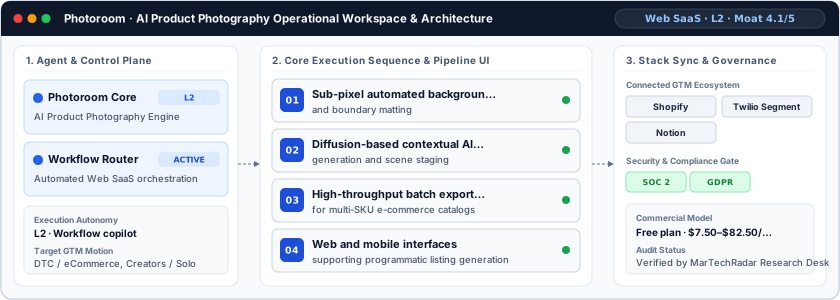
- Target ICP & Stack Fit: You operate as DTC / eCommerce and Creators / Solo requiring a Web SaaS deployment for AI Product Photography, with verified ecosystem connectivity for Shopify, Twilio Segment, Notion.
- L2 Architecture & Defensibility: Proprietary high-precision segmentation networks, dedicated model fine-tuning for commercial product packaging, and widespread mobile and web capture ecosystem adoption.
- Commercial Model Fit: Your procurement budget aligns with Free plan · $7.50–$82.50/mo and want a self-serve free tier for zero-cost initial validation.
Walk away from Photoroom if (Deal-Breakers)
- Walk away if your workflow cannot tolerate high-volume sku consistency: Generating large batch runs using prompt-guided diffusion frequently introduces visual drift across color grading, contact shadow angles, and synthetic scale, necessitating human review.
- Walk away if transparent and reflective material artifacts is a deal-breaker for your team: Objects composed of clear glass, translucent liquids, or mirror-finished metals can experience boundary erosion or refractive masking errors during automated background removal.
Photoroom pricing, free plan & scorecard at a glance
| Pricing | Free plan · $7.50–$82.50/moVendor pricing page |
|---|---|
| Free plan | Yes |
| Delivery | Web SaaS |
| Audience | DTC / eCommerce, Creators / Solo |
| AI autonomy level | L2 · Workflow copilotEditor-verified |
| Moat tier & score | 4.1 / 5.0 · Proprietary moatEditor-verified |
| Funding | Series B |
| Total funding | $62.1MBacked by Balderton Capital, Aglaé Ventures, Y Combinator |
| Founders | Eliot Andres, Matthieu Rouif |
| Company size | 51-200 employees |
| Ecosystem integrations | Shopify, Twilio Segment, Notion |
| Compliance & governance | SOC 2, GDPR |
| Governance & docs | Trust & Security ↗ · API & Docs ↗ · Privacy ↗ |
| Headquarters | New York, United States |
| Founded | 2019 |
| Last verified | Oct 11, 2026 |
Photoroom pros & cons: strengths vs. operational limitations
Pros: core strengths & capabilities
- Sub-pixel automated background removal and boundary matting
- Diffusion-based contextual AI background: generation and scene staging
- High-throughput batch export tools: for multi-SKU e-commerce catalogs
- Web and mobile interfaces: supporting programmatic listing generation
Cons: operational limitations & risks
- High-Volume SKU Consistency: Generating large batch runs using prompt-guided diffusion frequently introduces visual drift across color grading, contact shadow angles, and synthetic scale, necessitating human review.
- Transparent and Reflective Material Artifacts: Objects composed of clear glass, translucent liquids, or mirror-finished metals can experience boundary erosion or refractive masking errors during automated background removal.
- API Rate and Credit Constraints: Strict monthly allocation caps on high-resolution inference credits restrict continuous automated ingestion for enterprise merchant catalogs undergoing daily re-indexing.
Photoroom TCO & deal-breaker stress test
Simulate 12-month stepped TCO, hidden cost multipliers, contract lock-in exposure, and stack failure modes using only facts verified by MarTechRadar Research Desk on 2026-10-11 · Capture SHA 2997d429.
Photoroom aligns with your 5-seat / $800/mo profile. Review the walk-away triggers and contract levers below before deployment.
- Moat Score
- 4.1 / 5.0
- AI Autonomy
- L2
- Free Tier / Trial
- Free plan
Triggered audit signals & failure modes
- Published Self-Serve Entry FloorVerified Pricing Ledger
Photoroom publishes a transparent entry point (Free plan · $7.50–$82.50/mo) with a free tier for initial validation before committing.
- Primary Operational Bottleneck: API Rate and Credit ConstraintsAudit by MarTechRadar Research Desk
Strict monthly allocation caps on high-resolution inference credits restrict continuous automated ingestion for enterprise merchant catalogs undergoing daily re-indexing.
Test a custom Photoroom budget or stack constraint
Fits within $800/mo budget (From $13/mo)
Fits within $800/mo budget ($59–$99/mo)
Photoroom integrations, API, security & compliance stack
Photoroom AI moat & AI Product Photography positioning
Proprietary high-precision segmentation networks, dedicated model fine-tuning for commercial product packaging, and widespread mobile and web capture ecosystem adoption.
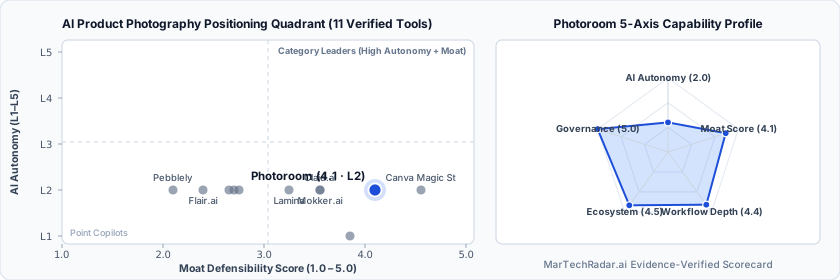
Photoroom in-depth review, pricing & architecture analysis
Editor sign-off: Oct 11, 2026. How profiles are made.
What is Photoroom? Overview & background
Architectured around real-time neural matting and generative diffusion, Photoroom was established in 2019 and is headquartered in New York, United States. Backed by $62.1M in total venture funding, the company engineers visual editing infrastructure specifically targeted at e-commerce catalog operations, marketplace sellers, and brand creative teams. The platform automates repetitive visual production workflows by replacing conventional physical photo shoots with computer-vision-driven subject extraction and algorithmic scene staging.
How Photoroom works: architecture & workflow
At its operational foundation, Photoroom executes an L2 semi-automated pipeline that combines custom semantic segmentation models with generative image synthesis. When an asset is ingested via mobile interface or REST API endpoints, proprietary vision models detect subject boundaries, extracting products with hair-level and edge-level alpha matting. Users then apply prompt-driven or template-based diffusion engines that synthesize photorealistic backgrounds, matching ground-plane contact shadows, specular lighting reflections, and contextual perspective to the isolated item, alongside native workflow integrations for Shopify and Notion under verified SOC 2 Type II and GDPR governance controls.
Photoroom limitations, drawbacks & risks
Operational considerations and platform boundaries include:
- High-Volume SKU Consistency: Generating large batch runs using prompt-guided diffusion frequently introduces visual drift across color grading, contact shadow angles, and synthetic scale, necessitating human review.
- Transparent and Reflective Material Artifacts: Objects composed of clear glass, translucent liquids, or mirror-finished metals can experience boundary erosion or refractive masking errors during automated background removal.
- API Rate and Credit Constraints: Strict monthly allocation caps on high-resolution inference credits restrict continuous automated ingestion for enterprise merchant catalogs undergoing daily re-indexing.
Photoroom pricing, plans & cost breakdown
Photoroom distributes its software via a tiered subscription framework beginning with a baseline Free plan. Paid subscriptions scale between $7.50 and $82.50 per month when billed yearly, granting higher processing allotments, batch workflows, and team collaboration. High-volume enterprise integration paths require credit allocations tailored to programmatic catalog volume.
How Photoroom compares vs. competitors & alternatives
Within the product imagery sector, Photoroom competes directly against niche merchandising engines like Blunge, Caimera, and clova within the AI Product Photography segment. While Clova and Caimera emphasize focused e-commerce listing optimizations or localized retail merchandising workflows, Photoroom differentiates through superior edge extraction speed and mature cross-platform utility. The system serves high-velocity digital retailers that require high-throughput asset generation without retaining external creative production agencies.
Direct competitors & market radar
Top algorithmic competitors based on category positioning, capability overlap, and ICP alignment.
Frequently asked questions about Photoroom
How much does Photoroom cost in 2026?
Photoroom pricing: Free plan · $7.50–$82.50/mo. A permanent free plan is available. Photoroom distributes its software via a tiered subscription framework beginning with a baseline Free plan.
What are the top Photoroom alternatives in AI Product Photography?
Verified AI Product Photography alternatives include Caspa AI (From $39/mo), FancyTech (Custom / enterprise pricing), Caimera ($15–$117/seat/mo), Bria.ai (Usage-based pricing). Within the product imagery sector, Photoroom competes directly against niche merchandising engines like Blunge, Caimera, and clova within the AI Product Photography segment.
What are the main limitations and trade-offs of Photoroom?
Operational considerations and platform boundaries include: High-Volume SKU Consistency: Generating large batch runs using prompt-guided diffusion frequently introduces visual drift across color grading, contact shadow angles, and synthetic scale, necessitating human review. Walk away if your workflow cannot tolerate high-volume sku consistency: Generating large batch runs using prompt-guided diffusion frequently introduces visual drift across color grading, contact shadow angles, and synthetic scale, necessitating human review.
Verified sources & evidence trail
- Official product domain: https://photoroom.com
- Commercial pricing verification: https://www.photoroom.com/pricing
- Verified corporate entity profiles (
sameAs): LinkedIn Company Profile · Crunchbase Entity Record - First-party governance & documentation links: Trust & Security · API & Docs · Privacy
- Editor sign-off: Oct 11, 2026 (how profiles are made).
