Caimera Review (2026): AI Product Photography Pricing, Limits & Alternatives
Bottom line
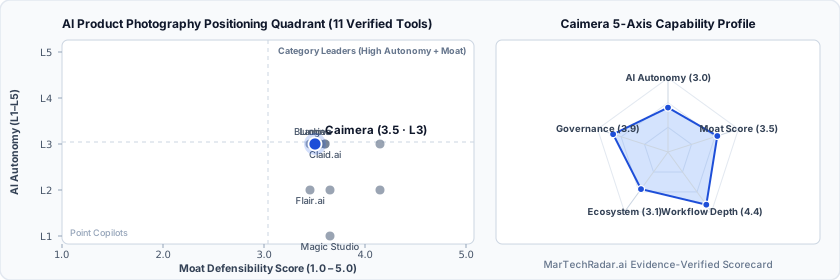
Caimera is a Web SaaS tool for AI Product Photography (Product Photography & AI Retouching) in Visual & Creative Media. Pricing: $15–$117/seat/mo. Best suited to eCommerce Brands, Creative Agencies and Performance Video Marketers. Editor ratings: AI autonomy L3 (conditional automation); moat score 3.5/5.0 (Proprietary moat). Fact-checked by Jiacky Lee on Oct 10, 2026.
AI visual production platform for fashion and apparel brands generating on-model product imagery and technical packs from flat sketches.
Caimera buyer fit verdict: when to choose vs. when to walk away
Choose Caimera if (Best Fit)
- Target ICP & Stack Fit: You operate as eCommerce Brands, Creative Agencies and Performance Video Marketers requiring a Web SaaS deployment for AI Product Photography.
- L3 Architecture & Defensibility: Domain-specific diffusion models tuned for apparel drape, fabric texture fidelity, and garment-to-model alignment, combined with structured tech pack generation capabilities.
- Commercial Model Fit: Your procurement budget aligns with $15–$117/seat/mo.
Walk away from Caimera if (Deal-Breakers)
- Walk away if your workflow requires uncapped enterprise volume on the $15–$117/seat/mo entry plan without upgrading tiers.
- Walk away if your workflow cannot tolerate complex fabric rendering: High-sheen fabrics, intricate embroideries, and translucent textiles frequently exhibit artifact distortion or surface texture flattening during the virtual drape process.
- Walk away if strict brand consistency is a deal-breaker for your team: Generating continuous poses across identical synthetic human models requires precise seed management, which can drift across separate generation batches.
Caimera key facts & scorecard
| Pricing | $15–$117/seat/moVendor pricing page |
|---|---|
| Free plan | No / not disclosed |
| Delivery | Web SaaS |
| Audience | eCommerce Brands, Creative Agencies, Performance Video Marketers |
| AI autonomy level | L3 · Conditional automationEditor-verified |
| Moat tier & score | 3.5 / 5.0 · Proprietary moatEditor-verified |
| Funding | Pre-seed |
| Total funding | $700KBacked by Blume Ventures, Hearth Ventures |
| Founders | Kirti Poonia, Prateek Gupte |
| Company size | 11-50 employees |
| Governance & docs | Changelog ↗ · Privacy ↗ |
| Headquarters | Mumbai, India |
| Founded | 2023 |
| Last verified |
Caimera pros & cons: strengths vs. operational limitations
Pros: core strengths & capabilities
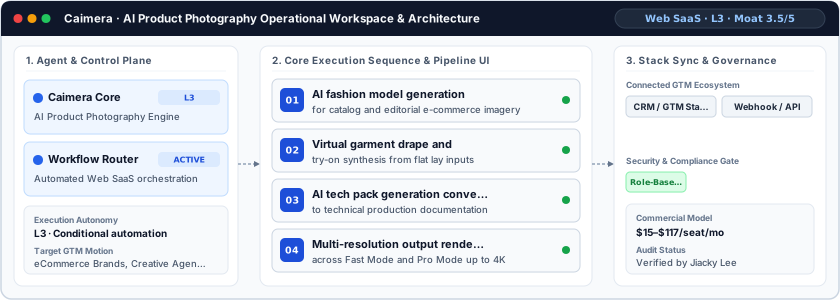
- AI fashion model generation: for catalog and editorial e-commerce imagery
- Virtual garment drape and: try-on synthesis from flat lay inputs
- AI tech pack generation converting sketches: to technical production documentation
- Multi-resolution output rendering: across Fast Mode and Pro Mode up to 4K
Cons: operational limitations & risks
- Complex Fabric Rendering: High-sheen fabrics, intricate embroideries, and translucent textiles frequently exhibit artifact distortion or surface texture flattening during the virtual drape process.
- Strict Brand Consistency: Generating continuous poses across identical synthetic human models requires precise seed management, which can drift across separate generation batches.
- Catalog Aspect Ratio Rigidity: Marketplace requirements demanding rigid multi-angle catalog standards (back, profile, micro-details) require extensive manual prompt calibration and verification.
Caimera TCO & deal-breaker stress test
Simulate 12-month stepped TCO, hidden cost multipliers, contract lock-in exposure, and stack failure modes using only facts verified by Jiacky Lee on · Capture SHA 9c4bf0d0.
Caimera aligns with your 5-seat / $800/mo profile. Review the walk-away triggers and contract levers below before deployment.
| Plan / Tier | Verified Rate | Scale Fit | Scope & Quota Notes |
|---|---|---|---|
| Entry / Starter | $15/seat/mo | 1–2 seats | Verified $15/seat/mo tier from vendor pricing schedule. |
| Pro | $117/seat/mo | 5 seats | Scale up your AI impact |
- Moat Score
- 3.5 / 5.0
- AI Autonomy
- L3
- Free Tier / Trial
- None disclosed
Triggered audit signals & failure modes
- Published Self-Serve Entry FloorVerified Pricing Ledger
Caimera publishes a transparent entry point ($15–$117/seat/mo) for initial validation before committing.
- Linear Per-Seat Scaling (5 Seats × $15/seat/mo)Commercial Model Audit
Base license scales linearly with operator headcount ($75/mo for 5 seats on Entry / Starter).
- Primary Operational Bottleneck: Complex Fabric RenderingAudit by Jiacky Lee
High-sheen fabrics, intricate embroideries, and translucent textiles frequently exhibit artifact distortion or surface texture flattening during the virtual drape process.
Hidden TCO Multipliers & Quota Gates
- Per-Seat Linear Scaling: Caimera prices licenses on a per-user/seat basis ($15–$117/seat/mo); expanding from 2 to 15+ operators multiplies base recurring spend linearly.
- Annual Billing Headline vs. Monthly Premium: Headline entry rates reflect annual billing commitments (Save 20%); month-to-month flexibility carries a higher effective monthly rate or requires annual prepayment.
- Credit & Usage Burn Multiplier: Automated workflows consume metered credits/usage quotas; multi-step enrichment, voice minutes, or high-frequency agent runs can trigger mid-cycle top-up packs.
When to Walk Away & Negotiation Levers
- Walk away if your workflow requires uncapped enterprise volume on the $15–$117/seat/mo entry plan without upgrading tiers.
- Walk away if your workflow cannot tolerate complex fabric rendering: High-sheen fabrics, intricate embroideries, and translucent textiles frequently exhibit artifact distortion or surface texture flattening during the virtual drape process.
- Walk away if strict brand consistency is a deal-breaker for your team: Generating continuous poses across identical synthetic human models requires precise seed management, which can drift across separate generation batches.
- Validate exact quota thresholds (seats, credits, or API calls) included in Caimera's $15–$117/seat/mo tier before converting from monthly to annual billing.
- Require a sandbox proof-of-concept testing complex fabric rendering against your live CRM/data schema before annual sign-off.
Ask a custom procurement or TCO stress-test question about Caimera
Lower 5-seat floor (~$8/mo vs. $75 / mo)
Lower 5-seat floor (~$10/mo vs. $75 / mo)
Caimera moat & subtrack positioning
Domain-specific diffusion models tuned for apparel drape, fabric texture fidelity, and garment-to-model alignment, combined with structured tech pack generation capabilities.
Editorial review
Fact-checked by Jiacky Lee (Managing Editor, AI Autonomy & Moat Methodology) on .
Background
To eliminate the capital overhead and prolonged turnaround times of physical apparel photoshoots, brands require automated visual pipelines capable of translating garments into commercial imagery. Established in 2023 in Mumbai, India, Caimera developed a generative production system specifically targeting e-commerce fashion houses, merchandisers, and apparel design teams. Backed by $700K in venture funding, the company addresses the apparel lifecycle from design conceptualization to catalog deployment. Rather than functioning as a horizontal image generator, Caimera focuses on turning flat garments and sketches into commercial on-model photography.
How Caimera works
The technical engine ingests flat-lay photography, ghost mannequin shots, or rough sketches to execute virtual try-on synthesis. The ingestion pipeline extracts garment geometry, seam lines, and textile textures using localized semantic segmentation. These features are mapped onto synthetic models using specialized diffusion models that preserve fabric patterns, drape physics, and stitch integrity. The platform operates across dual execution tiers: Fast Mode handles high-throughput 1K exploratory iterations, while Pro Mode performs higher-denoise passes producing up to 4K resolution assets. Additionally, structured metadata parsing converts sketch inputs into functional production tech packs.
Limitations
Operational considerations and platform boundaries include:
- Complex Fabric Rendering: High-sheen fabrics, intricate embroideries, and translucent textiles frequently exhibit artifact distortion or surface texture flattening during the virtual drape process.
- Strict Brand Consistency: Generating continuous poses across identical synthetic human models requires precise seed management, which can drift across separate generation batches.
- Catalog Aspect Ratio Rigidity: Marketplace requirements demanding rigid multi-angle catalog standards (back, profile, micro-details) require extensive manual prompt calibration and verification.
Caimera pricing
Commercial access is structured around a credit-based subscription model. A free exploration tier provides baseline generation with watermarked output at $0. Paid commercial tiers start at $15 per user per month on the Mini plan, which grants 120 monthly credits for editorial generations, scaling up to $117 per user per month on higher-volume packages. Pricing scales according to credit consumption, export resolution, and access to unwatermarked commercial licensing.
How Caimera compares
Within the product imagery sector, Caimera competes alongside specialized visual engines like Flair.ai, Clova, and Blunge. While Flair.ai emphasizes packaged consumer goods and ambient tabletop backgrounds, Caimera specifically optimizes for apparel drapery and human pose interaction. Blunge offers broader multi-category retail staging, whereas Caimera integrates apparel-specific design tooling such as tech pack generation. The platform is best suited for mid-market apparel retailers and direct-to-consumer fashion brands seeking to streamline high-SKU catalog production without coordinating studio shoots.
Frequently asked questions about Caimera
How much does Caimera cost per seat and does it have a free plan?
Published pricing summary for Caimera: $15–$117/seat/mo. A permanent free plan is not disclosed for Caimera. Verified tier schedule: Entry / Starter ($15/seat/mo for 1–2 seats); Pro ($117/seat/mo for 5 seats). Commercial access is structured around a credit-based subscription model. A free exploration tier provides baseline generation with watermarked output at $0.
How does Caimera work and how autonomous is its AI architecture?
AI visual production platform for fashion and apparel brands generating on-model product imagery and technical packs from flat sketches. Within AI Product Photography (Product Photography & AI Retouching), MarTechRadar rates its execution architecture at L3 · Conditional automation with a verified Moat Score of 3.5 / 5.0 (Proprietary moat). Domain-specific diffusion models tuned for apparel drape, fabric texture fidelity, and garment-to-model alignment, combined with structured tech pack generation capabilities. Corporate profile: Founded by Kirti Poonia, Prateek Gupte, operating at 11-50 employees scale.
What are the main limitations of Caimera and when should buyers walk away?
Based on our editorial technical audit, key operational considerations and boundaries for Caimera include: (1) Complex Fabric Rendering: High-sheen fabrics, intricate embroideries, and translucent textiles frequently exhibit artifact distortion or surface texture flattening during the virtual drape process. (2) Strict Brand Consistency: Generating continuous poses across identical synthetic human models requires precise seed management, which can drift across separate generation batches. (3) Catalog Aspect Ratio Rigidity: Marketplace requirements demanding rigid multi-angle catalog standards (back, profile, micro-details) require extensive manual prompt calibration and verification. Primary procurement walk-away rule: Walk away if your workflow requires uncapped enterprise volume on the $15–$117/seat/mo entry plan without upgrading tiers.
What integrations, compliance certifications, and contract terms apply to Caimera?
Key TCO multiplier to watch: Per-Seat Linear Scaling (Caimera prices licenses on a per-user/seat basis ($15–$117/seat/mo); expanding from 2 to 15+ operators multiplies base recurring spend linearly.) Before signing a contract, procurement teams should validate exact quota thresholds (seats, credits, or API calls) included in Caimera's $15–$117/seat/mo tier before converting from monthly to annual billing.
What are the best Caimera alternatives and head-to-head competitors in 2026?
Top fact-checked alternatives to Caimera in AI Product Photography (Product Photography & AI Retouching) include Flair.ai (Free plan · $8–$38/mo), Blunge ($10–$20/mo), Magic Studio (Free plan · $0/mo · Enterprise plan), Pixelcut (Free plan · $0/mo · Enterprise plan). Within the product imagery sector, Caimera competes alongside specialized visual engines like Flair.ai, Clova, and Blunge. While Flair.ai emphasizes packaged consumer goods and ambient tabletop backgrounds, Caimera specifically optimizes for apparel drapery and human pose interaction.
Verified sources & evidence trail
- Official product domain: https://www.caimera.ai
- Commercial pricing verification: https://www.caimera.ai/pricing
- Verified corporate entity profiles (
sameAs): LinkedIn Company Profile · Crunchbase Entity Record - First-party governance & documentation links: Changelog · Privacy
- Editorial audit sign-off: Fact-checked by Jiacky Lee on under the MarTechRadar Evidence-Ledger Protocol.