Magic Studio Review (2026): AI Product Photography Pricing, Pros & Cons
Bottom line
Magic Studio is a Web SaaS tool for AI Product Photography (Product Photography & AI Retouching) in Visual & Creative Media. Pricing: Custom / enterprise pricing. Best suited to DTC / eCommerce and Creators / Solo. Editor ratings: AI autonomy L1 (prompt-assisted); moat score 2.2/5.0 (Workflow-embedded). Fact-checked by MarTechRadar Research Desk on Oct 15, 2026.
Web and mobile AI photography suite automating subject isolation, background generation, inpainting, and synthetic headshot creation for commercial assets.
Is Magic Studio worth it in 2026? Buyer fit & when to walk away
Choose Magic Studio if (Best Fit)
- Target ICP & Stack Fit: You operate as DTC / eCommerce and Creators / Solo requiring a Web SaaS deployment for AI Product Photography, with verified ecosystem connectivity for Notion.
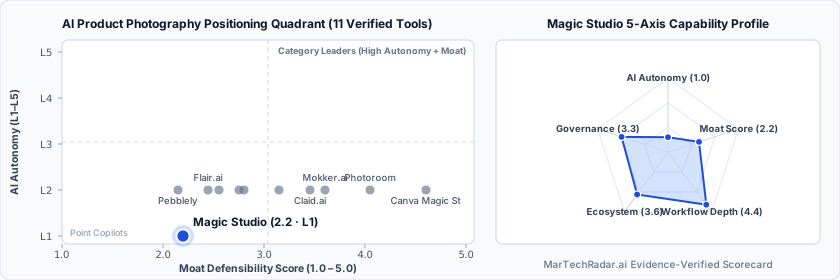
- L1 Architecture & Defensibility: Relies primarily on fine-tuned open-source diffusion models and streamlined micro-tool user experiences. Moat is constrained by low model defensibility, leaning mainly on consumer brand acquisition volume.
- Commercial Model Fit: Your procurement budget aligns with Custom / enterprise pricing and want a self-serve free tier for zero-cost initial validation.
Walk away from Magic Studio if (Deal-Breakers)
- Walk away if you need published self-serve pricing: Magic Studio is sold by custom quote.
- Walk away if your workflow cannot tolerate batch throughput bottlenecks: The standard interface restricts execution to single-asset workflows, requiring manual interaction per image rather than automated multi-SKU pipeline processing.
- Walk away if high-frequency artifacting is a deal-breaker for your team: Complex edge transitions such as reflective product glass or fine hair strands frequently display latent blurring or hallucinated edge artifacts under magnification.
Magic Studio pricing, free plan & scorecard at a glance
| Pricing | Custom / enterprise pricingVendor pricing page |
|---|---|
| Free plan | Yes |
| Delivery | Web SaaS |
| Audience | DTC / eCommerce, Creators / Solo |
| AI autonomy level | L1 · Prompt-assistedEditor-verified |
| Moat tier & score | 2.2 / 5.0 · Workflow-embeddedEditor-verified |
| Funding | Bootstrapped |
| Founders | Akhilesh Bussa, Bharat Prabhakar, Vinod Bollini, Vivek Sharma |
| Company size | 11-50 employees |
| Ecosystem integrations | Notion |
| Governance & docs | Terms ↗ · Privacy ↗ |
| Headquarters | Claymont, Delaware |
| Founded | 2023 |
| Last verified | Oct 15, 2026 |
Magic Studio pros & cons: strengths vs. operational limitations
Pros: core strengths & capabilities
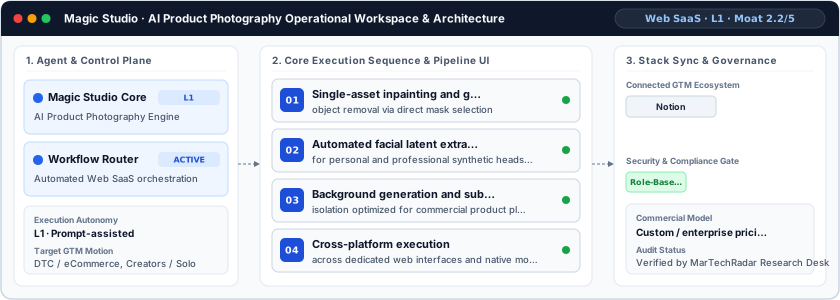
- Single-asset inpainting and generative: object removal via direct mask selection
- Automated facial latent extraction: for personal and professional synthetic headshot rendering
- Background generation and subject: isolation optimized for commercial product placements
- Cross-platform execution: across dedicated web interfaces and native mobile applications
Cons: operational limitations & risks
- Batch Throughput Bottlenecks: The standard interface restricts execution to single-asset workflows, requiring manual interaction per image rather than automated multi-SKU pipeline processing.
- High-Frequency Artifacting: Complex edge transitions such as reflective product glass or fine hair strands frequently display latent blurring or hallucinated edge artifacts under magnification.
- Absence of Custom API Integration: Enterprise systems cannot programmatically pipe raw digital asset management assets into dynamic rendering queues due to the focus on consumer-facing graphical interfaces.
Magic Studio TCO & deal-breaker stress test
Simulate 12-month stepped TCO, hidden cost multipliers, contract lock-in exposure, and stack failure modes using only facts verified by MarTechRadar Research Desk on 2026-10-15 · Capture SHA aa7816a4.
Magic Studio is viable for 5 seats, but requires commercial or technical verification on the flagged items below.
- Moat Score
- 2.2 / 5.0
- AI Autonomy
- L1
- Free Tier / Trial
- Free plan
Triggered audit signals & failure modes
- Opaque Enterprise Quoting vs. SMB/Mid-Market BudgetVerified Pricing Ledger
Magic Studio does not disclose a public self-serve floor (Custom / enterprise pricing). Buyers with a $800/mo cap face high sales-qualification friction.
- Published Self-Serve Entry FloorVerified Pricing Ledger
Magic Studio publishes a transparent entry point (Custom / enterprise pricing) with a free tier for initial validation before committing.
- Primary Operational Bottleneck: Batch Throughput BottlenecksAudit by MarTechRadar Research Desk
The standard interface restricts execution to single-asset workflows, requiring manual interaction per image rather than automated multi-SKU pipeline processing.
Test a custom Magic Studio budget or stack constraint
Lower 5-seat floor (~$23/mo vs. Custom Quote)
Magic Studio integrations, API, security & compliance stack
Magic Studio AI moat & AI Product Photography positioning
Relies primarily on fine-tuned open-source diffusion models and streamlined micro-tool user experiences. Moat is constrained by low model defensibility, leaning mainly on consumer brand acquisition volume.
Magic Studio in-depth review, pricing & architecture analysis
Editor sign-off: Oct 15, 2026. How profiles are made.
What is Magic Studio? Overview & background
Established in 2023 in Claymont, Delaware, Magic Studio addresses the friction of commercial asset production for digital storefront operators and growth teams. Rather than requiring specialized design software, the platform unbundles generative diffusion and computer vision utilities into task-specific web and mobile workflows. Designed primarily for e-commerce catalog managers and social media marketing leads, Magic Studio streamlines background synthesis, portrait rendering, and object removal without manual masking.
How Magic Studio works: architecture & workflow
Operating at an L1 assistance level, Magic Studio functions through targeted generative pipelines triggered by discrete user inputs. For portrait and headshot generation, the ingestion system processes reference images into a standardized identity embedding via latent diffusion networks. For product retouching and inpainting, the engine combines browser-based brush masking with server-side edge detection and segmentation models, passing raster inputs to diffusion backends that replace or reconstruct contextual backgrounds while preserving foreground geometry, alongside native workflow integrations for Notion.
Magic Studio limitations, drawbacks & risks
Operational considerations and platform boundaries include:
- Batch Throughput Bottlenecks: The standard interface restricts execution to single-asset workflows, requiring manual interaction per image rather than automated multi-SKU pipeline processing.
- High-Frequency Artifacting: Complex edge transitions such as reflective product glass or fine hair strands frequently display latent blurring or hallucinated edge artifacts under magnification.
- Absence of Custom API Integration: Enterprise systems cannot programmatically pipe raw digital asset management assets into dynamic rendering queues due to the focus on consumer-facing graphical interfaces.
Magic Studio pricing, plans & cost breakdown
Magic Studio deploys a freemium distribution strategy. Entry-level users can access basic functionality via a free tier at $0 per month, which enforces output watermarks, limited generation quotas, and restricted download resolutions. Paid commercial and pro tiers remove watermarking, increase generation throughput, and introduce bulk processing for specific tools, while bespoke enterprise agreements govern large-scale organizational access.
| Plan / Tier | Verified Price & Billing | Included Scope & Contract Terms | |
|---|---|---|---|
| Free / Sandbox | $0 | Free plan or free tier offered by the vendor. | |
| Enterprise / Custom | Custom quote | Custom-quoted plan; terms come from the vendor's sales team. | |
| Contract Watchout: Annual Billing Headline vs. Monthly Premium | The vendor pricing page advertises an annual-billing discount (Save 63%); month-to-month billing carries a higher effective monthly rate. | ||
How Magic Studio compares vs. competitors & alternatives
Within the product photography and AI retouching domain, Magic Studio competes against specialized engines like Blunge, Caimera, and clova within the AI Product Photography segment. While Blunge and clova focus on catalog automation and structured e-commerce studio workflows, Magic Studio emphasizes consumer-grade micro-utilities. Caimera offers deeper algorithmic controls for brand-governed lighting consistency. Consequently, Magic Studio fits small digital merchants needing rapid visual asset generation rather than enterprises requiring programmatic asset syndication.
Direct competitors & market radar
Top algorithmic competitors based on category positioning, capability overlap, and ICP alignment.
Frequently asked questions about Magic Studio
Does Magic Studio publish pricing or require an enterprise quote?
Magic Studio pricing: Custom / enterprise pricing. A permanent free plan is available. Published tiers: Free / Sandbox ($0); Enterprise / Custom (Custom quote). Magic Studio deploys a freemium distribution strategy. Entry-level users can access basic functionality via a free tier at $0 per month, which enforces output watermarks, limited generation quotas, and restricted download resolutions.
What are the top Magic Studio alternatives in AI Product Photography?
Verified AI Product Photography alternatives include clova ($23–$95/mo), Smartmockups (Custom / enterprise pricing), Booth.ai (Custom / enterprise pricing), Sume (Usage-based pricing). Within the product photography and AI retouching domain, Magic Studio competes against specialized engines like Blunge, Caimera, and clova within the AI Product Photography segment.
What are the main limitations and trade-offs of Magic Studio?
Operational considerations and platform boundaries include: Batch Throughput Bottlenecks: The standard interface restricts execution to single-asset workflows, requiring manual interaction per image rather than automated multi-SKU pipeline processing. Walk away if you need published self-serve pricing: Magic Studio is sold by custom quote.
Verified sources & evidence trail
- Official product domain: https://magicstudio.com
- Commercial pricing verification: https://magicstudio.com/pricing/
- Verified corporate entity profiles (
sameAs): LinkedIn Company Profile · Crunchbase Entity Record - First-party governance & documentation links: Terms · Privacy
- Editor sign-off: Oct 15, 2026 (how profiles are made).
