Claid.ai Review (2026): AI Product Photography Pricing, Pros & Cons
Bottom line
Claid.ai is a API / SDK tool for AI Product Photography (Product Photography & AI Retouching) in Visual & Creative Media. Pricing: From $120/mo. Best suited to DTC / eCommerce and Enterprise Brands. Editor ratings: AI autonomy L2 (workflow copilot); moat score 3.5/5.0 (Proprietary moat). Fact-checked by MarTechRadar Research Desk on Oct 16, 2026.
Programmatic AI imaging platform automating eCommerce product photography enhancement, background generation, and resolution upscaling at scale.
Is Claid.ai worth it in 2026? Buyer fit & when to walk away
Choose Claid.ai if (Best Fit)
- Target ICP & Stack Fit: You operate as DTC / eCommerce and Enterprise Brands requiring a API / SDK deployment for AI Product Photography, with verified ecosystem connectivity for Twilio Segment.
- L2 Architecture & Defensibility: High-throughput API infrastructure specialized in texture-preserving upscaling and natural light generation for high-volume commerce catalogs.
- Commercial Model Fit: Your procurement budget aligns with From $120/mo.
Walk away from Claid.ai if (Deal-Breakers)
- Walk away if your workflow cannot tolerate edge case artifacting: Fine transparent surfaces, refractive glass containers, and complex wireframes often induce edge-bleeding or alpha-channel clipping during automated segmentation.
- Walk away if high-volume latency is a deal-breaker for your team: Synchronous diffusion-based scene generation introduces processing latency compared to basic geometric crops, requiring asynchronous queue architectures for peak catalog imports.
Claid.ai pricing, free plan & scorecard at a glance
| Pricing | From $120/moVendor pricing page |
|---|---|
| Free plan | No / not disclosed |
| Delivery | API / SDK |
| Audience | DTC / eCommerce, Enterprise Brands |
| AI autonomy level | L2 · Workflow copilotEditor-verified |
| Moat tier & score | 3.5 / 5.0 · Proprietary moatEditor-verified |
| Funding | Seed |
| Founders | Vladislav Pranskevičius |
| Company size | 11-50 employees |
| Ecosystem integrations | Twilio Segment |
| Governance & docs | API & Docs ↗ · Terms ↗ · Privacy ↗ |
| Headquarters | San Francisco, California |
| Founded | 2017 |
| Last verified | Oct 16, 2026 |
Claid.ai pros & cons: strengths vs. operational limitations
Pros: core strengths & capabilities
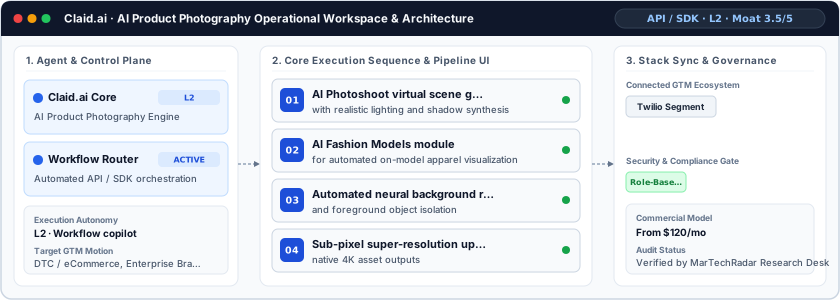
- AI Photoshoot virtual scene generator: with realistic lighting and shadow synthesis
- AI Fashion Models module: for automated on-model apparel visualization
- Automated neural background removal and foreground object isolation
- Sub-pixel super-resolution upscaler supporting: native 4K asset outputs
Cons: operational limitations & risks
- Edge Case Artifacting: Fine transparent surfaces, refractive glass containers, and complex wireframes often induce edge-bleeding or alpha-channel clipping during automated segmentation.
- High-Volume Latency: Synchronous diffusion-based scene generation introduces processing latency compared to basic geometric crops, requiring asynchronous queue architectures for peak catalog imports.
- Model Fit Alignment: The AI Fashion Model engine requires precise silhouette alignment; non-standard apparel cuts frequently demand manual prompt fine-tuning to avoid structural distortion.
Claid.ai TCO & deal-breaker stress test
Simulate 12-month stepped TCO, hidden cost multipliers, contract lock-in exposure, and stack failure modes using only facts verified by MarTechRadar Research Desk on 2026-10-16 · Capture SHA 0bab1911.
Claid.ai aligns with your 5-seat / $800/mo profile. Review the walk-away triggers and contract levers below before deployment.
- Moat Score
- 3.5 / 5.0
- AI Autonomy
- L2
- Free Tier / Trial
- None disclosed
Triggered audit signals & failure modes
- Published Self-Serve Entry FloorVerified Pricing Ledger
Claid.ai publishes a transparent entry point (From $120/mo) for initial validation before committing.
- Primary Operational Bottleneck: Edge Case ArtifactingAudit by MarTechRadar Research Desk
Fine transparent surfaces, refractive glass containers, and complex wireframes often induce edge-bleeding or alpha-channel clipping during automated segmentation.
Test a custom Claid.ai budget or stack constraint
Lower 5-seat floor (~$10/mo vs. From $120 / mo)
Lower 5-seat floor (~$49/mo vs. From $120 / mo)
Claid.ai integrations, API, security & compliance stack
Claid.ai AI moat & AI Product Photography positioning
High-throughput API infrastructure specialized in texture-preserving upscaling and natural light generation for high-volume commerce catalogs.
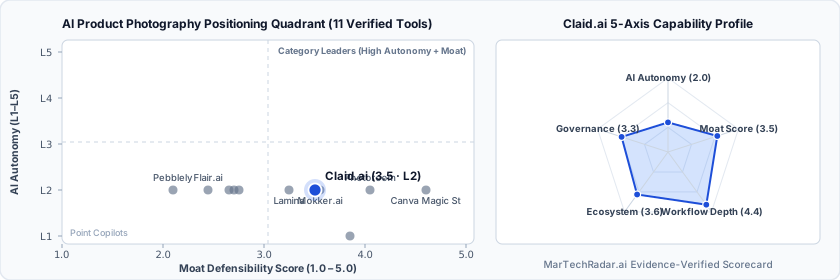
Claid.ai in-depth review, pricing & architecture analysis
Editor sign-off: Oct 16, 2026. How profiles are made.
What is Claid.ai? Overview & background
Headquartered in San Francisco, California, and founded in 2017, Claid.ai addresses catalog asset normalization for eCommerce merchandisers and visual production managers. Consumer marketplaces regularly ingest substandard merchant photos featuring compression artifacts, misaligned framing, and inconsistent studio lighting. Claid.ai serves as an automated visual processing layer that standardizes multi-source imagery into production-grade merchandising assets.
How Claid.ai works: architecture & workflow
Operating at an L2 autonomy level, Claid.ai ingests visual assets via a headless REST API or batch studio interface. The architecture couples proprietary super-resolution networks with conditional diffusion pipelines. First, foreground extraction isolating semantic product contours runs in parallel with neural de-noising. The pipeline then executes context-aware background generation, rendering perspective-matched lighting, cast shadows, and reflections without warping typographic packaging or fabric textures up to native 4K output, alongside native workflow integrations for Shopify and Zapier.
Claid.ai limitations, drawbacks & risks
Operational considerations and platform boundaries include:
- Edge Case Artifacting: Fine transparent surfaces, refractive glass containers, and complex wireframes often induce edge-bleeding or alpha-channel clipping during automated segmentation.
- High-Volume Latency: Synchronous diffusion-based scene generation introduces processing latency compared to basic geometric crops, requiring asynchronous queue architectures for peak catalog imports.
- Model Fit Alignment: The AI Fashion Model engine requires precise silhouette alignment; non-standard apparel cuts frequently demand manual prompt fine-tuning to avoid structural distortion.
Claid.ai pricing, plans & cost breakdown
Commercial access utilizes credit-based tiers spanning web and developer interfaces, starting from $120/month for standard operations. The business expands into custom enterprise licensing featuring dedicated rate limits, volume API discounts, and tailored service level agreements for enterprise marketplace throughput.
How Claid.ai compares vs. competitors & alternatives
Relative to alternative retouching systems like Blunge, Caimera, and Clova, Claid.ai emphasizes enterprise-grade API automation over purely consumer-facing generative canvases within the AI Product Photography segment. While Caimera and Blunge target ad-hoc creative studio edits, and Clova provides broad computer vision tools, Claid.ai optimizes for programmatic, high-throughput catalog transformations for high-volume retail platforms and digital marketplaces.
Direct competitors & market radar
Top algorithmic competitors based on category positioning, capability overlap, and ICP alignment.
Frequently asked questions about Claid.ai
How much does Claid.ai cost in 2026?
Claid.ai pricing: From $120/mo. No free plan is publicly disclosed. Commercial access utilizes credit-based tiers spanning web and developer interfaces, starting from $120/month for standard operations.
What are the top Claid.ai alternatives in AI Product Photography?
Verified AI Product Photography alternatives include Caspa AI (From $39/mo), Shop OS (Custom / enterprise pricing), Blunge ($10–$20/mo), Presti AI (Free plan · $49–$999/mo). Relative to alternative retouching systems like Blunge, Caimera, and Clova, Claid.ai emphasizes enterprise-grade API automation over purely consumer-facing generative canvases within the AI Product Photography segment.
What are the main limitations and trade-offs of Claid.ai?
Operational considerations and platform boundaries include: Edge Case Artifacting: Fine transparent surfaces, refractive glass containers, and complex wireframes often induce edge-bleeding or alpha-channel clipping during automated segmentation. Walk away if your workflow cannot tolerate edge case artifacting: Fine transparent surfaces, refractive glass containers, and complex wireframes often induce edge-bleeding or alpha-channel clipping during automated segmentation.
Verified sources & evidence trail
- Official product domain: https://claid.ai
- Commercial pricing verification: https://claid.ai/pricing
- Verified corporate entity profiles (
sameAs): LinkedIn Company Profile · Crunchbase Entity Record - First-party governance & documentation links: API & Docs · Terms · Privacy
- Editor sign-off: Oct 16, 2026 (how profiles are made).
