Figcel Review (2026): AI Product Photography Pricing, Pros & Cons
Bottom line
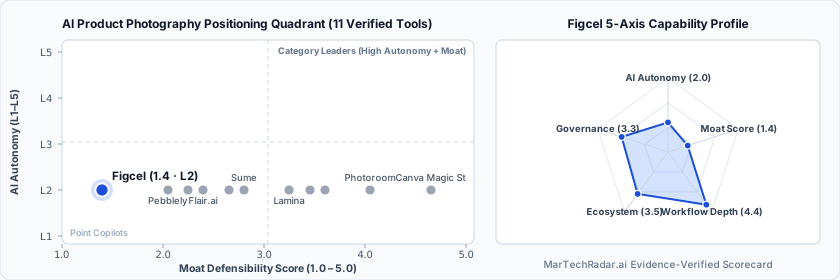
Figcel is a Web SaaS tool for AI Product Photography (Product Photography & AI Retouching) in Visual & Creative Media. Pricing: Free plan · $99–$199/mo. Editor ratings: AI autonomy L2 (workflow copilot); moat score 1.4/5.0 (Thin wrapper). Fact-checked by MarTechRadar Research Desk on Oct 28, 2026.
E-commerce ad creative studio that turns a store URL into brand-styled Meta static ads and multi-slide carousels with ready-to-paste ad copy.
Is Figcel worth it in 2026? Buyer fit & when to walk away
Choose Figcel if (Best Fit)
- Target ICP & Stack Fit: You operate as AI Product Photography teams requiring a Web SaaS deployment for AI Product Photography, with verified ecosystem connectivity for Shopify, Meta Ads.
- L2 Architecture & Defensibility: Extracts brand typography, colors, product imagery, and factual claims directly from a store URL and renders multi-ratio Meta carousels and static ads through art-directed house styles rather than unguided diffusion prompts.
- Commercial Model Fit: Your procurement budget aligns with Free plan · $99–$199/mo and want a self-serve free tier for zero-cost initial validation.
Walk away from Figcel if (Deal-Breakers)
- Walk away if your workflow requires uncapped enterprise volume on the Free plan · $99–$199/mo entry plan without upgrading tiers.
- Walk away if your workflow cannot tolerate unlaunched roadmap modules: Several features listed on Figcel's pricing table—including automated **Competitor analysis** (5 rivals per brand), **Reels** video generation, **Post scheduling**, client **Review links**, and multi-user **Team seats**—are marked as *coming soon* and are not yet live in production.
- Walk away if meta static & carousel format lock-in is a deal-breaker for your team: Output layouts and copy lengths are engineered specifically for Meta feed and story placements; advertisers needing YouTube pre-roll videos, TikTok creator UGC actors, or HTML5 display banners face workflow friction and must use external video tools.
Figcel pricing, free plan & scorecard at a glance
| Pricing | Free plan · $99–$199/moVendor pricing page |
|---|---|
| Free plan | Yes |
| Delivery | Web SaaS |
| Audience | — |
| AI autonomy level | L2 · Workflow copilotEditor-verified |
| Moat tier & score | 1.4 / 5.0 · Thin wrapperEditor-verified |
| Funding | Bootstrapped |
| Ecosystem integrations | Shopify, Meta Ads |
| Headquarters | India |
| Founded | 2025 |
| Last verified | Oct 28, 2026 |
Figcel pros & cons: strengths vs. operational limitations
Pros: core strengths & capabilities
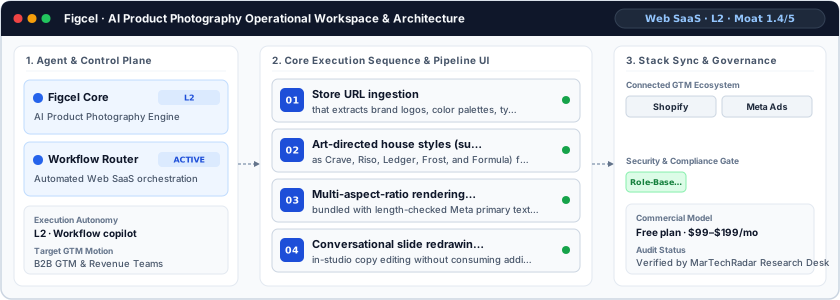
- Store URL ingestion: that extracts brand logos, color palettes, typography, product photos, and verified site facts
- Art-directed house styles (such: as Crave, Riso, Ledger, Frost, and Formula) for static Meta ads, motion carousels, and festival packs
- Multi-aspect-ratio rendering (4:5, 1:1, and 9:16): bundled with length-checked Meta primary text, headlines, and descriptions
- Conversational slide redrawing and: in-studio copy editing without consuming additional monthly pack credits
Cons: operational limitations & risks
- Unlaunched Roadmap Modules: Several features listed on Figcel's pricing table—including automated **Competitor analysis** (5 rivals per brand), **Reels** video generation, **Post scheduling**, client **Review links**, and multi-user **Team seats**—are marked as *coming soon* and are not yet live in production.
- Meta Static & Carousel Format Lock-In: Output layouts and copy lengths are engineered specifically for Meta feed and story placements; advertisers needing YouTube pre-roll videos, TikTok creator UGC actors, or HTML5 display banners face workflow friction and must use external video tools.
- Dependency on Storefront Asset Fidelity: Because Figcel populates its art-directed templates using the merchant's existing product photos and website facts, storefronts with low-resolution product imagery or sparse copy suffer visual fidelity degradation unless manually edited.
Figcel TCO & deal-breaker stress test
Simulate 12-month stepped TCO, hidden cost multipliers, contract lock-in exposure, and stack failure modes using only facts verified by MarTechRadar Research Desk on 2026-10-28 · Capture SHA b450c00e.
Figcel aligns with your 5-seat / $800/mo profile. Review the walk-away triggers and contract levers below before deployment.
- Moat Score
- 1.4 / 5.0
- AI Autonomy
- L2
- Free Tier / Trial
- Free plan
Triggered audit signals & failure modes
- Published Self-Serve Entry FloorVerified Pricing Ledger
Figcel publishes a transparent entry point (Free plan · $99–$199/mo) with a free tier for initial validation before committing.
- Tier Fit for 5-Seat Scale: Agency ($199/mo)Verified Tier Schedule
Verified $199/mo Agency tier from vendor pricing schedule.
- Primary Operational Bottleneck: Meta Static & Carousel Format Lock-InAudit by MarTechRadar Research Desk
Output layouts and copy lengths are engineered specifically for Meta feed and story placements; advertisers needing YouTube pre-roll videos, TikTok creator UGC actors, or HTML5 display banners face workflow friction and must use external video tools.
Test a custom Figcel budget or stack constraint
Lower 5-seat floor (~$5/mo vs. $199 / mo)
Figcel integrations, API, security & compliance stack
Figcel AI moat & AI Product Photography positioning
Extracts brand typography, colors, product imagery, and factual claims directly from a store URL and renders multi-ratio Meta carousels and static ads through art-directed house styles rather than unguided diffusion prompts.
Figcel in-depth review, pricing & architecture analysis
Audited by MarTechRadar Research Desk (First-Party Snapshot Audited) on Oct 28, 2026.
What is Figcel? Overview & background
### What Figcel actually does
DTC brands and performance agencies need a steady volume of fresh Meta static ads and multi-slide carousels each week, but generic AI image generators often produce off-brand visuals and distorted typography. Figcel (figcel.com), a bootstrapped creative SaaS founded in 2025 in India, turns a pasted store link into ready-to-launch Meta ads and carousels. Rather than generating raw diffusion art from scratch, Figcel combines automated store extraction with human-crafted, art-directed layout systems ("house styles") so every slide preserves the merchant's real product photography, brand palette, and factual product claims.
How Figcel works: architecture & workflow
### How store-link extraction & studio redrawing operate Core Mechanism: When a marketer pastes a store URL into Figcel, the ingestion pipeline scrapes the brand's logo, color palette, typography, product photography, and on-site facts, mapping them across proven e-commerce ad angles—such as *Bestseller*, *First order*, *Gifting*, *Festive*, *Comparison*, *Problem and fix*, *Seasonal*, *New launch*, and *Back in stock*. Users select a curated house style (including *Crave*, *Riso*, *Ledger*, *Frost*, or *Formula*) and generate a creative pack containing static ads, multi-slide carousels, or motion carousels across all three Meta placements (4:5, 1:1, and 9:16). Alongside the visuals, Figcel generates Meta ad copy constrained to platform character limits. Inside the studio, marketers can edit any word directly or leave a natural-language revision note to redraw a slide, switch house styles, or toggle between product-photo and typography-only slides without consuming another pack credit.
Figcel limitations, drawbacks & risks
### Where the platform hits operational limits
Operational considerations and platform boundaries include:
- Unlaunched Roadmap Modules: Several features listed on Figcel's pricing table—including automated Competitor analysis (5 rivals per brand), Reels video generation, Post scheduling, client Review links, and multi-user Team seats—are marked as *coming soon* and are not yet live in production.
- Meta Static & Carousel Format Lock-In: Output layouts and copy lengths are engineered specifically for Meta feed and story placements; advertisers needing YouTube pre-roll videos, TikTok creator UGC actors, or HTML5 display banners face workflow friction and must use external video tools.
- Dependency on Storefront Asset Fidelity: Because Figcel populates its art-directed templates using the merchant's existing product photos and website facts, storefronts with low-resolution product imagery or sparse copy suffer visual fidelity degradation unless manually edited.
Figcel pricing, plans & cost breakdown
### Pricing & pack allowances
Commercial Model: Figcel prices by monthly creative packs (where 1 pack produces up to 2 carousels or ads, and redos or size changes do not consume extra packs):
- Free (
$0): First pack free with no credit card required (up to 2 carousels or ads across 4:5, 1:1, and 9:16 with Meta copy and ZIP download). - Growth (
$99/month, Most Popular): Covers 1 brand with 30 packs/month (up to 60 carousels/ads, roughly$1.65per carousel), motion carousels, festival packs, and priority rendering. - Agency (
$199/month): Includes 3 brand workspaces (30 packs / up to 60 carousels per brand each month) and priority support, with additional brands priced at$49/montheach.
| Plan / Tier | Verified Price & Billing | Target Seat / Scale Fit | Included Scope & Contract Terms |
|---|---|---|---|
| Free / Sandbox | $0 | 1–2 seats (Evaluation) | Entry free tier with capped usage or feature quotas for initial workflow testing. |
| Growth | $99/mo | 1–2 seats | Verified $99/mo Growth tier from vendor pricing schedule. |
| Agency | $199/mo | 5 seats | Verified $199/mo Agency tier from vendor pricing schedule. |
| Contract Watchout: Credit & Usage Burn Multiplier | Workflows on Figcel consume metered credits or usage quotas; high-volume AI generation, batch queries, or recurring automation runs can exhaust base allocations and trigger mid-cycle top-up packs. | ||
How Figcel compares vs. competitors & alternatives
### How Figcel compares to ad creative peers
Competitive Landscape: Within CAT-02-01 (*AI Video Generation & Ad Creative*), Figcel competes with AdCreative.ai, Pencil, and Creatopy.
- AdCreative.ai generates high-volume display and social banners across dozens of ad networks using automated conversion scoring, whereas Figcel focuses on editorial-grade Meta carousels and static ads built around curated house styles.
- Pencil emphasizes generative AI video ads and predictive ROAS benchmarking for enterprise spenders, while Figcel offers a predictable
$99/monthpack model tailored to DTC storefronts and boutique agencies. - Best fit: Shopify and DTC e-commerce brands and social ad studios that want art-directed Meta carousels and static ads generated directly from their store URL.
Frequently asked questions about Figcel
How much does Figcel cost in 2026?
Figcel pricing: Free plan · $99–$199/mo. A permanent free plan is available. Published tiers: Free / Sandbox ($0); Growth ($99/mo); Agency ($199/mo). ### Pricing & pack allowances Commercial Model: Figcel prices by monthly creative packs (where 1 pack produces up to 2 carousels or ads, and redos or size changes do not consume extra packs): Free (`$0`): First pack free with no credit card required (up to 2 carousels or ads across 4:5, 1:1, and 9:16 with Meta copy and ZIP download).
What are the top Figcel alternatives in AI Product Photography?
Verified AI Product Photography alternatives include Relight AI (Custom / enterprise pricing), Erase.bg (From $5 usage-based · Enterprise plan), Pencil (From $14/mo), AdCreative.ai (Custom / enterprise pricing). ### How Figcel compares to ad creative peers Competitive Landscape: Within `CAT-02-01` (*AI Video Generation & Ad Creative*), Figcel competes with AdCreative.ai, Pencil, and Creatopy.
Verified sources & evidence trail
- Official product domain: https://figcel.com
- Commercial pricing verification: https://figcel.com/pricing
- Editorial audit sign-off: Audited by MarTechRadar Research Desk (First-Party Snapshot Audited) on Oct 28, 2026.
