Outbrain Smartlogic Review (2026): AI Programmatic Advertising Pricing, Pros & Cons
Bottom line
Outbrain Smartlogic is a Web SaaS tool for AI Programmatic Advertising (Programmatic DSP/SSP & Contextual AdTech) in AdTech & Paid Media. Pricing: Custom / enterprise pricing. Best suited to DTC / eCommerce and Enterprise Brands. Editor ratings: AI autonomy L3 (conditional automation); moat score 2.8/5.0 (Workflow-embedded). Fact-checked by MarTechRadar Research Desk on Oct 7, 2026.
Algorithmic native recommendation feed engine that dynamically personalizes layout, format, and content card composition for open-web digital publishers.
Is Outbrain Smartlogic worth it in 2026? Buyer fit & when to walk away
Choose Outbrain Smartlogic if (Best Fit)
- Target ICP & Stack Fit: You operate as DTC / eCommerce and Enterprise Brands requiring a Web SaaS deployment for AI Programmatic Advertising.
- L3 Architecture & Defensibility: High defensibility anchored in deep publisher SDK integration across major global media domains, combined with extensive historical reader interest graphs and real-time contextual behavioral signals.
- Commercial Model Fit: Your procurement budget aligns with Custom / enterprise pricing.
Walk away from Outbrain Smartlogic if (Deal-Breakers)
- Walk away if you need published self-serve pricing: Outbrain Smartlogic is sold by custom quote.
- Walk away if your workflow cannot tolerate algorithmic brand control: Automated card recombination can intermittently prioritize high-CTR arbitrage content over premium editorial adjacencies, requiring publishers to enforce strict manual domain whitelisting and negative keyword blocks.
- Walk away if page-weight latency is a deal-breaker for your team: Heavy client-side script payloads and dynamic asset rendering introduce render-blocking execution overhead, which can degrade Core Web Vitals without aggressive asynchronous loading configurations.
Outbrain Smartlogic pricing, free plan & scorecard at a glance
| Pricing | Custom / enterprise pricing |
|---|---|
| Free plan | No / not disclosed |
| Delivery | Web SaaS |
| Audience | DTC / eCommerce, Enterprise Brands |
| AI autonomy level | L3 · Conditional automationEditor-verified |
| Moat tier & score | 2.8 / 5.0 · Workflow-embeddedEditor-verified |
| Funding | Public company |
| Governance & docs | Trust & Security ↗ · Privacy ↗ |
| Headquarters | New York, United States |
| Founded | 2006 |
| Last verified | Oct 7, 2026 |
Outbrain Smartlogic pros & cons: strengths vs. operational limitations
Pros: core strengths & capabilities
- Dynamic feed rendering adjusting: visual card ratios and formats based on reader signals
- Contextual semantic extraction parsing: page context without third-party cookie dependency
- Automated yield optimization balancing: editorial recirculations and paid ad performance
- Direct response campaign distribution: across integrated open-web publisher networks
Cons: operational limitations & risks
- Algorithmic Brand Control: Automated card recombination can intermittently prioritize high-CTR arbitrage content over premium editorial adjacencies, requiring publishers to enforce strict manual domain whitelisting and negative keyword blocks.
- Page-Weight Latency: Heavy client-side script payloads and dynamic asset rendering introduce render-blocking execution overhead, which can degrade Core Web Vitals without aggressive asynchronous loading configurations.
- Closed-Ecosystem Signal Blindspots: Behavioral inference models operate strictly across partner publisher networks, preventing cross-channel identity graph reconciliation against walled gardens without external enrichment layers.
Outbrain Smartlogic TCO & deal-breaker stress test
Simulate 12-month stepped TCO, hidden cost multipliers, contract lock-in exposure, and stack failure modes using only facts verified by MarTechRadar Research Desk on 2026-10-07.
Outbrain Smartlogic triggers high-severity friction under your 5-seat / $800/mo constraints. Benchmark the verified subtrack alternatives below before committing.
- Moat Score
- 2.8 / 5.0
- AI Autonomy
- L3
- Free Tier / Trial
- None disclosed
Triggered audit signals & failure modes
- Opaque Enterprise Quoting vs. SMB/Mid-Market BudgetVerified Pricing Ledger
Outbrain Smartlogic does not disclose a public self-serve floor (Custom / enterprise pricing). Buyers with a $800/mo cap face high sales-qualification friction.
- Sales-Gated Contract TermsFact-checked by MarTechRadar Research Desk
Commercial access is structured around customized enterprise agreements, with pricing available on request through tailored enterprise sales quotes based on organizational scale and seats.
- Primary Operational Bottleneck: Algorithmic Brand ControlAudit by MarTechRadar Research Desk
Automated card recombination can intermittently prioritize high-CTR arbitrage content over premium editorial adjacencies, requiring publishers to enforce strict manual domain whitelisting and negative keyword blocks.
Test a custom Outbrain Smartlogic budget or stack constraint
Lower 5-seat floor (~$36/mo vs. Custom Quote) · Transparent self-serve entry without mandatory annual lock-in
Outbrain Smartlogic AI moat & AI Programmatic Advertising positioning
High defensibility anchored in deep publisher SDK integration across major global media domains, combined with extensive historical reader interest graphs and real-time contextual behavioral signals.
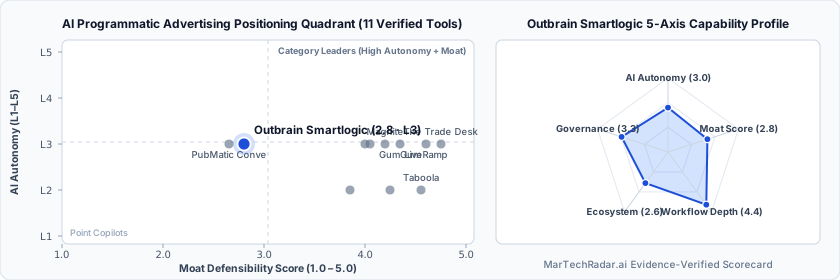
Outbrain Smartlogic in-depth review, pricing & architecture analysis
Editor sign-off: Oct 7, 2026. How profiles are made.
What is Outbrain Smartlogic? Overview & background
Established in 2006 in New York, United States, Outbrain engineered Smartlogic to transition static native recommendation widgets into dynamic, machine-learning-driven content feeds. Designed for enterprise digital publishers and performance-focused media buyers, the platform addresses monetized audience recirculation across the open web. Rather than relying on rigid grids, Smartlogic serves as an algorithmic publisher-side monetization and distribution framework tailored for media monetization leads and direct response marketers.
How Outbrain Smartlogic works: architecture & workflow
At an architectural level, Smartlogic functions at Level 3 autonomy using a predictive real-time optimization engine. Embedded via publisher tag integrations, the system evaluates incoming user sessions, device attributes, and page-level contextual metadata within sub-second latencies. The underlying pipeline applies multi-armed bandit algorithms and predictive click-through models to automatically alter feed compositions—dynamically blending editorial recommendations, native sponsored content, and video units based on real-time reader engagement probabilities.
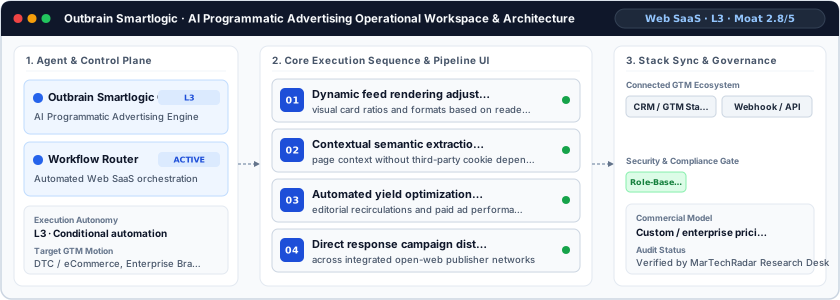
Outbrain Smartlogic limitations, drawbacks & risks
Operational considerations and platform boundaries include:
- Algorithmic Brand Control: Automated card recombination can intermittently prioritize high-CTR arbitrage content over premium editorial adjacencies, requiring publishers to enforce strict manual domain whitelisting and negative keyword blocks.
- Page-Weight Latency: Heavy client-side script payloads and dynamic asset rendering introduce render-blocking execution overhead, which can degrade Core Web Vitals without aggressive asynchronous loading configurations.
- Closed-Ecosystem Signal Blindspots: Behavioral inference models operate strictly across partner publisher networks, preventing cross-channel identity graph reconciliation against walled gardens without external enrichment layers.
Outbrain Smartlogic pricing, plans & cost breakdown
Commercial access is structured around customized enterprise agreements, with pricing available on request through tailored enterprise sales quotes based on organizational scale and seats. For digital publishers, compensation models typically follow performance-based revenue-sharing schedules aligned with delivered impressions and engagement yields. For advertisers utilizing the distribution pipeline, media spending runs through programmatic CPM or CPC auction bidding frameworks without standard public fee schedules.
| Plan / Tier | Verified Price & Billing | Included Scope & Contract Terms |
|---|---|---|
| Enterprise / Custom | Custom quote | Custom-quoted plan; terms come from the vendor's sales team. |
How Outbrain Smartlogic compares vs. competitors & alternatives
Within the contextual advertising ecosystem, Smartlogic diverges structurally from its peers. While AdRoll concentrates on cross-channel retargeting for mid-market e-commerce, and LiveRamp acts primarily as an identity resolution layer, Smartlogic operates directly inside publisher page layouts. GumGum offers deeper computer-vision contextual analysis on individual article pages, but Smartlogic delivers tighter end-of-article feed orchestration for high-volume content publishers seeking algorithmic layout automation.
Direct competitors & market radar
Top algorithmic competitors based on category positioning, capability overlap, and ICP alignment.
Frequently asked questions about Outbrain Smartlogic
Does Outbrain Smartlogic publish pricing or require an enterprise quote?
Outbrain Smartlogic pricing: Custom / enterprise pricing. No free plan is publicly disclosed. Commercial access is structured around customized enterprise agreements, with pricing available on request through tailored enterprise sales quotes based on organizational scale and seats.
What are the top Outbrain Smartlogic alternatives in AI Programmatic Advertising?
Verified AI Programmatic Advertising alternatives include AdRoll (Free plan · $36/mo), LiveRamp (From $20,000/yr), GumGum (Custom / enterprise pricing), Skai (From $114,000/yr · Enterprise plan). Within the contextual advertising ecosystem, Smartlogic diverges structurally from its peers.
What are the main limitations and trade-offs of Outbrain Smartlogic?
Operational considerations and platform boundaries include: Algorithmic Brand Control: Automated card recombination can intermittently prioritize high-CTR arbitrage content over premium editorial adjacencies, requiring publishers to enforce strict manual domain whitelisting and negative keyword blocks. Walk away if you need published self-serve pricing: Outbrain Smartlogic is sold by custom quote.
Verified sources & evidence trail
- Official product domain: https://outbrain.com
- Commercial pricing verification: Verified against official vendor pricing policy (Custom / enterprise pricing)
- First-party governance & documentation links: Trust & Security · Privacy
- Editor sign-off: Oct 7, 2026 (how profiles are made).
