Open Review (2026): eCommerce Chatbot Pricing, Pros & Cons
Bottom line
Open is a Cloud SaaS Platform tool for eCommerce Chatbot (Conversational eCommerce & Support Bots) in Lifecycle & CDP. Pricing: Usage-based pricing. Best suited to B2B Marketing and Growth & Revenue Teams. Editor ratings: AI autonomy L4 (autonomous agent); moat score 2.8/5.0 (Workflow-embedded). Fact-checked by MarTechRadar Research Desk on Oct 26, 2026.
Unified omnichannel AI customer support platform resolving tickets end-to-end across voice, chat, email, WhatsApp, and social on outcome-based pricing.
Is Open worth it in 2026? Buyer fit & when to walk away
Choose Open if (Best Fit)
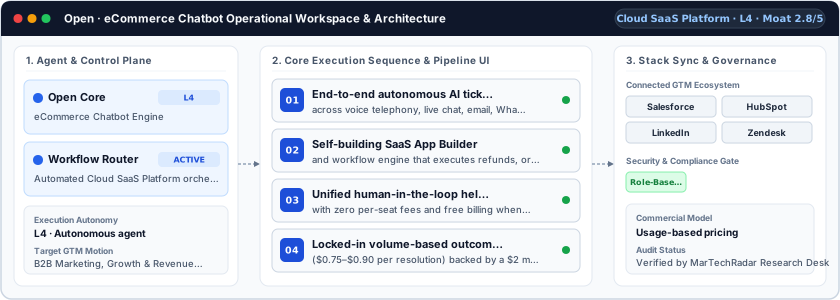
- Target ICP & Stack Fit: You operate as B2B Marketing and Growth & Revenue Teams requiring a Cloud SaaS Platform deployment for eCommerce Chatbot, with verified ecosystem connectivity for Salesforce, HubSpot, LinkedIn, Zendesk.
- L4 Architecture & Defensibility: Open commands a strong conversational CX moat through its self-building omnichannel support architecture, verified 77% autonomous resolution rate, outcome-only pricing ($0.75-$0.90 per resolved ticket with zero seat fees), and $9.1M in Seed funding led by Y Combinator and Shorooq Partners.
- Commercial Model Fit: Your procurement budget aligns with Usage-based pricing.
Walk away from Open if (Deal-Breakers)
- Walk away if you require transparent self-serve monthly billing or your budget ceiling is under $1,000/mo (Open requires sales-gated custom quoting).
- Walk away if your workflow cannot tolerate primary operational trade-off: In practical enterprise deployments, the primary trade-off is that achieving high autonomous resolution rates (such as 77%+) requires deep API integration into internal order management, billing, and ERP systems so the AI agent can complete actions rather than escalating to humans.
- Walk away if functional scope boundary is a deal-breaker for your team: Open is not built for top-of-funnel cold B2B prospect scraping, programmatic display ad bidding, or long-form SEO blog publishing.
Open pricing, free plan & scorecard at a glance
| Pricing | Usage-based pricingVendor pricing page |
|---|---|
| Free plan | No / not disclosed |
| Delivery | Cloud SaaS Platform |
| Audience | B2B Marketing, Growth & Revenue Teams |
| AI autonomy level | L4 · Autonomous agentEditor-verified |
| Moat tier & score | 2.8 / 5.0 · Workflow-embeddedEditor-verified |
| Funding | Seed |
| Total funding | $9.1MBacked by Y Combinator, Shorooq Partners, Pioneer Fund, Propeller Inc., Sadu Capital |
| Founders | Mohammad Algharabat, Shanur Rahman |
| Company size | 51-200 employees |
| Ecosystem integrations | Salesforce, HubSpot, LinkedIn, Zendesk, Intercom, Gorgias |
| Headquarters | San Francisco, California, United States |
| Founded | 2025 |
| Last verified | Oct 26, 2026 |
Open pros & cons: strengths vs. operational limitations
Pros: core strengths & capabilities
- End-to-end autonomous AI ticket resolution: across voice telephony, live chat, email, WhatsApp, SMS, and social channels
- Self-building SaaS App Builder: and workflow engine that executes refunds, order lookups, and account actions directly
- Unified human-in-the-loop helpdesk: with zero per-seat fees and free billing whenever a ticket is handed off to a human agent
- Locked-in volume-based outcome pricing: ($0.75–$0.90 per resolution) backed by a $2 million contractual refund guarantee
Cons: operational limitations & risks
- Primary Operational Trade-Off: In practical enterprise deployments, the primary trade-off is that achieving high autonomous resolution rates (such as 77%+) requires deep API integration into internal order management, billing, and ERP systems so the AI agent can complete actions rather than escalating to humans.
- Functional Scope Boundary: Open is not built for top-of-funnel cold B2B prospect scraping, programmatic display ad bidding, or long-form SEO blog publishing.
- Deployment & Governance Considerations: Additionally, organizations migrating away from entrenched legacy ticketing suites (such as Zendesk or Salesforce Service Cloud) must plan data schema migration, telephony number porting, and clear contractual definitions of a "resolved ticket" prior to go-live.
Open TCO & deal-breaker stress test
Simulate 12-month stepped TCO, hidden cost multipliers, contract lock-in exposure, and stack failure modes using only facts verified by MarTechRadar Research Desk on 2026-10-26 · Capture SHA b86d498b.
Open triggers high-severity friction under your 5-seat / $800/mo constraints. Benchmark the verified subtrack alternatives below before committing.
- Moat Score
- 2.8 / 5.0
- AI Autonomy
- L4
- Free Tier / Trial
- None disclosed
Triggered audit signals & failure modes
- Opaque Enterprise Quoting vs. SMB/Mid-Market BudgetVerified Pricing Ledger
Open does not disclose a public self-serve floor (Usage-based pricing). Buyers with a $800/mo cap face high sales-qualification friction.
- Sales-Gated Contract TermsFact-checked by MarTechRadar Research Desk
$0.75–$0.90 per resolved ticket (volume-based, no setup or seat fees).
- Usage / Credit Burn VolatilityCommercial Model Audit
Open uses credit or usage-metered billing (Usage-based pricing). High-volume automated workflows across 5 seats can trigger mid-cycle overage charges.
- Primary Operational Bottleneck: Primary Operational Trade-OffAudit by MarTechRadar Research Desk
In practical enterprise deployments, the primary trade-off is that achieving high autonomous resolution rates (such as 77%+) requires deep API integration into internal order management, billing, and ERP systems so the AI agent can complete actions rather than escalating to humans.
Test a custom Open budget or stack constraint
Lower 5-seat floor (~$19/mo vs. Custom Quote) · Transparent self-serve entry without mandatory annual lock-in
Lower 5-seat floor (~$60/mo vs. Custom Quote) · Transparent self-serve entry without mandatory annual lock-in
Open integrations, API, security & compliance stack
Open AI moat & eCommerce Chatbot positioning
Open commands a strong conversational CX moat through its self-building omnichannel support architecture, verified 77% autonomous resolution rate, outcome-only pricing ($0.75-$0.90 per resolved ticket with zero seat fees), and $9.1M in Seed funding led by Y Combinator and Shorooq Partners.
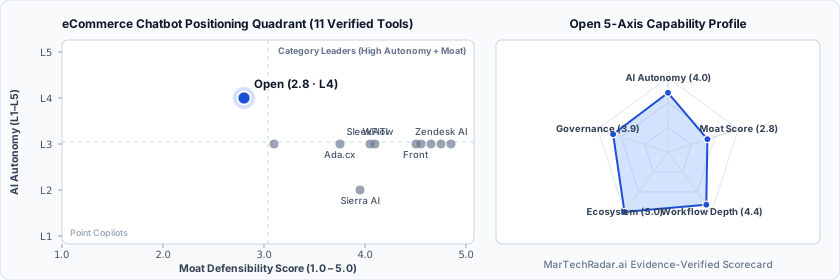
Open in-depth review, pricing & architecture analysis
Audited by MarTechRadar Research Desk (Evidence-Ledger Verified) on Oct 26, 2026.
What is Open? Overview & background
Open (formerly OpenCopilot, operating at open.cx) is a unified omnichannel AI customer support and conversational experience platform built for enterprise CX leaders, e-commerce support operations, and high-volume service teams. Founded by Mohammad Algharabat and Shanur Rahman and headquartered in San Francisco, California (with 2025 corporate incorporation recorded on LinkedIn and Crunchbase following its Y Combinator W24 launch), the company has scaled to 51 to 200 employees and raised $9.1M in Seed funding from Y Combinator, Shorooq Partners, Pioneer Fund, Propeller Inc., and Sadu Capital. Engineered to replace legacy seat-based stacks such as Fin by Intercom, Zendesk AI agents, Salesforce Einstein, and HubSpot Breeze AI, Open resolves up to 77% of customer inquiries autonomously across chat, email, voice, and outbound channels, capturing buyer searches for outcome based ai customer support, open cx pricing, and an intercom fin alternative.
How Open works: architecture & workflow
At the technical core of Open is a self-building conversational AI architecture that combines an omnichannel helpdesk, native cloud telephony, an autonomous workflow engine, and a custom App Builder within a single execution layer. Rather than acting as a shallow FAQ chatbot moored to static articles, Open's AI agents ingest historical ticket logs, knowledge bases, and backend REST/GraphQL APIs to execute multi-step transactional resolutions across voice calls, web chat, email, WhatsApp, SMS, and social DMs. When an inquiry requires complex human judgment, the platform transfers the full conversation context to the built-in human agent workspace without charging per-seat licensing fees.
Open limitations, drawbacks & risks
Operational considerations and platform boundaries include:
- Primary Operational Trade-Off: In practical enterprise deployments, the primary trade-off is that achieving high autonomous resolution rates (such as 77%+) requires deep API integration into internal order management, billing, and ERP systems so the AI agent can complete actions rather than escalating to humans.
- Functional Scope Boundary: Open is not built for top-of-funnel cold B2B prospect scraping, programmatic display ad bidding, or long-form SEO blog publishing.
- Deployment & Governance Considerations: Additionally, organizations migrating away from entrenched legacy ticketing suites (such as Zendesk or Salesforce Service Cloud) must plan data schema migration, telephony number porting, and clear contractual definitions of a "resolved ticket" prior to go-live.
Open pricing, plans & cost breakdown
$0.75–$0.90 per resolved ticket (volume-based, no setup or seat fees). On its official pricing page (open.cx/pricing), Open eliminates per-seat, per-message, and per-channel fees entirely, charging between $0.75 and $0.90 per fully AI-resolved ticket based on monthly volume (locked in writing before launch and backed by a $2 million refund guarantee). Full platform access—including the helpdesk, voice telephony, WhatsApp/SMS, outbound workflows, and the App Builder—is included, human-handled escalations are not billed, and enterprises exceeding 100,000 monthly resolutions receive custom volume quotes.
How Open compares vs. competitors & alternatives
In the conversational customer experience and AI support automation market, Open competes directly with Intercom Fin for Marketing, Ada.cx, and Gorgias (AI Agent), alongside verified subtrack peers such as Siena AI, Alhena AI, Zipchat AI, Replicant, and Yuma AI. Compared to incumbent helpdesks that layer per-resolution AI fees on top of expensive per-agent seat licenses, Open differentiates itself through its pure outcome-only pricing model, native voice-plus-digital omnichannel stack, and self-building App Builder. High-volume e-commerce, fintech, and SaaS support organizations should evaluate Open to consolidate ticketing and autonomous CX.
Frequently asked questions about Open
How does Open usage pricing work in 2026?
Open pricing: Usage-based pricing. No free plan is publicly disclosed. $0.75–$0.90 per resolved ticket (volume-based, no setup or seat fees).
What are the top Open alternatives in eCommerce Chatbot?
Verified eCommerce Chatbot alternatives include Zendesk AI (From $19/mo), Gorgias (AI Agent) (Custom / enterprise pricing), Intercom Fin for Marketing (Usage-based pricing), Alhena AI (Free plan · $60–$999/mo · Enterprise plan). In the conversational customer experience and AI support automation market, Open competes directly with Intercom Fin for Marketing, Ada.cx, and Gorgias (AI Agent), alongside verified subtrack peers such as Siena AI, Alhena AI, Zipchat AI, Replicant, and Yuma AI.
Verified sources & evidence trail
- Official product domain: https://www.open.cx
- Commercial pricing verification: https://www.open.cx/pricing
- Verified corporate entity profiles (
sameAs): LinkedIn Company Profile · Crunchbase Entity Record - Editorial audit sign-off: Audited by MarTechRadar Research Desk (Evidence-Ledger Verified) on Oct 26, 2026.
