Siena AI Review (2026): eCommerce Chatbot Pricing, Limits & Alternatives
Bottom line
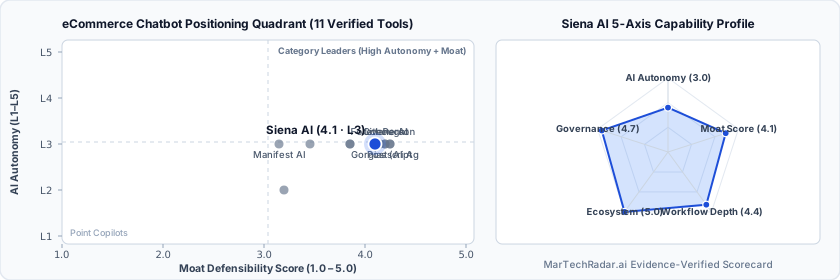
Siena AI is a SaaS Platform tool for eCommerce Chatbot (Conversational eCommerce & Support Bots) in Lifecycle & CDP. Pricing: $0.90/mo · Enterprise plan. Best suited to B2B Marketing & GTM Teams. Editor ratings: AI autonomy L3 (conditional automation); moat score 4.1/5.0 (Proprietary moat). Fact-checked by Sarah Per on Oct 26, 2026.
Empathic autonomous AI agent for commerce brands that resolves omnichannel customer inquiries and executes order actions.
Siena AI buyer fit verdict: when to choose vs. when to walk away
Choose Siena AI if (Best Fit)
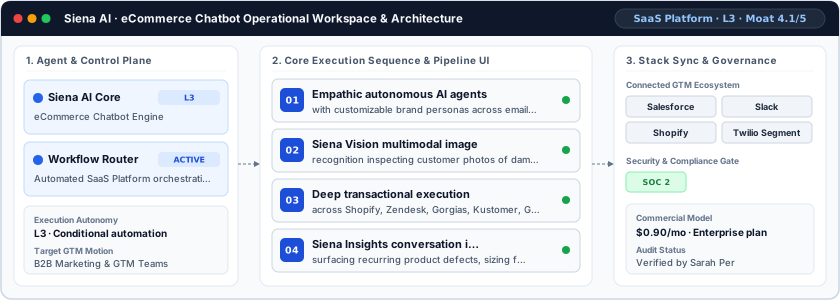
- Target ICP & Stack Fit: You operate as B2B Marketing & GTM Teams requiring a SaaS Platform deployment for eCommerce Chatbot, with verified ecosystem connectivity for Salesforce, Slack, Shopify, Twilio Segment.
- L3 Architecture & Defensibility: Empathic autonomous AI customer experience platform for commerce brands that combines customizable brand personas, multimodal vision understanding, and real-time order/subscription actions.
- Commercial Model Fit: Your procurement budget aligns with $0.90/mo · Enterprise plan.
Walk away from Siena AI if (Deal-Breakers)
- Walk away if your workflow requires uncapped enterprise volume on the $0.90/mo · Enterprise plan entry plan without upgrading tiers.
- Walk away if your workflow cannot tolerate primary operational constraint: Despite its strong enterprise commerce capabilities, Siena AI involves meaningful implementation and governance trade-offs.
- Walk away if integration & scaling friction is a deal-breaker for your team: The platform is engineered for established consumer commerce brands and is not built for low-volume solo dropshippers or B2B technical developer support teams.
Siena AI key facts & scorecard
| Pricing | $0.90/mo · Enterprise planVendor pricing page |
|---|---|
| Free plan | No / not disclosed |
| Delivery | SaaS Platform |
| Audience | B2B Marketing & GTM Teams |
| AI autonomy level | L3 · Conditional automationEditor-verified |
| Moat tier & score | 4.1 / 5.0 · Proprietary moatEditor-verified |
| Funding | Series A |
| Total funding | $28.1MBacked by Sierra Ventures, GapMinder VC, Village Global, Pari Passu Venture Partners, SuperAngel.Fund |
| Founders | Andrei Negrau, Lisa Popovici |
| Company size | 11-50 employees |
| Ecosystem integrations | Salesforce, Slack, Shopify, Twilio Segment, Zendesk, Intercom |
| Compliance & governance | SOC 2 |
| Headquarters | New York, New York, United States |
| Founded | 2023 |
| Last verified |
Siena AI pros & cons: strengths vs. operational limitations
Pros: core strengths & capabilities
- Empathic autonomous AI agents: with customizable brand personas across email, live chat, SMS, WhatsApp, Instagram, and Facebook
- Siena Vision multimodal image: recognition inspecting customer photos of damaged items to trigger instant replacements or refunds
- Deep transactional execution: across Shopify, Zendesk, Gorgias, Kustomer, Gladly, Recharge, and Loop Returns
- Siena Insights conversation intelligence: surfacing recurring product defects, sizing friction, and pre-purchase objections
Cons: operational limitations & risks
- Primary Operational Constraint: Despite its strong enterprise commerce capabilities, Siena AI involves meaningful implementation and governance trade-offs.
- Integration & Scaling Friction: The platform is engineered for established consumer commerce brands and is not built for low-volume solo dropshippers or B2B technical developer support teams.
- Governance & Cost Boundary: Achieving high autonomous resolution fidelity requires structured persona calibration, policy documentation, and integration mapping across 3PL and subscription tools, which introduces onboarding overhead compared to simple plug-and-play FAQ bots. Furthermore, reliance on third-party helpdesk and fulfillment APIs means external webhook latency can impact real-time chat response speeds.
Are you a founder, co-founder, or product/growth lead at Siena AI? Verify your official @siena.cx email to publish a factual architectural response or 2026 roadmap update below these limitations.
Siena AI TCO & deal-breaker stress test
Simulate 12-month stepped TCO, hidden cost multipliers, contract lock-in exposure, and stack failure modes using only facts verified by Sarah Per on · Capture SHA eafb4040.
Siena AI is viable for 5 seats, but requires commercial or technical verification on the flagged items below.
| Plan / Tier | Verified Rate | Scale Fit | Scope & Quota Notes |
|---|---|---|---|
| Entry / Starter | $0.9/mo | 1–2 seats | Verified $0.9/mo published rate on vendor pricing schedule. |
| Enterprise / Custom | Custom quote | 15–50+ seats (Enterprise SLA) | Sales-negotiated annual contract for custom volume, SSO/RBAC governance, and dedicated SLA. |
- Moat Score
- 4.1 / 5.0
- AI Autonomy
- L3
- Free Tier / Trial
- None disclosed
Triggered audit signals & failure modes
- Published Self-Serve Entry FloorVerified Pricing Ledger
Siena AI publishes a transparent entry point ($0.90/mo · Enterprise plan) for initial validation before committing.
- Usage / Credit Burn VolatilityCommercial Model Audit
Siena AI uses credit or usage-metered billing ($0.90/mo · Enterprise plan). High-volume automated workflows across 5 seats can trigger mid-cycle overage charges.
- Primary Operational Bottleneck: Governance & Cost BoundaryAudit by Sarah Per
Achieving high autonomous resolution fidelity requires structured persona calibration, policy documentation, and integration mapping across 3PL and subscription tools, which introduces onboarding overhead compared to simple plug-and-play FAQ bots. Furthermore, reliance on third-party helpdesk and fulfillment APIs means external webhook latency can impact real-time chat response speeds.
Hidden TCO Multipliers & Quota Gates
- Primary Operational Constraint: Despite its strong enterprise commerce capabilities, Siena AI involves meaningful implementation and governance trade-offs.
- Integration & Scaling Friction: The platform is engineered for established consumer commerce brands and is not built for low-volume solo dropshippers or B2B technical developer support teams.
When to Walk Away & Negotiation Levers
- Walk away if your workflow requires uncapped enterprise volume on the $0.90/mo · Enterprise plan entry plan without upgrading tiers.
- Walk away if your workflow cannot tolerate primary operational constraint: Despite its strong enterprise commerce capabilities, Siena AI involves meaningful implementation and governance trade-offs.
- Walk away if integration & scaling friction is a deal-breaker for your team: The platform is engineered for established consumer commerce brands and is not built for low-volume solo dropshippers or B2B technical developer support teams.
- Validate exact quota thresholds (seats, credits, or API calls) included in Siena AI's $0.90/mo · Enterprise plan tier before converting from monthly to annual billing.
- Require a sandbox proof-of-concept testing primary operational constraint against your live CRM/data schema before annual sign-off.
4 hard questions to ask on a Siena AI sales or technical demo
“Between Siena AI's Entry / Starter ($0.9/mo) and Enterprise / Custom (Custom quote) tiers, what exact seat, workspace, or credit ceiling triggers a mandatory upgrade—and are mid-cycle overages billed at the base unit rate or forced onto an annual Enterprise / Custom commitment?”
Contract / Technical Proof to Require: Validate exact quota thresholds (seats, credits, or API calls) included in Siena AI's $0.90/mo · Enterprise plan tier before converting from monthly to annual billing.
“Our technical audit of Siena AI flagged "Primary Operational Constraint" (Despite its strong enterprise commerce capabilities, Siena AI involves meaningful implementation and governance trade-offs.). Can you demonstrate how Siena AI handles this scenario live against Salesforce without manual CSV workarounds or webhook latency?”
Contract / Technical Proof to Require: Walk away if your workflow requires uncapped enterprise volume on the $0.90/mo · Enterprise plan entry plan without upgrading tiers.
“Because Siena AI operates at L3 · Conditional automation (eCommerce Chatbot), how do operators prevent "Integration & Scaling Friction" (The platform is engineered for established consumer commerce brands and is not built for low-volume solo dropshippers or B2B technical developer support teams.) during high-volume campaigns, and what human-in-the-loop approval gates are configurable?”
Contract / Technical Proof to Require: Require a sandbox proof-of-concept testing primary operational constraint against your live CRM/data schema before annual sign-off.
“We see Siena AI documents SOC 2. Can you provide the current audit report, sub-processor list, and written confirmation that customer inputs in Siena AI are never used to train shared foundation models?”
Contract / Technical Proof to Require: Attach a signed DPA with zero model-training rights and 30-day data deletion SLA upon contract termination.
Ask a custom procurement or TCO stress-test question about Siena AI
Generate your 4-role approval packet or request a custom Siena AI sandbox & eCommerce Chatbot quote
Active spec: 5 Seats · ≤ $800/mo ceiling · Any Stack · No Annual Lock-in
Lower 5-seat floor (~$43/mo vs. Usage-Metered)
Lower 5-seat floor (~$49/mo vs. Usage-Metered)
No public buyer quote requests logged in the current window for Siena AI. Be the first to lock a verified procurement specification above.
Siena AI key entities, modules & ecosystem stack
Siena AI moat & subtrack positioning
Empathic autonomous AI customer experience platform for commerce brands that combines customizable brand personas, multimodal vision understanding, and real-time order/subscription actions.
Editorial review
Fact-checked by Sarah Per (Principal Content Systems & Generative Media Editor) on .
Background
Siena AI is an autonomous, empathic customer experience and conversational commerce platform purpose-built for mid-market and enterprise direct-to-consumer (DTC) brands. Founded in 2023 by Andrei Negrau and Lisa Popovici and headquartered in New York, the company operates with 11 to 50 employees and has raised $28.1M through Series A funding backed by Sierra Ventures, GapMinder VC, Village Global, Pari Passu Venture Partners, and SuperAngel.Fund. Trusted by consumer brands such as HexClad, Kitsch, and Grüns, Siena AI enables CX leaders to automate up to 80% of customer interactions across email, live chat, SMS, and social media channels.
How Siena AI works
At the technical core of Siena AI is an orchestration engine that pairs context-aware emotional intelligence with deep back-office transaction execution. Marketers and CX directors can design distinct AI Personas with custom tone-of-voice guardrails, empathy levels, and channel-specific formatting across Instagram DMs, Facebook comments, WhatsApp, SMS, email, and web chat. Using multimodal Siena Vision capabilities, the agent can inspect customer-uploaded photos of damaged items or wrong shipments and immediately trigger replacement orders, subscription skips, address edits, or return labels across Shopify, Zendesk, Gorgias, Kustomer, Gladly, Salesforce, Recharge, Loop Returns, and Slack. Its Siena Insights module also mines conversation transcripts to surface product defect trends and pre-purchase objections.
Limitations
Operational limitations and deployment trade-offs include:
- Primary Operational Constraint: Despite its strong enterprise commerce capabilities, Siena AI involves meaningful implementation and governance trade-offs.
- Integration & Scaling Friction: The platform is engineered for established consumer commerce brands and is not built for low-volume solo dropshippers or B2B technical developer support teams.
- Governance & Cost Boundary: Achieving high autonomous resolution fidelity requires structured persona calibration, policy documentation, and integration mapping across 3PL and subscription tools, which introduces onboarding overhead compared to simple plug-and-play FAQ bots. Furthermore, reliance on third-party helpdesk and fulfillment APIs means external webhook latency can impact real-time chat response speeds.
Siena AI pricing
Siena AI uses an outcome-aligned, usage-based pricing model tailored to merchant ticket volume and automation depth. Published pricing starts at $0.90 per autonomous resolution with monthly platform packages starting around $750 per month, scaling to custom Enterprise annual contracts that include SOC 2 Type II compliance, dedicated CX automation engineers, custom SLA guarantees, and multi-brand workspace management.
How Siena AI compares
In the e-commerce AI support arena, Siena AI competes directly with Yuma AI, Gorgias Automate, Alhena AI, and Fin by Intercom. Compared to Gorgias Automate or Yuma AI, Siena AI differentiates through its multimodal visual damage inspection (Siena Vision), deep social media comment/DM moderation, and highly tunable brand persona controls. High-growth DTC and omnichannel retail brands handling complex post-purchase workflows should evaluate Siena AI to scale empathetic support without expanding human agent headcount within the eCommerce Chatbot segment.
Frequently asked questions about Siena AI
How much does Siena AI cost and what pricing tiers are available?
Published pricing summary for Siena AI: $0.90/mo · Enterprise plan. A permanent free plan is not disclosed for Siena AI. Verified tier schedule: Entry / Starter ($0.9/mo for 1–2 seats); Enterprise / Custom (Custom quote for 15–50+ seats (Enterprise SLA)). Siena AI uses an outcome-aligned, usage-based pricing model tailored to merchant ticket volume and automation depth.
How does Siena AI work and how autonomous is its AI architecture?
Empathic autonomous AI agent for commerce brands that resolves omnichannel customer inquiries and executes order actions. Within eCommerce Chatbot (Conversational eCommerce & Support Bots), MarTechRadar rates its execution architecture at L3 · Conditional automation with a verified Moat Score of 4.1 / 5.0 (Proprietary moat). Empathic autonomous AI customer experience platform for commerce brands that combines customizable brand personas, multimodal vision understanding, and real-time order/subscription actions. Corporate profile: Founded by Andrei Negrau, Lisa Popovici, operating at 11-50 employees scale.
What are the main limitations of Siena AI and when should buyers walk away?
Based on our editorial technical audit, key operational considerations and boundaries for Siena AI include: (1) Primary Operational Constraint: Despite its strong enterprise commerce capabilities, Siena AI involves meaningful implementation and governance trade-offs. (2) Integration & Scaling Friction: The platform is engineered for established consumer commerce brands and is not built for low-volume solo dropshippers or B2B technical developer support teams. (3) Governance & Cost Boundary: Achieving high autonomous resolution fidelity requires structured persona calibration, policy documentation, and integration mapping across 3PL and subscription tools, which introduces onboarding overhead compared to simple plug-and-play FAQ bots. Furthermore, reliance on third-party helpdesk and fulfillment APIs means external webhook latency can impact real-time chat response speeds. Primary procurement walk-away rule: Walk away if your workflow requires uncapped enterprise volume on the $0.90/mo · Enterprise plan entry plan without upgrading tiers.
What integrations, compliance certifications, and contract terms apply to Siena AI?
Verified ecosystem and stack integrations include Salesforce, Slack, Shopify, Twilio Segment, Zendesk, Intercom, Gorgias. Documented security and governance attestations include SOC 2. Key TCO multiplier to watch: Primary Operational Constraint (Despite its strong enterprise commerce capabilities, Siena AI involves meaningful implementation and governance trade-offs.) Before signing a contract, procurement teams should validate exact quota thresholds (seats, credits, or API calls) included in Siena AI's $0.90/mo · Enterprise plan tier before converting from monthly to annual billing.
What are the best Siena AI alternatives and head-to-head competitors in 2026?
Top fact-checked alternatives to Siena AI in eCommerce Chatbot (Conversational eCommerce & Support Bots) include Yuma AI (From $0/yr · Enterprise plan), Alhena AI (Free plan · From $0/mo · Enterprise plan), Gladly (Custom / enterprise pricing), Kustomer (Custom / enterprise pricing). In the e-commerce AI support arena, Siena AI competes directly with Yuma AI, Gorgias Automate, Alhena AI, and Fin by Intercom.
Siena AI profile completeness & verified buyer trust checklist
Our analysts verified the first 5 baseline facts below from public captures. Founders and growth leads at Siena AI can reach 100% Gold Verified Transparency (and unlock priority buyer sandbox inquiries) by supplying workflow screenshots, customer ROI case studies, and direct support SLA contacts:
- 1. Corporate Identity & HQ: Founded 2023 · New York, New York, United States · Founders: Andrei Negrau, Lisa Popovici
- 2. Team Scale & Backing: 11-50 employees · $28.1M
- 3. Published Pricing Floor: $0.90/mo · Enterprise plan (Sentinel S7 verified)
- 4. Free Trial & Onboarding: Demo / Sales onboarding
- 5. Stack & Compliance Signals: Salesforce, Slack, Shopify, Twilio Segment · SOC 2
- 6. Product Workflow Screenshots & Customer Case Studies: Upload 3 UI screenshots & verified ROI case study (+15% completeness) →
- 7. Direct Support SLA, Hotline & Reader Perk Code: Add official support email/phone, SLA & exclusive buyer trial perk (+10% completeness) →
Verified sources & evidence trail
- Official product domain: https://siena.cx
- Commercial pricing verification: https://www.siena.cx/pricing
- Verified corporate entity profiles (
sameAs): LinkedIn Company Profile · Crunchbase Entity Record - Editorial audit sign-off: Fact-checked by Sarah Per on under the MarTechRadar Evidence-Ledger Protocol.