Gladly Review (2026): eCommerce Chatbot Pricing, Pros & Cons
Bottom line
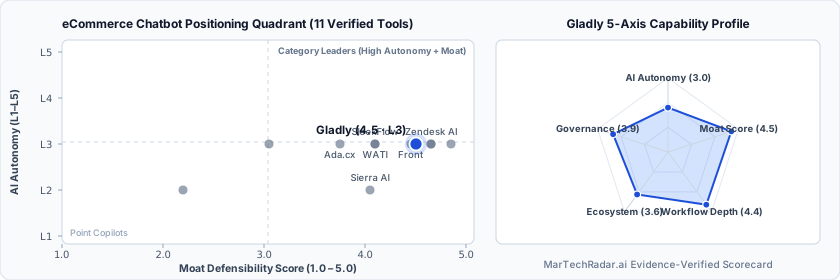
Gladly is a Web SaaS tool for eCommerce Chatbot (Conversational eCommerce & Support Bots) in Lifecycle & CDP. Pricing: Custom / enterprise pricing. Best suited to DTC / eCommerce and Enterprise Brands. Editor ratings: AI autonomy L3 (conditional automation); moat score 4.5/5.0 (Proprietary moat (category leader)). Fact-checked by MarTechRadar Research Desk on Oct 15, 2026.
Agentic commerce and lifecycle communication platform delivering persistent, customer-centric conversation history and automated omnichannel journey.
Is Gladly worth it in 2026? Buyer fit & when to walk away
Choose Gladly if (Best Fit)
- Target ICP & Stack Fit: You operate as DTC / eCommerce and Enterprise Brands requiring a Web SaaS deployment for eCommerce Chatbot, with verified ecosystem connectivity for Shopify.
- L3 Architecture & Defensibility: Persistent single-thread customer architecture unified across voice, digital messaging, and commerce endpoints, combined with domain-specific agentic commerce reasoning engines.
- Commercial Model Fit: Your procurement budget aligns with Custom / enterprise pricing.
Walk away from Gladly if (Deal-Breakers)
- Walk away if you need published self-serve pricing: Gladly is sold by custom quote.
- Walk away if your workflow cannot tolerate ecosystem dependency: Requires tightly mapped product catalog schemas and clean order data; fragmented back-office ERP configurations degrade automated agent accuracy and product lookup speed.
- Walk away if attribution model latency is a deal-breaker for your team: Multichannel interaction events face reconciliation delays when matching anonymous web sessions to authenticated subscriber profiles across disparate lifecycle stages.
Gladly pricing, free plan & scorecard at a glance
| Pricing | Custom / enterprise pricing |
|---|---|
| Free plan | No / not disclosed |
| Delivery | Web SaaS |
| Audience | DTC / eCommerce, Enterprise Brands |
| AI autonomy level | L3 · Conditional automationEditor-verified |
| Moat tier & score | 4.5 / 5.0 · Proprietary moat (category leader)Editor-verified |
| Funding | Series C+ |
| Total funding | $208M |
| Founders | Dirk Kessler, Joseph Ansanelli, Michael Wolfe |
| Company size | 201-500 employees |
| Ecosystem integrations | Shopify |
| Governance & docs | Trust & Security ↗ · API & Docs ↗ · Terms ↗ · Privacy ↗ |
| Headquarters | San Francisco, California |
| Founded | 2014 |
| Last verified | Oct 15, 2026 |
Gladly pros & cons: strengths vs. operational limitations
Pros: core strengths & capabilities
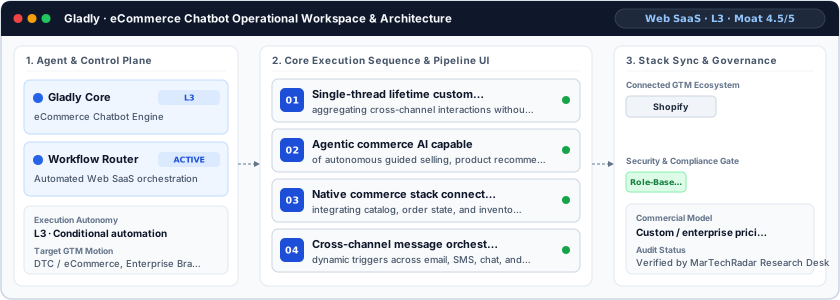
- Single-thread lifetime customer history: aggregating cross-channel interactions without fragmented ticket IDs
- Agentic commerce AI capable: of autonomous guided selling, product recommendations, and post-purchase resolution
- Native commerce stack connectors: integrating catalog, order state, and inventory telemetry in real time
- Cross-channel message orchestration coordinating: dynamic triggers across email, SMS, chat, and voice
Cons: operational limitations & risks
- Ecosystem Dependency: Requires tightly mapped product catalog schemas and clean order data; fragmented back-office ERP configurations degrade automated agent accuracy and product lookup speed.
- Attribution Model Latency: Multichannel interaction events face reconciliation delays when matching anonymous web sessions to authenticated subscriber profiles across disparate lifecycle stages.
- Context Window Boundary Overhead: Extremely long lifetime customer timelines demand aggressive context summarization, occasionally dropping granular past purchase nuances during automated agent prompt construction.
Gladly TCO & deal-breaker stress test
Simulate 12-month stepped TCO, hidden cost multipliers, contract lock-in exposure, and stack failure modes using only facts verified by MarTechRadar Research Desk on 2026-10-15.
Gladly triggers high-severity friction under your 5-seat / $800/mo constraints. Benchmark the verified subtrack alternatives below before committing.
- Moat Score
- 4.5 / 5.0
- AI Autonomy
- L3
- Free Tier / Trial
- None disclosed
Triggered audit signals & failure modes
- Opaque Enterprise Quoting vs. SMB/Mid-Market BudgetVerified Pricing Ledger
Gladly does not disclose a public self-serve floor (Custom / enterprise pricing). Buyers with a $800/mo cap face high sales-qualification friction.
- Sales-Gated Contract TermsFact-checked by MarTechRadar Research Desk
Commercial procurement operates entirely through custom enterprise pricing available on request via sales engagements.
- Primary Operational Bottleneck: Ecosystem DependencyAudit by MarTechRadar Research Desk
Requires tightly mapped product catalog schemas and clean order data; fragmented back-office ERP configurations degrade automated agent accuracy and product lookup speed.
Test a custom Gladly budget or stack constraint
Lower 5-seat floor (~$750/mo vs. Custom Quote) · Transparent self-serve entry without mandatory annual lock-in
Lower 5-seat floor (~$750/mo vs. Custom Quote) · Transparent self-serve entry without mandatory annual lock-in
Gladly integrations, API, security & compliance stack
Gladly AI moat & eCommerce Chatbot positioning
Persistent single-thread customer architecture unified across voice, digital messaging, and commerce endpoints, combined with domain-specific agentic commerce reasoning engines.
Gladly in-depth review, pricing & architecture analysis
Editor sign-off: Oct 15, 2026. How profiles are made.
What is Gladly? Overview & background
Centering customer lifecycle architecture on a lifelong communication thread rather than transient support tickets, Gladly positions itself as an agentic commerce and lifecycle interaction platform. Headquartered in San Francisco, California and founded in 2014, the company has secured $208M in venture funding to rebuild retention workflows for high-growth consumer brands. The platform targets VP of Customer Experience and retention marketing leaders seeking to bridge automated conversational messaging directly into transactional journey touchpoints.
How Gladly works: architecture & workflow
Technically, Gladly decouples conversational data from transactional silos by ingesting behavioral events, catalog metadata, and communication history into a consolidated customer graph. Driven by conditional machine learning routines, the platform employs contextual language models to interpret shopper intent, retrieve dynamic order details via native e-commerce APIs like Shopify, and determine next-best actions. These agentic models autonomously draft contextual email replies, resolve inbound transactional inquiries, and route anomalous edge cases through human-in-the-loop escalation rules.
Gladly limitations, drawbacks & risks
Operational considerations and platform boundaries include:
- Ecosystem Dependency: Requires tightly mapped product catalog schemas and clean order data; fragmented back-office ERP configurations degrade automated agent accuracy and product lookup speed.
- Attribution Model Latency: Multichannel interaction events face reconciliation delays when matching anonymous web sessions to authenticated subscriber profiles across disparate lifecycle stages.
- Context Window Boundary Overhead: Extremely long lifetime customer timelines demand aggressive context summarization, occasionally dropping granular past purchase nuances during automated agent prompt construction.
Gladly pricing, plans & cost breakdown
Commercial procurement operates entirely through custom enterprise pricing available on request via sales engagements. Contracts are tailored around organizational seat tiers, expected customer conversation volume, and platform implementation scope without public fixed monthly fees.
| Plan / Tier | Verified Price & Billing | Included Scope & Contract Terms |
|---|---|---|
| Enterprise / Custom | Custom quote | Custom-quoted plan; terms come from the vendor's sales team. |
How Gladly compares vs. competitors & alternatives
Compared to direct category competitors like Klaviyo AI and Omnisend, Gladly functions as an alternative focused on specialized workflow execution. Within modern retention stacks, Gladly diverges sharply from website generation tools like 10Web AI and experimentation engines like AB Tasty by focusing entirely on bidirectional conversational lifecycle engagement. Unlike autonomous marketing execution agents such as Ability.ai that concentrate on automated ad orchestration, Gladly excels in persistent post-click and post-purchase customer interactions. It represents an ideal architecture for mid-market to enterprise direct-to-consumer merchants operating high-consideration catalogs that require unified conversational continuity.
Direct competitors & market radar
Top algorithmic competitors based on category positioning, capability overlap, and ICP alignment.
Frequently asked questions about Gladly
Does Gladly publish pricing or require an enterprise quote?
Gladly pricing: Custom / enterprise pricing. No free plan is publicly disclosed. Commercial procurement operates entirely through custom enterprise pricing available on request via sales engagements.
What are the top Gladly alternatives in eCommerce Chatbot?
Verified eCommerce Chatbot alternatives include Omnisend (Custom / enterprise pricing), Kustomer (Custom / enterprise pricing), Help Scout (Custom / enterprise pricing), Siena AI (From $750/mo · Enterprise plan). Compared to direct category competitors like Klaviyo AI and Omnisend, Gladly functions as an alternative focused on specialized workflow execution.
What are the main limitations and trade-offs of Gladly?
Operational considerations and platform boundaries include: Ecosystem Dependency: Requires tightly mapped product catalog schemas and clean order data; fragmented back-office ERP configurations degrade automated agent accuracy and product lookup speed. Walk away if you need published self-serve pricing: Gladly is sold by custom quote.
Verified sources & evidence trail
- Official product domain: https://gladly.com
- Commercial pricing verification: Verified against official vendor pricing policy (Custom / enterprise pricing)
- Verified corporate entity profiles (
sameAs): LinkedIn Company Profile · Crunchbase Entity Record - First-party governance & documentation links: Trust & Security · API & Docs · Terms · Privacy
- Editor sign-off: Oct 15, 2026 (how profiles are made).
