Tidio Lyro Review (2026): eCommerce Chatbot Pricing, Pros & Cons
Bottom line
Tidio Lyro is a Web SaaS tool for eCommerce Chatbot (Conversational eCommerce & Support Bots) in Lifecycle & CDP. Pricing: From $16.67/mo. Best suited to DTC / eCommerce and Creators / Solo. Editor ratings: AI autonomy L2 (workflow copilot); moat score 2.2/5.0 (Workflow-embedded). Fact-checked by MarTechRadar Research Desk on Oct 15, 2026.
Autonomous conversational AI agent for eCommerce support that resolves customer inquiries, handles order tracking, and deflects tickets directly within.
Is Tidio Lyro worth it in 2026? Buyer fit & when to walk away
Choose Tidio Lyro if (Best Fit)
- Target ICP & Stack Fit: You operate as DTC / eCommerce and Creators / Solo requiring a Web SaaS deployment for eCommerce Chatbot, with verified ecosystem connectivity for Salesforce, Slack, Zendesk, Zapier.
- L2 Architecture & Defensibility: Deep Shopify ecosystem distribution paired with out-of-the-box knowledge base ingestion, enabling small-to-midsize digital retailers to deploy grounded conversational agents without complex prompt engineering.
- Commercial Model Fit: Your procurement budget aligns with From $16.67/mo.
Walk away from Tidio Lyro if (Deal-Breakers)
- Walk away if your workflow cannot tolerate knowledge boundary drift: Static scraping of storefront policy updates can introduce stale responses if catalog schemas or fulfillment rules change without prompt manual re-indexing.
- Walk away if multi-system API latency is a deal-breaker for your team: Dynamic transactional lookups across complex external enterprise CRMs can trigger response latency bottlenecks during concurrent peak traffic surges.
Tidio Lyro pricing, free plan & scorecard at a glance
| Pricing | From $16.67/moVendor pricing page |
|---|---|
| Free plan | No / not disclosed |
| Delivery | Web SaaS |
| Audience | DTC / eCommerce, Creators / Solo |
| AI autonomy level | L2 · Workflow copilotEditor-verified |
| Moat tier & score | 2.2 / 5.0 · Workflow-embeddedEditor-verified |
| Funding | Undisclosed |
| Ecosystem integrations | Salesforce, Slack, Zendesk, Zapier |
| Compliance & governance | SOC 2, GDPR, CCPA |
| Governance & docs | Trust & Security ↗ · System Status ↗ · API & Docs ↗ · Terms ↗ · Privacy ↗ |
| Headquarters | Poland |
| Founded | 2013 |
| Last verified | Oct 15, 2026 |
Tidio Lyro pros & cons: strengths vs. operational limitations
Pros: core strengths & capabilities
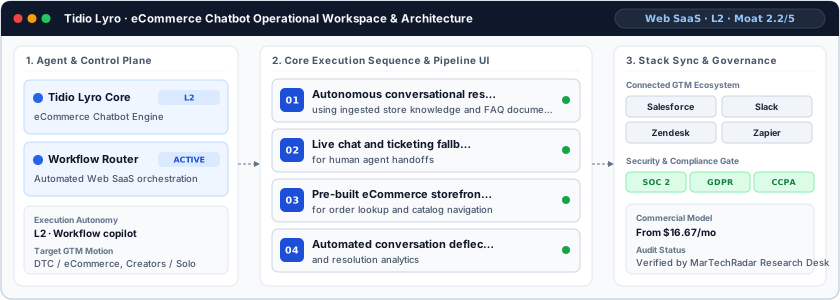
- Autonomous conversational resolution: using ingested store knowledge and FAQ documentation
- Live chat and ticketing fallback routing: for human agent handoffs
- Pre-built eCommerce storefront connectors: for order lookup and catalog navigation
- Automated conversation deflection tracking and resolution analytics
Cons: operational limitations & risks
- Knowledge boundary drift: Static scraping of storefront policy updates can introduce stale responses if catalog schemas or fulfillment rules change without prompt manual re-indexing.
- Multi-system API latency: Dynamic transactional lookups across complex external enterprise CRMs can trigger response latency bottlenecks during concurrent peak traffic surges.
- Edge-case conversational failure: Unstructured customer inquiries spanning multi-intent edge cases frequently trigger early escalation fallbacks, decreasing automated deflection yields.
Tidio Lyro TCO & deal-breaker stress test
Simulate 12-month stepped TCO, hidden cost multipliers, contract lock-in exposure, and stack failure modes using only facts verified by MarTechRadar Research Desk on 2026-10-15 · Capture SHA 49189320.
Tidio Lyro aligns with your 5-seat / $800/mo profile. Review the walk-away triggers and contract levers below before deployment.
- Moat Score
- 2.2 / 5.0
- AI Autonomy
- L2
- Free Tier / Trial
- None disclosed
Triggered audit signals & failure modes
- Published Self-Serve Entry FloorVerified Pricing Ledger
Tidio Lyro publishes a transparent entry point (From $16.67/mo) for initial validation before committing.
- Primary Operational Bottleneck: Knowledge boundary driftAudit by MarTechRadar Research Desk
Static scraping of storefront policy updates can introduce stale responses if catalog schemas or fulfillment rules change without prompt manual re-indexing.
Test a custom Tidio Lyro budget or stack constraint
Fits within $800/mo budget (From $49/mo)
Fits within $800/mo budget (From $19/mo)
Tidio Lyro integrations, API, security & compliance stack
Tidio Lyro AI moat & eCommerce Chatbot positioning
Deep Shopify ecosystem distribution paired with out-of-the-box knowledge base ingestion, enabling small-to-midsize digital retailers to deploy grounded conversational agents without complex prompt engineering.
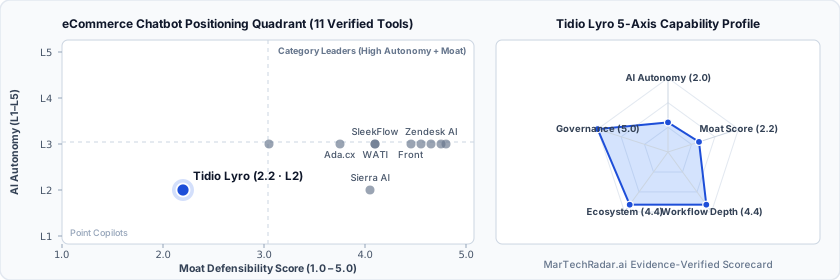
Tidio Lyro in-depth review, pricing & architecture analysis
Editor sign-off: Oct 15, 2026. How profiles are made.
What is Tidio Lyro? Overview & background
ECommerce support teams frequently struggle with repetitive inbound queries that drain human representative bandwidth and stall customer checkout momentum. Headquartered in Poland, Tidio Lyro operates as an autonomous conversational agent engineered to deflect routine support tickets and accelerate digital storefront conversions. Designed primarily for direct-to-consumer digital commerce brands and customer operations managers, the platform deploys conversational automation across web chat and storefront channels. It automates repetitive operational interactions, including order tracking and policy inquiries, without requiring teams to write manual decision trees.
How Tidio Lyro works: architecture & workflow
At its technical core, the platform operates a retrieval-augmented generation engine that indexes structured store data, knowledge base documents, and FAQs. When an inbound customer session initiates, the system parses semantic intent, checks contextual boundary parameters, and retrieves verified source snippets to construct answers. The system functions at an L2 autonomy profile, independently executing full multi-turn conversations while monitoring confidence thresholds. If query ambiguity exceeds programmed tolerance levels or triggers sentiment flags, the pipeline drops execution to deterministic routing queues for human handoff, alongside native workflow integrations for Slack and Zapier under verified SOC 2 Type II, GDPR, and CCPA governance controls.
Tidio Lyro limitations, drawbacks & risks
Operational considerations and platform boundaries include:
- Knowledge boundary drift: Static scraping of storefront policy updates can introduce stale responses if catalog schemas or fulfillment rules change without prompt manual re-indexing.
- Multi-system API latency: Dynamic transactional lookups across complex external enterprise CRMs can trigger response latency bottlenecks during concurrent peak traffic surges.
- Edge-case conversational failure: Unstructured customer inquiries spanning multi-intent edge cases frequently trigger early escalation fallbacks, decreasing automated deflection yields.
Tidio Lyro pricing, plans & cost breakdown
Commercial access is packaged via tiered subscriptions that scale based on automated conversation consumption and agent seat counts, with entry tiers starting from $16.67/month. Upper tiers scale operational quotas for billable conversation volumes and unlock enterprise help-desk integrations with external platforms such as Zendesk and Salesforce.
How Tidio Lyro compares vs. competitors & alternatives
Within the support automation sector, Tidio Lyro competes with enterprise-focused platforms such as Ada.cx and Forethought, as well as digital commerce native entrants like Manifest AI within the eCommerce Chatbot segment. While Ada.cx and Forethought provide complex enterprise orchestration across distributed CRM stacks, they introduce high setup overhead. Manifest AI emphasizes direct product discovery, whereas Tidio Lyro focuses on turnkey ticket deflection for mid-market merchants seeking quick time-to-value.
Direct competitors & market radar
Top algorithmic competitors based on category positioning, capability overlap, and ICP alignment.
Frequently asked questions about Tidio Lyro
How much does Tidio Lyro cost in 2026?
Tidio Lyro pricing: From $16.67/mo. No free plan is publicly disclosed. Commercial access is packaged via tiered subscriptions that scale based on automated conversation consumption and agent seat counts, with entry tiers starting from $16.67/month.
What are the top Tidio Lyro alternatives in eCommerce Chatbot?
Verified eCommerce Chatbot alternatives include Athena AI (Custom / enterprise pricing), Manifest AI (Custom / enterprise pricing), Postscript (From $49/mo), LivePerson (Custom / enterprise pricing). Within the support automation sector, Tidio Lyro competes with enterprise-focused platforms such as Ada.cx and Forethought, as well as digital commerce native entrants like Manifest AI within the eCommerce Chatbot segment.
What are the main limitations and trade-offs of Tidio Lyro?
Operational considerations and platform boundaries include: Knowledge boundary drift: Static scraping of storefront policy updates can introduce stale responses if catalog schemas or fulfillment rules change without prompt manual re-indexing. Walk away if your workflow cannot tolerate knowledge boundary drift: Static scraping of storefront policy updates can introduce stale responses if catalog schemas or fulfillment rules change without prompt manual re-indexing.
Verified sources & evidence trail
- Official product domain: https://tidio.com
- Commercial pricing verification: https://www.tidio.com/pricing/
- First-party governance & documentation links: Trust & Security · System Status · API & Docs · Terms · Privacy
- Editor sign-off: Oct 15, 2026 (how profiles are made).
