Zendesk AI Review (2026): eCommerce Chatbot Pricing, Pros & Cons
Bottom line
Zendesk AI is a Web SaaS tool for eCommerce Chatbot (Conversational eCommerce & Support Bots) in Lifecycle & CDP. Pricing: From $19/mo. Best suited to B2B SaaS, DTC / eCommerce and Enterprise Brands. Editor ratings: AI autonomy L3 (conditional automation); moat score 4.7/5.0 (Proprietary moat (category leader)). Fact-checked by MarTechRadar Research Desk on Oct 14, 2026.
Enterprise customer experience and lifecycle journey platform integrating contextual AI agents, intent classification, and automated email ticketing.
Is Zendesk AI worth it in 2026? Buyer fit & when to walk away
Choose Zendesk AI if (Best Fit)
- Target ICP & Stack Fit: You operate as B2B SaaS, DTC / eCommerce and Enterprise Brands requiring a Web SaaS deployment for eCommerce Chatbot, with verified ecosystem connectivity for Salesforce, Intercom.
- L3 Architecture & Defensibility: Deep institutional distribution, proprietary ticket interaction dataset spanning billions of conversations, and deep ecosystem integrations inherited from its core ticketing infrastructure.
- Commercial Model Fit: Your procurement budget aligns with From $19/mo.
Walk away from Zendesk AI if (Deal-Breakers)
- Walk away if your documentation and macro repositories are fragmented or infrequently updated, leading to knowledge base synchronization drift and degraded agent accuracy.
- Walk away if your workflows depend on real-time triggers over complex custom CRM relational data models that suffer from ingestion latency.
- Walk away if your service workflows involve multi-turn interactions across shifting billing states that trigger premature fallback to tier-1 queues.
Zendesk AI pricing, free plan & scorecard at a glance
| Pricing | From $19/moVendor pricing page |
|---|---|
| Free plan | No / not disclosed |
| Delivery | Web SaaS |
| Audience | B2B SaaS, DTC / eCommerce, Enterprise Brands |
| AI autonomy level | L3 · Conditional automationEditor-verified |
| Moat tier & score | 4.7 / 5.0 · Proprietary moat (category leader)Editor-verified |
| Funding | AcquiredAcquired by Hellman & Friedman |
| Total funding | $85.5M |
| Founders | Alexander Aghassipour, Mikkel Asger Svane, Morten Primdahl |
| Company size | 5001-10000 employees |
| Ecosystem integrations | Salesforce, Intercom |
| Governance & docs | Trust & Security ↗ · System Status ↗ · API & Docs ↗ · Terms ↗ · Privacy ↗ |
| Headquarters | San Francisco, California, United States |
| Founded | 2007 |
| Last verified | Oct 14, 2026 |
Zendesk AI pros & cons: strengths vs. operational limitations
Pros: core strengths & capabilities
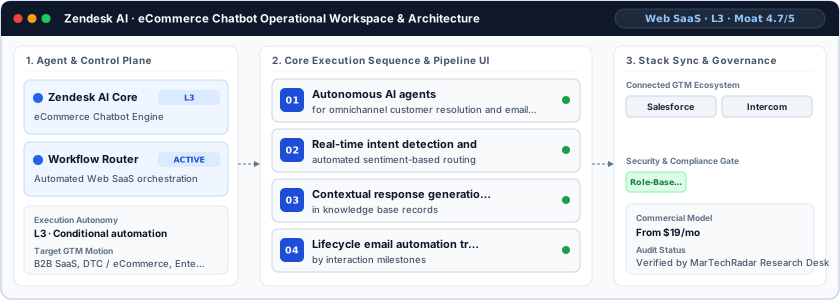
- Autonomous AI agents: for omnichannel customer resolution and email dispatch
- Real-time intent detection and automated sentiment-based routing
- Contextual response generation grounded: in knowledge base records
- Lifecycle email automation triggers driven: by interaction milestones
Cons: operational limitations & risks
- Knowledge Base Synchronization Drift: The autonomous agent exhibits degraded accuracy when underlying help documents or macro repositories fall out of date, requiring continuous schema validation and content pruning.
- Complex Custom Object Ingestion Latency: Processing non-standard relational data models across third-party CRMs can introduce latency into ticket enrichment, creating minor lag in real-time journey triggers.
- Multi-turn Escalation Edge Cases: Highly nuanced customer inquiries that transition across disparate billing or account recovery states occasionally encounter premature fallback to human tier-1 queues.
Zendesk AI TCO & deal-breaker stress test
Simulate 12-month stepped TCO, hidden cost multipliers, contract lock-in exposure, and stack failure modes using only facts verified by MarTechRadar Research Desk on 2026-10-14 · Capture SHA 38529edc.
Zendesk AI aligns with your 5-seat / $800/mo profile. Review the walk-away triggers and contract levers below before deployment.
- Moat Score
- 4.7 / 5.0
- AI Autonomy
- L3
- Free Tier / Trial
- None disclosed
Triggered audit signals & failure modes
- Published Self-Serve Entry FloorVerified Pricing Ledger
Zendesk AI publishes a transparent entry point (From $19/mo) for initial validation before committing.
- Primary Operational Bottleneck: Multi-turn Escalation Edge CasesAudit by MarTechRadar Research Desk
Highly nuanced customer inquiries that transition across disparate billing or account recovery states occasionally encounter premature fallback to human tier-1 queues.
Test a custom Zendesk AI budget or stack constraint
Fits within $800/mo budget (Free plan · $60–$999/mo · Enterprise plan)
Lower 5-seat floor (~$17/mo vs. From $19 / mo)
Zendesk AI integrations, API, security & compliance stack
Zendesk AI AI moat & eCommerce Chatbot positioning
Deep institutional distribution, proprietary ticket interaction dataset spanning billions of conversations, and deep ecosystem integrations inherited from its core ticketing infrastructure.
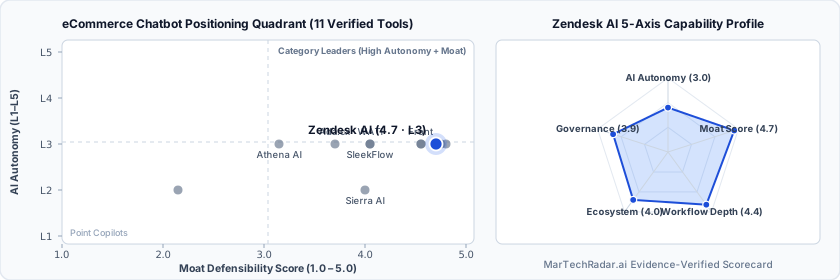
Zendesk AI in-depth review, pricing & architecture analysis
Editor sign-off: Oct 14, 2026. How profiles are made.
What is Zendesk AI? Overview & background
Established in 2007 in San Francisco, California, United States, Zendesk raised $85.5M in venture capital prior to its private equity acquisition by Hellman & Friedman. While historically recognized as a support ticketing system, the vendor deployed Zendesk AI to target customer experience leads and lifecycle retention marketers who manage high-volume customer communications across transactional and relationship channels. The platform coordinates inbound requests, contextual resolutions, and outbound lifecycle touches within an integrated administrative workspace.
How Zendesk AI works: architecture & workflow
At its technical core, Zendesk AI operates as an L3 autonomous interaction engine. The ingestion layer processes structured behavioral events, transactional webhooks, and raw inbound email payloads via REST pipelines. An intent classification engine analyzes customer sentiment and conversational history against domain-specific embeddings, categorizing queries without manual tagging. Generative contextual agents draft replies and trigger outbound lifecycle follow-ups by grounding responses in enterprise knowledge bases, reducing human triage to capable edge-case approvals, alongside native workflow integrations for Salesforce and Intercom.
Zendesk AI limitations, drawbacks & risks
Operational considerations and platform boundaries include:
- Knowledge Base Synchronization Drift: The autonomous agent exhibits degraded accuracy when underlying help documents or macro repositories fall out of date, requiring continuous schema validation and content pruning.
- Complex Custom Object Ingestion Latency: Processing non-standard relational data models across third-party CRMs can introduce latency into ticket enrichment, creating minor lag in real-time journey triggers.
- Multi-turn Escalation Edge Cases: Highly nuanced customer inquiries that transition across disparate billing or account recovery states occasionally encounter premature fallback to human tier-1 queues.
Zendesk AI pricing, plans & cost breakdown
Commercial access for Zendesk AI relies on per-agent seat tiers alongside volume-based conversational add-ons. Core ticketing entry points start from $19 per agent per month when billed annually on the basic support tier, with higher plans scaling to $55 per agent per month to unlock unified channels and advanced AI agent capabilities.
How Zendesk AI compares vs. competitors & alternatives
Within automated customer communication ecosystems, Zendesk AI competes against alternatives like 10Web AI, AB Tasty, and Ability.ai within the Email Marketing segment. Whereas 10Web AI centers on generative site builds and AB Tasty optimizes user journeys via client-side experimentation, Zendesk AI relies on its native ticketing database to handle reactive and proactive touchpoints. Ability.ai emphasizes automated acquisition, contrasting with Zendesk AI's specialized focus on enterprise post-purchase retention, support-driven re-engagement, and structured account-level lifecycle operations.
Direct competitors & market radar
Top algorithmic competitors based on category positioning, capability overlap, and ICP alignment.
Frequently asked questions about Zendesk AI
How much does Zendesk AI cost in 2026?
Zendesk AI pricing: From $19/mo. No free plan is publicly disclosed. Commercial access for Zendesk AI relies on per-agent seat tiers alongside volume-based conversational add-ons.
What are the top Zendesk AI alternatives in eCommerce Chatbot?
Verified eCommerce Chatbot alternatives include Sierra AI (Custom / enterprise pricing), Drift (Custom / enterprise pricing), Alhena AI (Free plan · $60–$999/mo · Enterprise plan), Open (Usage-based pricing). Within automated customer communication ecosystems, Zendesk AI competes against alternatives like 10Web AI, AB Tasty, and Ability.ai within the Email Marketing segment.
What are the main limitations and trade-offs of Zendesk AI?
Operational considerations and platform boundaries include: Knowledge Base Synchronization Drift: The autonomous agent exhibits degraded accuracy when underlying help documents or macro repositories fall out of date, requiring continuous schema validation and content pruning. Walk away if your documentation and macro repositories are fragmented or infrequently updated, leading to knowledge base synchronization drift and degraded agent accuracy.
Verified sources & evidence trail
- Official product domain: https://zendesk.com
- Commercial pricing verification: https://www.zendesk.com/pricing/
- Verified corporate entity profiles (
sameAs): Crunchbase Entity Record - First-party governance & documentation links: Trust & Security · System Status · API & Docs · Terms · Privacy
- Editor sign-off: Oct 14, 2026 (how profiles are made).
