Front Review (2026): eCommerce Chatbot Pricing, Pros & Cons
Bottom line
Front is a Web SaaS tool for eCommerce Chatbot (Conversational eCommerce & Support Bots) in Lifecycle & CDP. Pricing: $25–$105/seat/mo. Best suited to B2B SaaS. Editor ratings: AI autonomy L3 (conditional automation); moat score 4.5/5.0 (Proprietary moat (category leader)). Fact-checked by MarTechRadar Research Desk on Oct 15, 2026.
Collaborative customer operations and omnichannel communication platform combining shared inboxes, workflow automation, and conversational artificial.
Is Front worth it in 2026? Buyer fit & when to walk away
Choose Front if (Best Fit)
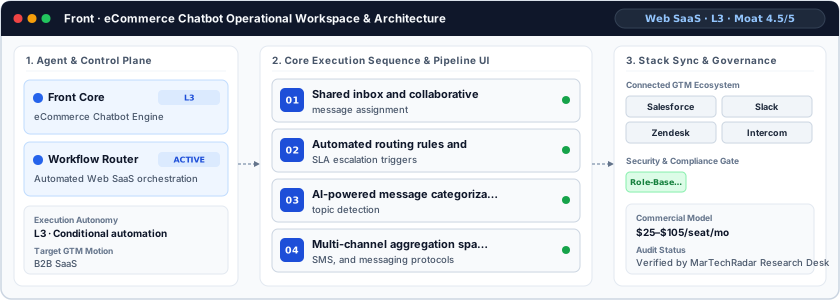
- Target ICP & Stack Fit: You operate as B2B SaaS requiring a Web SaaS deployment for eCommerce Chatbot, with verified ecosystem connectivity for Salesforce, Slack, Zendesk, Intercom.
- L3 Architecture & Defensibility: Front maintains a defensible position through its unified shared inbox architecture that bridges internal team collaboration and multi-channel external communications, reinforced by extensive third-party integration pipelines and deep workflow routing data.
- Commercial Model Fit: Your procurement budget aligns with $25–$105/seat/mo.
Walk away from Front if (Deal-Breakers)
- Walk away if your workflow cannot tolerate throughput and API rate throttling: Mass transactional or programmatic outbound campaigns hit strict API and concurrency limits, as the architecture prioritizes conversational threads over bulk marketing blast throughput.
- Walk away if cross-workspace collision management is a deal-breaker for your team: Complex multi-inbox routing logic frequently introduces operational collisions, requiring rigorous rule-order maintenance to prevent concurrent automated triggers from firing across overlapping shared accounts.
Front pricing, free plan & scorecard at a glance
| Pricing | $25–$105/seat/moVendor pricing page |
|---|---|
| Free plan | No / not disclosed |
| Delivery | Web SaaS |
| Audience | B2B SaaS |
| AI autonomy level | L3 · Conditional automationEditor-verified |
| Moat tier & score | 4.5 / 5.0 · Proprietary moat (category leader)Editor-verified |
| Funding | Venture-backed |
| Total funding | $203.6M |
| Founders | Laurent Perrin, Mathilde Collin, Mohammed Attar |
| Company size | 501-1,000 employees |
| Ecosystem integrations | Salesforce, Slack, Zendesk, Intercom |
| Governance & docs | Trust & Security ↗ · Changelog ↗ · Privacy ↗ |
| Headquarters | San Francisco, California |
| Founded | 2013 |
| Last verified | Oct 15, 2026 |
Front pros & cons: strengths vs. operational limitations
Pros: core strengths & capabilities
- Shared inbox and collaborative: message assignment
- Automated routing rules and SLA escalation triggers
- AI-powered message categorization and topic detection
- Multi-channel aggregation spanning email,: SMS, and messaging protocols
Cons: operational limitations & risks
- Throughput and API Rate Throttling: Mass transactional or programmatic outbound campaigns hit strict API and concurrency limits, as the architecture prioritizes conversational threads over bulk marketing blast throughput.
- Cross-Workspace Collision Management: Complex multi-inbox routing logic frequently introduces operational collisions, requiring rigorous rule-order maintenance to prevent concurrent automated triggers from firing across overlapping shared accounts.
- Lifecycle State Synchronization Delay: Bi-directional CRM synchronization experiences intermittent polling latency, creating temporary discrepancies between contact lifecycle status in external data warehouses and the Front inbox interface.
Front TCO & deal-breaker stress test
Simulate 12-month stepped TCO, hidden cost multipliers, contract lock-in exposure, and stack failure modes using only facts verified by MarTechRadar Research Desk on 2026-10-15 · Capture SHA 141d3917.
Front aligns with your 5-seat / $800/mo profile. Review the walk-away triggers and contract levers below before deployment.
- Moat Score
- 4.5 / 5.0
- AI Autonomy
- L3
- Free Tier / Trial
- None disclosed
Triggered audit signals & failure modes
- Published Self-Serve Entry FloorVerified Pricing Ledger
Front publishes a transparent entry point ($25–$105/seat/mo) for initial validation before committing.
- Linear Per-Seat Scaling (5 Seats × $25/seat/mo)Commercial Model Audit
Base license scales linearly with operator headcount ($125/mo for 5 seats on Starter).
- Primary Operational Bottleneck: Throughput and API Rate ThrottlingAudit by MarTechRadar Research Desk
Mass transactional or programmatic outbound campaigns hit strict API and concurrency limits, as the architecture prioritizes conversational threads over bulk marketing blast throughput.
Test a custom Front budget or stack constraint
Lower 5-seat floor (~$49/mo vs. $125 / mo)
Fits within $800/mo budget ($59–$279/mo)
Front integrations, API, security & compliance stack
Front AI moat & eCommerce Chatbot positioning
Front maintains a defensible position through its unified shared inbox architecture that bridges internal team collaboration and multi-channel external communications, reinforced by extensive third-party integration pipelines and deep workflow routing data.
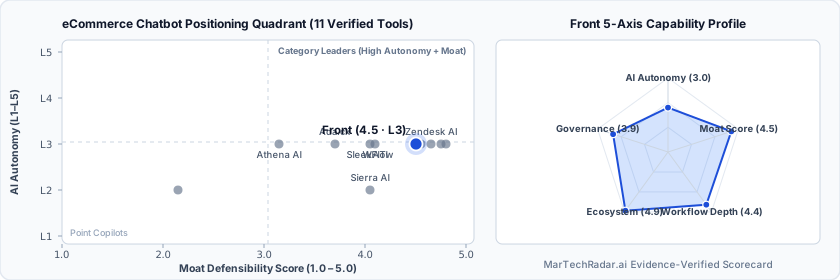
Front in-depth review, pricing & architecture analysis
Editor sign-off: Oct 15, 2026. How profiles are made.
What is Front? Overview & background
Backed by $203.6M in venture financing, Front established its operational footprint when founded in 2013 in San Francisco, California. The platform positions itself as a centralized communications hub for customer success leads, account managers, and lifecycle service operators who manage high-touch B2B relationships. Instead of routing interactions through isolated personal accounts, Front unifies inbound customer dialogues into coordinated operational workflows, giving cross-functional revenue teams governance over complex account conversations.
How Front works: architecture & workflow
Under the hood, Front ingests real-time message streams across SMTP, SMS, WhatsApp, and social API endpoints into an asynchronous routing bus. Inbound payloads trigger rule-based state machines that assign ownership, evaluate custom metadata, and orchestrate automated handoffs. The system incorporates natural language processing models to classify customer intent, extract conversation topics, and draft suggested replies at an L3 autonomy profile, allowing human operators to supervise automated triage and exception handling, alongside native workflow integrations for Salesforce, Slack, Intercom, and Zendesk.
Front limitations, drawbacks & risks
Operational considerations and platform boundaries include:
- Throughput and API Rate Throttling: Mass transactional or programmatic outbound campaigns hit strict API and concurrency limits, as the architecture prioritizes conversational threads over bulk marketing blast throughput.
- Cross-Workspace Collision Management: Complex multi-inbox routing logic frequently introduces operational collisions, requiring rigorous rule-order maintenance to prevent concurrent automated triggers from firing across overlapping shared accounts.
- Lifecycle State Synchronization Delay: Bi-directional CRM synchronization experiences intermittent polling latency, creating temporary discrepancies between contact lifecycle status in external data warehouses and the Front inbox interface.
Front pricing, plans & cost breakdown
Front operates on a tiered seat-based licensing structure billed on an annual cadence. The Starter tier begins at $25 per seat monthly (up to 10 seats), scaling through Growth/Professional at $65 per seat monthly up to Enterprise at $105 per seat monthly, with AI resolution add-ons metered per outcome.
| Plan / Tier | Verified Price & Billing | Included Scope & Contract Terms | |
|---|---|---|---|
| Starter | $25/seat/mo | /seat/mo, up to 10 seats | |
| Professional | $65/seat/mo | /seat/mo, up to 50 seats | |
| Enterprise | $105/seat/mo | Advanced AI tools to accelerate resolution and elevate CX | |
| Contract Watchout: Per-Seat Linear Scaling | Front prices licenses on a per-user/seat basis ($25–$105/seat/mo); expanding from 2 to 15+ operators multiplies base recurring spend linearly. | ||
How Front compares vs. competitors & alternatives
Compared to direct category competitors like Klaviyo (AI) and Dreamdata, Front functions as an alternative focused on reliable workflow execution and transparent unit economics within the Email Marketing segment.
Direct competitors & market radar
Top algorithmic competitors based on category positioning, capability overlap, and ICP alignment.
Frequently asked questions about Front
How much does Front cost in 2026?
Front pricing: $25–$105/seat/mo. No free plan is publicly disclosed. Published tiers: Starter ($25/seat/mo); Professional ($65/seat/mo); Enterprise ($105/seat/mo). Front operates on a tiered seat-based licensing structure billed on an annual cadence.
What are the top Front alternatives in eCommerce Chatbot?
Verified eCommerce Chatbot alternatives include Dreamdata (Custom / enterprise pricing), SleekFlow ($49–$279/mo), WATI ($59–$279/mo), Athena AI (Custom / enterprise pricing). Compared to direct category competitors like Klaviyo (AI) and Dreamdata, Front functions as an alternative focused on reliable workflow execution and transparent unit economics within the Email Marketing segment.
What are the main limitations and trade-offs of Front?
Operational considerations and platform boundaries include: Throughput and API Rate Throttling: Mass transactional or programmatic outbound campaigns hit strict API and concurrency limits, as the architecture prioritizes conversational threads over bulk marketing blast throughput. Walk away if your workflow cannot tolerate throughput and API rate throttling: Mass transactional or programmatic outbound campaigns hit strict API and concurrency limits, as the architecture prioritizes conversational threads over bulk marketing blast throughput.
Verified sources & evidence trail
- Official product domain: https://front.com
- Commercial pricing verification: https://front.com/pricing
- Verified corporate entity profiles (
sameAs): LinkedIn Company Profile · Crunchbase Entity Record - First-party governance & documentation links: Trust & Security · Changelog · Privacy
- Editor sign-off: Oct 15, 2026 (how profiles are made).
