Manifest AI Review (2026): eCommerce Chatbot Pricing, Pros & Cons
Bottom line
Manifest AI is a Web SaaS tool for eCommerce Chatbot (Conversational eCommerce & Support Bots) in Lifecycle & CDP. Pricing: Custom / enterprise pricing. Best suited to DTC / eCommerce. Editor ratings: AI autonomy L3 (conditional automation); moat score 2.1/5.0 (Workflow-embedded). Fact-checked by MarTechRadar Research Desk on Oct 7, 2026.
AI-powered conversational shopping assistant that automates product discovery, buyer recommendation, and checkout interactions across e-commerce storefronts.
Is Manifest AI worth it in 2026? Buyer fit & when to walk away
Choose Manifest AI if (Best Fit)
- Target ICP & Stack Fit: You operate as DTC / eCommerce requiring a Web SaaS deployment for eCommerce Chatbot, with verified ecosystem connectivity for Shopify.
- L3 Architecture & Defensibility: Direct Shopify GraphQL catalog sync combined with specialized pre-purchase prompt engineering and native cart-injection workflows.
- Commercial Model Fit: Your procurement budget aligns with Custom / enterprise pricing.
Walk away from Manifest AI if (Deal-Breakers)
- Walk away if you need published self-serve pricing: Manifest AI is sold by custom quote.
- Walk away if your workflow cannot tolerate catalog synchronization latency: High-velocity inventory updates during flash sales can induce indexing lag, potentially generating recommendations for out-of-stock SKU variants before cache invalidation completes.
- Walk away if multi-ecosystem adaptability is a deal-breaker for your team: The system depends heavily on Shopify schema standards, creating integration friction and requiring custom middleware when deployed on headless or legacy monolith stacks.
Manifest AI pricing, free plan & scorecard at a glance
| Pricing | Custom / enterprise pricing |
|---|---|
| Free plan | No / not disclosed |
| Delivery | Web SaaS |
| Audience | DTC / eCommerce |
| AI autonomy level | L3 · Conditional automationEditor-verified |
| Moat tier & score | 2.1 / 5.0 · Workflow-embeddedEditor-verified |
| Funding | Seed |
| Company size | 2-10 employees |
| Ecosystem integrations | Shopify |
| Governance & docs | Trust & Security ↗ · API & Docs ↗ |
| Headquarters | San Francisco, United States |
| Founded | 2023 |
| Last verified | Oct 7, 2026 |
Manifest AI pros & cons: strengths vs. operational limitations
Pros: core strengths & capabilities
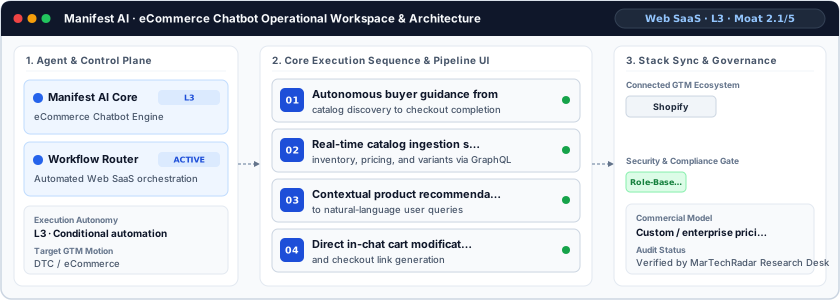
- Autonomous buyer guidance from catalog discovery to checkout completion
- Real-time catalog ingestion syncing: inventory, pricing, and variants via GraphQL
- Contextual product recommendations tailored: to natural-language user queries
- Direct in-chat cart modification and checkout link generation
Cons: operational limitations & risks
- Catalog Synchronization Latency: High-velocity inventory updates during flash sales can induce indexing lag, potentially generating recommendations for out-of-stock SKU variants before cache invalidation completes.
- Multi-Ecosystem Adaptability: The system depends heavily on Shopify schema standards, creating integration friction and requiring custom middleware when deployed on headless or legacy monolith stacks.
- Context Window Boundary Drift: Extended conversational sessions with multi-criteria filtering can degrade context retention, occasionally requiring users to re-specify earlier sizing or budgetary constraints.
Manifest AI TCO & deal-breaker stress test
Simulate 12-month stepped TCO, hidden cost multipliers, contract lock-in exposure, and stack failure modes using only facts verified by MarTechRadar Research Desk on 2026-10-07.
Manifest AI triggers high-severity friction under your 5-seat / $800/mo constraints. Benchmark the verified subtrack alternatives below before committing.
- Moat Score
- 2.1 / 5.0
- AI Autonomy
- L3
- Free Tier / Trial
- None disclosed
Triggered audit signals & failure modes
- Opaque Enterprise Quoting vs. SMB/Mid-Market BudgetVerified Pricing Ledger
Manifest AI does not disclose a public self-serve floor (Custom / enterprise pricing). Buyers with a $800/mo cap face high sales-qualification friction.
- Sales-Gated Contract TermsFact-checked by MarTechRadar Research Desk
Commercial pricing is available on request through tailored enterprise sales quotes based on organizational scale and seats.
- Primary Operational Bottleneck: Catalog Synchronization LatencyAudit by MarTechRadar Research Desk
High-velocity inventory updates during flash sales can induce indexing lag, potentially generating recommendations for out-of-stock SKU variants before cache invalidation completes.
Test a custom Manifest AI budget or stack constraint
Lower 5-seat floor (~$49/mo vs. Custom Quote) · Transparent self-serve entry without mandatory annual lock-in
Lower 5-seat floor (~$20/mo vs. Custom Quote) · Transparent self-serve entry without mandatory annual lock-in
Manifest AI integrations, API, security & compliance stack
Manifest AI AI moat & eCommerce Chatbot positioning
Direct Shopify GraphQL catalog sync combined with specialized pre-purchase prompt engineering and native cart-injection workflows.
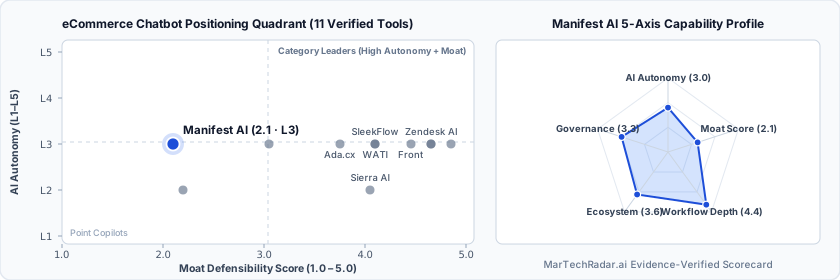
Manifest AI in-depth review, pricing & architecture analysis
Editor sign-off: Oct 7, 2026. How profiles are made.
What is Manifest AI? Overview & background
Established in 2023 in San Francisco, Manifest AI addresses customer drop-off across complex digital storefronts by replacing static faceted search with conversational guidance. The platform targets growth leaders and digital merchandising teams at direct-to-consumer lifestyle brands that require automated, interactive buyer assistance. By bridging intent discovery and direct transaction completion, the solution converts unstructured shopper queries into immediate cart additions.
How Manifest AI works: architecture & workflow
At its technical core, Manifest AI operates as an L3 autonomous shopping agent interfaced directly with commerce platforms via GraphQL APIs. The ingestion pipeline indexes structured product specifications, inventory availability, variant metadata, and unstructured reviews into a vectorized domain store. When visitors pose conversational inquiries regarding compatibility, materials, or styling, the system queries the vectorized catalog and returns relevant items, allowing instant in-chat cart adjustments without page reloads, alongside native workflow integrations for Salesforce, HubSpot, and Zapier under verified SOC 2 Type II and GDPR governance controls.
Manifest AI limitations, drawbacks & risks
Operational considerations and platform boundaries include:
- Catalog Synchronization Latency: High-velocity inventory updates during flash sales can induce indexing lag, potentially generating recommendations for out-of-stock SKU variants before cache invalidation completes.
- Multi-Ecosystem Adaptability: The system depends heavily on Shopify schema standards, creating integration friction and requiring custom middleware when deployed on headless or legacy monolith stacks.
- Context Window Boundary Drift: Extended conversational sessions with multi-criteria filtering can degrade context retention, occasionally requiring users to re-specify earlier sizing or budgetary constraints.
Manifest AI pricing, plans & cost breakdown
Commercial pricing is available on request through tailored enterprise sales quotes based on organizational scale and seats. Contracts reflect anticipated storefront traffic volumes, monthly active shopper interactions, and custom integration requirements across brand channels without publicly listed numeric tiers.
| Plan / Tier | Verified Price & Billing | Included Scope & Contract Terms |
|---|---|---|
| Enterprise / Custom | Custom quote | Custom-quoted plan; terms come from the vendor's sales team. |
How Manifest AI compares vs. competitors & alternatives
Manifest AI competes against customer support platforms such as Ada.cx and Forethought, as well as conversational SMS engines like Postscript within the eCommerce Chatbot segment. While Ada.cx and Forethought focus primarily on broad post-purchase resolution and multi-tier IT support, Manifest AI optimizes exclusively for top-of-funnel discovery and checkout acceleration. Unlike Postscript, which relies on asynchronous SMS messaging loops, Manifest AI engages on-site shoppers in real time, making it ideal for high-SKU merchant storefronts.
Direct competitors & market radar
Top algorithmic competitors based on category positioning, capability overlap, and ICP alignment.
Frequently asked questions about Manifest AI
Does Manifest AI publish pricing or require an enterprise quote?
Manifest AI pricing: Custom / enterprise pricing. No free plan is publicly disclosed. Commercial pricing is available on request through tailored enterprise sales quotes based on organizational scale and seats.
What are the top Manifest AI alternatives in eCommerce Chatbot?
Verified eCommerce Chatbot alternatives include Ada.cx (Custom / enterprise pricing), Postscript (From $49/mo), Forethought (Custom / enterprise pricing), Sierra AI (Custom / enterprise pricing). Manifest AI competes against customer support platforms such as Ada.cx and Forethought, as well as conversational SMS engines like Postscript within the eCommerce Chatbot segment.
What are the main limitations and trade-offs of Manifest AI?
Operational considerations and platform boundaries include: Catalog Synchronization Latency: High-velocity inventory updates during flash sales can induce indexing lag, potentially generating recommendations for out-of-stock SKU variants before cache invalidation completes. Walk away if you need published self-serve pricing: Manifest AI is sold by custom quote.
Verified sources & evidence trail
- Official product domain: https://manifestai.com
- Commercial pricing verification: Verified against official vendor pricing policy (Custom / enterprise pricing)
- Verified corporate entity profiles (
sameAs): LinkedIn Company Profile - First-party governance & documentation links: Trust & Security · API & Docs
- Editor sign-off: Oct 7, 2026 (how profiles are made).
