Replicant Review (2026): eCommerce Chatbot Pricing, Limits & Alternatives
Bottom line
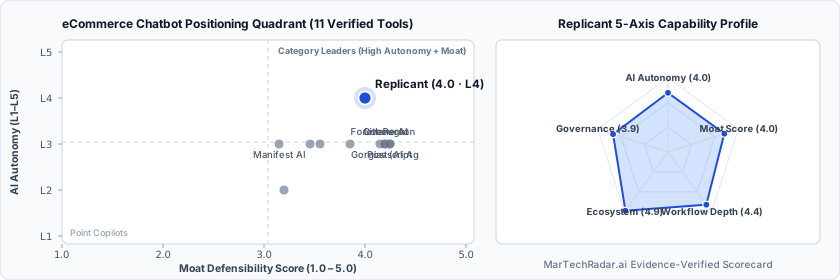
Replicant is a SaaS Platform tool for eCommerce Chatbot (Conversational eCommerce & Support Bots) in Lifecycle & CDP. Pricing: Pricing not disclosed. Best suited to B2B Marketing & GTM Teams. Editor ratings: AI autonomy L4 (autonomous agent); moat score 4.0/5.0 (Proprietary moat). Fact-checked by Sarah Per on Oct 23, 2026.
Enterprise contact center conversation automation platform deploying autonomous Thinking Machines across voice, SMS, and chat.
Replicant buyer fit verdict: when to choose vs. when to walk away
Choose Replicant if (Best Fit)
- Target ICP & Stack Fit: You operate as B2B Marketing & GTM Teams requiring a SaaS Platform deployment for eCommerce Chatbot, with verified ecosystem connectivity for Salesforce, Shopify, Zendesk, Stripe.
- L4 Architecture & Defensibility: Replicant commands an enterprise contact-center automation moat through its low-latency voice Thinking Machines, Conversation Design Studio, and $113M in venture backing from Norwest and Salesforce Ventures.
- Commercial Model Fit: Your procurement budget aligns with Pricing not disclosed.
Walk away from Replicant if (Deal-Breakers)
- Walk away if you require transparent self-serve monthly billing or your budget ceiling is under $1,000/mo (Replicant requires sales-gated custom quoting).
- Walk away if your workflow cannot tolerate backend API & telephony integration bottleneck: Achieving true end-to-end call resolution (rather than FAQ routing) requires connecting Replicant to enterprise CRM, ERP, billing, and telephony APIs, introducing a multi-week deployment and testing cycle.
- Walk away if high call-volume enterprise threshold is a deal-breaker for your team: Replicant is not built for small businesses or low-volume helpdesks; its managed conversation design, compliance guardrails, and enterprise licensing target contact centers handling tens of thousands of monthly interactions.
Replicant key facts & scorecard
| Pricing | Pricing not disclosed |
|---|---|
| Free plan | No / not disclosed |
| Delivery | SaaS Platform |
| Audience | B2B Marketing & GTM Teams |
| AI autonomy level | L4 · Autonomous agentEditor-verified |
| Moat tier & score | 4.0 / 5.0 · Proprietary moatEditor-verified |
| Funding | Series B |
| Total funding | $113MBacked by Alumni Ventures, Norwest, Salesforce Ventures, Costanoa Ventures, Omega Venture Partners |
| Founders | Andrew Abraham, Benjamin Gleitzman, Gadi Shamia, Jack Abraham |
| Company size | 51-200 employees |
| Ecosystem integrations | Salesforce, Shopify, Zendesk, Stripe |
| Headquarters | San Francisco, California, United States |
| Founded | 2017 |
| Last verified |
Replicant pros & cons: strengths vs. operational limitations
Pros: core strengths & capabilities
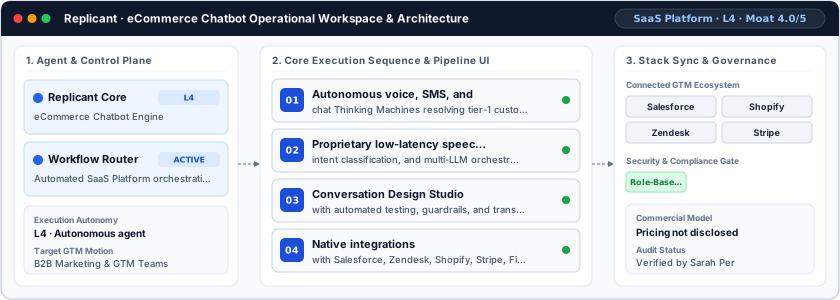
- Autonomous voice, SMS, and: chat Thinking Machines resolving tier-1 customer service, booking, and retention workflows end-to-end
- Proprietary low-latency speech recognition,: intent classification, and multi-LLM orchestration engineered for noisy telephony environments
- Conversation Design Studio: with automated testing, guardrails, and transcript intelligence surfacing root-cause customer friction
- Native integrations: with Salesforce, Zendesk, Shopify, Stripe, Five9, Genesys, NICE CXone, and Amazon Connect
Cons: operational limitations & risks
- Backend API & Telephony Integration Bottleneck: Achieving true end-to-end call resolution (rather than FAQ routing) requires connecting Replicant to enterprise CRM, ERP, billing, and telephony APIs, introducing a multi-week deployment and testing cycle.
- High Call-Volume Enterprise Threshold: Replicant is not built for small businesses or low-volume helpdesks; its managed conversation design, compliance guardrails, and enterprise licensing target contact centers handling tens of thousands of monthly interactions.
- Edge-Case Escalation Handoff Governance: Emotionally escalated disputes or bespoke multi-department exceptions still require warm SIP/CTI transfers with full transcript context to human agents.
Are you a founder, co-founder, or product/growth lead at Replicant? Verify your official @replicant.com email to publish a factual architectural response or 2026 roadmap update below these limitations.
Replicant TCO & deal-breaker stress test
Simulate 12-month stepped TCO, hidden cost multipliers, contract lock-in exposure, and stack failure modes using only facts verified by Sarah Per on · Capture SHA a6c6cce6.
Replicant triggers high-severity friction under your 5-seat / $800/mo constraints. Benchmark the verified subtrack alternatives below before committing.
| Plan / Tier | Verified Rate | Scale Fit | Scope & Quota Notes |
|---|---|---|---|
| Enterprise / Custom | Custom quote | 15–50+ seats (Enterprise SLA) | Sales-negotiated annual contract for custom volume, SSO/RBAC governance, and dedicated SLA. |
- Moat Score
- 4.0 / 5.0
- AI Autonomy
- L4
- Free Tier / Trial
- None disclosed
Triggered audit signals & failure modes
- Opaque Enterprise Quoting vs. SMB/Mid-Market BudgetVerified Pricing Ledger
Replicant does not disclose a public self-serve floor (Pricing not disclosed). Buyers with a $800/mo cap face high sales-qualification friction.
- Sales-Gated Contract TermsFact-checked by Sarah Per
Replicant operates exclusively on a custom enterprise SaaS subscription and usage-based consumption model with pricing available on request.
- Usage / Credit Burn VolatilityCommercial Model Audit
Replicant uses credit or usage-metered billing (Pricing not disclosed). High-volume automated workflows across 5 seats can trigger mid-cycle overage charges.
- Primary Operational Bottleneck: Backend API & Telephony Integration BottleneckAudit by Sarah Per
Achieving true end-to-end call resolution (rather than FAQ routing) requires connecting Replicant to enterprise CRM, ERP, billing, and telephony APIs, introducing a multi-week deployment and testing cycle.
Hidden TCO Multipliers & Quota Gates
- Backend API & Telephony Integration Bottleneck: Achieving true end-to-end call resolution (rather than FAQ routing) requires connecting Replicant to enterprise CRM, ERP, billing, and telephony APIs, introducing a multi-week deployment and testing cycle.
- High Call-Volume Enterprise Threshold: Replicant is not built for small businesses or low-volume helpdesks; its managed conversation design, compliance guardrails, and enterprise licensing target contact centers handling tens of thousands of monthly interactions.
When to Walk Away & Negotiation Levers
- Walk away if you require transparent self-serve monthly billing or your budget ceiling is under $1,000/mo (Replicant requires sales-gated custom quoting).
- Walk away if your workflow cannot tolerate backend API & telephony integration bottleneck: Achieving true end-to-end call resolution (rather than FAQ routing) requires connecting Replicant to enterprise CRM, ERP, billing, and telephony APIs, introducing a multi-week deployment and testing cycle.
- Walk away if high call-volume enterprise threshold is a deal-breaker for your team: Replicant is not built for small businesses or low-volume helpdesks; its managed conversation design, compliance guardrails, and enterprise licensing target contact centers handling tens of thousands of monthly interactions.
- Demand a 30- to 60-day paid pilot opt-out clause in the Replicant order form before signing a 12-month enterprise commitment.
- Require a sandbox proof-of-concept testing backend API & telephony integration bottleneck against your live CRM/data schema before annual sign-off.
Ask a custom procurement or TCO stress-test question about Replicant
Lower 5-seat floor (~$43/mo vs. Custom Quote) · Transparent self-serve entry without mandatory annual lock-in
Lower 5-seat floor (~$49/mo vs. Custom Quote) · Transparent self-serve entry without mandatory annual lock-in
Replicant key entities, modules & ecosystem stack
Replicant moat & subtrack positioning
Replicant commands an enterprise contact-center automation moat through its low-latency voice Thinking Machines, Conversation Design Studio, and $113M in venture backing from Norwest and Salesforce Ventures.
Editorial review
Fact-checked by Sarah Per (Principal Content Systems & Generative Media Editor) on .
Background
Founded in 2017 by Andrew Abraham, Benjamin Gleitzman, Gadi Shamia, and Jack Abraham and headquartered in San Francisco, California, United States, Replicant (replicant.com) is an enterprise contact center conversation automation platform built for high-volume consumer, retail, healthcare, financial services, and travel brands. Operating with a team of 51-200 employees and backed by $113M in Series B funding across four rounds from lead investors including Norwest, Salesforce Ventures, Costanoa Ventures, Omega Venture Partners, and Alumni Ventures, the company replaces rigid legacy IVR phone trees with autonomous AI agents ("Thinking Machines") designed for full call resolution rather than mere call deflection.
How Replicant works
Replicant operates at Level 4 autonomy by orchestrating real-time automatic speech recognition (ASR), domain-tuned large language models, deterministic policy guardrails, and natural text-to-speech synthesis over live telephony and digital messaging channels. When a customer calls a support line or initiates an SMS/chat session, Replicant's Thinking Machine answers with zero hold time, authenticates the caller, understands complex multi-part intents amidst background noise or interruptions, and executes backend transactions—such as order modifications, subscription retention offers, appointment scheduling, and billing payments—via live API integrations with Salesforce, Zendesk, Shopify, Stripe, and enterprise CCaaS platforms (Genesys, Five9, NICE CXone, Amazon Connect). Every interaction is logged and analyzed in Replicant's Conversation Intelligence suite to identify emerging product or lifecycle friction.
Limitations
Operational limitations and technical trade-offs include:
- Backend API & Telephony Integration Bottleneck: Achieving true end-to-end call resolution (rather than FAQ routing) requires connecting Replicant to enterprise CRM, ERP, billing, and telephony APIs, introducing a multi-week deployment and testing cycle.
- High Call-Volume Enterprise Threshold: Replicant is not built for small businesses or low-volume helpdesks; its managed conversation design, compliance guardrails, and enterprise licensing target contact centers handling tens of thousands of monthly interactions.
- Edge-Case Escalation Handoff Governance: Emotionally escalated disputes or bespoke multi-department exceptions still require warm SIP/CTI transfers with full transcript context to human agents.
Replicant pricing
Replicant operates exclusively on a custom enterprise SaaS subscription and usage-based consumption model with pricing available on request. Commercial contracts are structured around annual resolved conversation volume or connected voice/messaging minutes, the number of automated call flows deployed, and enterprise SLA requirements. Prospective customer experience and lifecycle leaders engage Replicant's enterprise team for an ROI assessment and custom pricing proposal.
How Replicant compares
Within the Conversational Marketing, AI Chatbots & Voice Agents category, Replicant competes against enterprise voice and contact center AI platforms such asSierra, PolyAI, Parloa, Kore.ai, and Bland AI. Versus developer-only voice APIs like Bland AI that require teams to build their own telephony and compliance stack from scratch, Replicant differentiates itself through its turnkey enterprise Conversation Design Studio, deep CCaaS/Salesforce integrations, and $113M-backed deployment methodology proven across millions of resolved consumer calls.
Frequently asked questions about Replicant
How much does Replicant cost and does it require a custom enterprise quote?
Published pricing summary for Replicant: Pricing not disclosed. A permanent free plan is not disclosed for Replicant. Replicant operates exclusively on a custom enterprise SaaS subscription and usage-based consumption model with pricing available on request.
How does Replicant work and how autonomous is its AI architecture?
Enterprise contact center conversation automation platform deploying autonomous Thinking Machines across voice, SMS, and chat. Within eCommerce Chatbot (Conversational eCommerce & Support Bots), MarTechRadar rates its execution architecture at L4 · Autonomous agent with a verified Moat Score of 4.0 / 5.0 (Proprietary moat). Replicant commands an enterprise contact-center automation moat through its low-latency voice Thinking Machines, Conversation Design Studio, and $113M in venture backing from Norwest and Salesforce Ventures. Corporate profile: Founded by Andrew Abraham, Benjamin Gleitzman, Gadi Shamia, Jack Abraham, operating at 51-200 employees scale.
What are the main limitations of Replicant and when should buyers walk away?
Based on our editorial technical audit, key operational considerations and boundaries for Replicant include: (1) Backend API & Telephony Integration Bottleneck: Achieving true end-to-end call resolution (rather than FAQ routing) requires connecting Replicant to enterprise CRM, ERP, billing, and telephony APIs, introducing a multi-week deployment and testing cycle. (2) High Call-Volume Enterprise Threshold: Replicant is not built for small businesses or low-volume helpdesks; its managed conversation design, compliance guardrails, and enterprise licensing target contact centers handling tens of thousands of monthly interactions. (3) Edge-Case Escalation Handoff Governance: Emotionally escalated disputes or bespoke multi-department exceptions still require warm SIP/CTI transfers with full transcript context to human agents. Primary procurement walk-away rule: Walk away if you require transparent self-serve monthly billing or your budget ceiling is under $1,000/mo (Replicant requires sales-gated custom quoting).
What integrations, compliance certifications, and contract terms apply to Replicant?
Verified ecosystem and stack integrations include Salesforce, Shopify, Zendesk, Stripe. Key TCO multiplier to watch: Backend API & Telephony Integration Bottleneck (Achieving true end-to-end call resolution (rather than FAQ routing) requires connecting Replicant to enterprise CRM, ERP, billing, and telephony APIs, introducing a multi-week deployment and testing cycle.) Before signing a contract, procurement teams should demand a 30- to 60-day paid pilot opt-out clause in the Replicant order form before signing a 12-month enterprise commitment.
What are the best Replicant alternatives and head-to-head competitors in 2026?
Top fact-checked alternatives to Replicant in eCommerce Chatbot (Conversational eCommerce & Support Bots) include PolyAI (Pricing not disclosed), Cenote (Pricing not disclosed), Klaviyo (AI) (Custom / enterprise pricing), Braze AI (Custom / enterprise pricing). Within the Conversational Marketing, AI Chatbots & Voice Agents category, Replicant competes against enterprise voice and contact center AI platforms such asSierra, PolyAI, Parloa, Kore.ai, and Bland AI.
Verified sources & evidence trail
- Official product domain: https://replicant.com
- Commercial pricing verification: Verified against official vendor pricing policy (Pricing not disclosed)
- Verified corporate entity profiles (
sameAs): LinkedIn Company Profile · Crunchbase Entity Record - Editorial audit sign-off: Fact-checked by Sarah Per on under the MarTechRadar Evidence-Ledger Protocol.