ImageToImage AI Review (2026): AI Product Photography Pricing, Pros & Cons
Bottom line
ImageToImage AI is a Web SaaS tool for AI Product Photography (Product Photography & AI Retouching) in Visual & Creative Media. Pricing: Free plan · $7.50–$15/mo. Editor ratings: AI autonomy L1 (prompt-assisted); moat score 1.6/5.0 (Thin wrapper). Fact-checked by MarTechRadar Research Desk on Nov 14, 2026.
Prompt-driven image-to-image editor for creators and marketers supporting 2K/4K product staging, restyling, photo restoration, outpainting, and erasure.
Is ImageToImage AI worth it in 2026? Buyer fit & when to walk away
Choose ImageToImage AI if (Best Fit)
- Target ICP & Stack Fit: You operate as AI Product Photography teams requiring a Web SaaS deployment for AI Product Photography.
- L1 Architecture & Defensibility: ImageToImage AI wraps Google Nano Banana 2 (2K/4K) and GPT Image behind a low-friction credit workflow with non-expiring packs, automatic failed-run refunds, and 24-hour asset auto-deletion, with limited proprietary model lock-in.
- Commercial Model Fit: Your procurement budget aligns with Free plan · $7.50–$15/mo and want a self-serve free tier for zero-cost initial validation.
Walk away from ImageToImage AI if (Deal-Breakers)
- Walk away if your workflow cannot tolerate manual single-asset workflow only: ImageToImage AI is not built for autonomous ad campaign management, multi-SKU batch automation, or CRM workflows; it lacks Shopify/Amazon feed connectors, a programmatic REST API, and enterprise DAM integrations, creating manual upload friction for large catalogs.
- Walk away if free-tier watermark, format, and fidelity dependency is a deal-breaker for your team: Free daily runs are restricted to the 2K Standard model and export exclusively as watermarked JPG files capped at 2048 px, whereas PNG/WebP format selection, 4K HD subject fidelity, and unwatermarked downloads carry a paid credit dependency.
ImageToImage AI pricing, free plan & scorecard at a glance
| Pricing | Free plan · $7.50–$15/moVendor pricing page |
|---|---|
| Free plan | Yes |
| Delivery | Web SaaS |
| Audience | — |
| AI autonomy level | L1 · Prompt-assistedEditor-verified |
| Moat tier & score | 1.6 / 5.0 · Thin wrapperEditor-verified |
| Funding | Undisclosed |
| Headquarters | — |
| Last verified | Nov 14, 2026 |
ImageToImage AI pros & cons: strengths vs. operational limitations
Pros: core strengths & capabilities
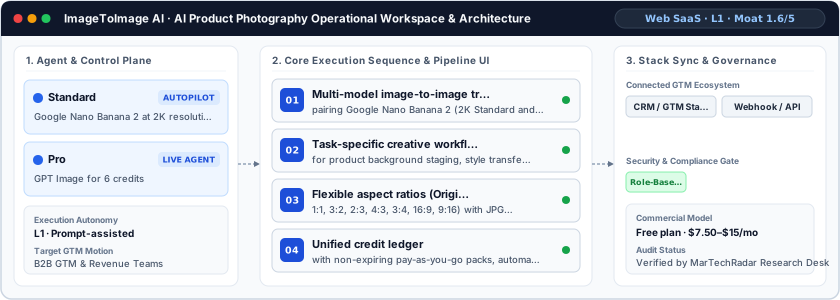
- Multi-model image-to-image transformation: pairing Google Nano Banana 2 (2K Standard and 4K HD) with OpenAI GPT Image
- Task-specific creative workflows: for product background staging, style transfer, photo restoration, outpainting extend, and object erasure
- Flexible aspect ratios (Original,: 1:1, 3:2, 2:3, 4:3, 3:4, 16:9, 9:16) with JPG, PNG, and WebP exports
- Unified credit ledger: with non-expiring pay-as-you-go packs, automatic credit refunds on failed runs, and 24-hour upload auto-deletion
Cons: operational limitations & risks
- Manual Single-Asset Workflow Only: ImageToImage AI is not built for autonomous ad campaign management, multi-SKU batch automation, or CRM workflows; it lacks Shopify/Amazon feed connectors, a programmatic REST API, and enterprise DAM integrations, creating manual upload friction for large catalogs.
- Free-Tier Watermark, Format, and Fidelity Dependency: Free daily runs are restricted to the 2K Standard model and export exclusively as watermarked JPG files capped at 2048 px, whereas PNG/WebP format selection, 4K HD subject fidelity, and unwatermarked downloads carry a paid credit dependency.
- Governance Barrier and Unverified Corporate Entity: Public registry checks show no verified LinkedIn or Crunchbase company profile, and the web app lacks multi-seat workspace permissions, brand-kit lockups, and SOC 2 or SSO enterprise compliance controls.
ImageToImage AI TCO & deal-breaker stress test
Simulate 12-month stepped TCO, hidden cost multipliers, contract lock-in exposure, and stack failure modes using only facts verified by MarTechRadar Research Desk on 2026-11-14 · Capture SHA 4eaa3c9d.
ImageToImage AI aligns with your 5-seat / $800/mo profile. Review the walk-away triggers and contract levers below before deployment.
- Moat Score
- 1.6 / 5.0
- AI Autonomy
- L1
- Free Tier / Trial
- Free plan
Triggered audit signals & failure modes
- Published Self-Serve Entry FloorVerified Pricing Ledger
ImageToImage AI publishes a transparent entry point (Free plan · $7.50–$15/mo) with a free tier for initial validation before committing.
- Primary Operational Bottleneck: Free-Tier Watermark, Format, and Fidelity DependencyAudit by MarTechRadar Research Desk
Free daily runs are restricted to the 2K Standard model and export exclusively as watermarked JPG files capped at 2048 px, whereas PNG/WebP format selection, 4K HD subject fidelity, and unwatermarked downloads carry a paid credit dependency.
Test a custom ImageToImage AI budget or stack constraint
Fits within $800/mo budget (Free plan · $8–$38/mo)
Fits within $800/mo budget (From $9/mo)
ImageToImage AI integrations, API, security & compliance stack
Google Nano Banana 2 at 2K resolution for 5 credits, tuned to preserve facial and product identity
GPT Image for 6 credits
Nano Banana 2 at 4K resolution for 8 credits
ImageToImage AI AI moat & AI Product Photography positioning
ImageToImage AI wraps Google Nano Banana 2 (2K/4K) and GPT Image behind a low-friction credit workflow with non-expiring packs, automatic failed-run refunds, and 24-hour asset auto-deletion, with limited proprietary model lock-in.
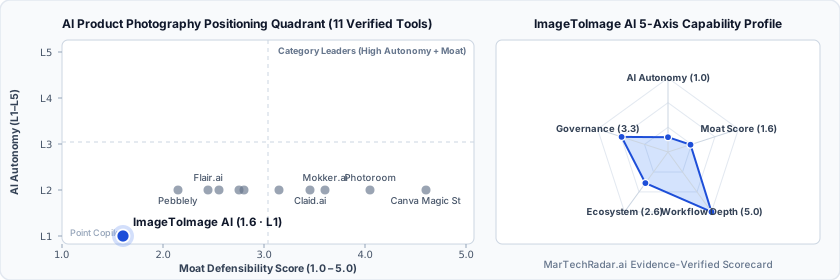
ImageToImage AI in-depth review, pricing & architecture analysis
Editor sign-off: Nov 14, 2026. How profiles are made.
What is ImageToImage AI? Overview & background
Operated by founder Lixun (imagetoimage-ai.app), ImageToImage AI is a browser-based prompt-guided image transformation and retouching utility built for e-commerce sellers, content creators, and solo marketers. Instead of requiring node-based diffusion setups or recurring studio subscriptions for occasional product shots, the web application lets users upload a reference photo, describe the desired visual edit in plain text, and export restyled, staged, or restored imagery within 15 to 40 seconds.
How ImageToImage AI works: architecture & workflow
ImageToImage AI operates at Level 1 assistive copilot autonomy: a human supplies a reference image (JPEG, PNG, or WebP up to 15 MB) and a natural-language instruction up to 1,500 characters, selects one of eight aspect ratios (Original, 1:1, 3:2, 2:3, 4:3, 3:4, 16:9, or 9:16), and reviews each generated result before downloading. Under the hood, the platform routes edits across three model tiers—Standard (Google Nano Banana 2 at 2K resolution for 5 credits, tuned to preserve facial and product identity), Pro (GPT Image for 6 credits), and HD (Nano Banana 2 at 4K resolution for 8 credits)—alongside dedicated tools for painting/sketch/cartoon restyling (5 credits), photo restoration (4 credits), and canvas extension or object removal (6 credits). Failed generation runs automatically refund spent credits, and uploaded source files and generated outputs auto-delete after 24 hours on standard runs (extended to a 7-day download history for Pro subscribers).
ImageToImage AI limitations, drawbacks & risks
Operational limitations and technical trade-offs include:
- Manual Single-Asset Workflow Only: ImageToImage AI is not built for autonomous ad campaign management, multi-SKU batch automation, or CRM workflows; it lacks Shopify/Amazon feed connectors, a programmatic REST API, and enterprise DAM integrations, creating manual upload friction for large catalogs.
- Free-Tier Watermark, Format, and Fidelity Dependency: Free daily runs are restricted to the 2K Standard model and export exclusively as watermarked JPG files capped at 2048 px, whereas PNG/WebP format selection, 4K HD subject fidelity, and unwatermarked downloads carry a paid credit dependency.
- Governance Barrier and Unverified Corporate Entity: Public registry checks show no verified LinkedIn or Crunchbase company profile, and the web app lacks multi-seat workspace permissions, brand-kit lockups, and SOC 2 or SSO enterprise compliance controls.
ImageToImage AI pricing, plans & cost breakdown
ImageToImage AI combines a daily free allowance with pay-as-you-go credit packs and an optional monthly subscription:
- Free Daily Tier: Provides 1 free Standard run per day without an account or 10 free credits per day (2 Standard images) when signed in, exporting watermarked JPGs up to 2048 px.
- Pay-As-You-Go Credit Packs (from $2.99 for 40 credits, up to 5,000 credits): One-time credit purchases that never expire, require no prior sign-up (checkout provisions an account from the payment email), and unlock full-resolution, watermark-free exports across all models and editing tools.
- Pro Plan ($15/month billed monthly, or $7.50/month billed annually): Includes 400 monthly credits (roughly 80 Standard runs), rollover of unused monthly credits up to 1,200 while active (cleared upon subscription end, while purchased packs remain), a 20% credit bonus on add-on pack purchases, and 7-day download history.
How ImageToImage AI compares vs. competitors & alternatives
Within the Product Photography & AI Retouching subtrack, ImageToImage AI competes against specialized commercial visual suites such as Photoroom, Claid.ai, Pebblely, Flair.ai, Pixelcut, and Photoleap. Whereas Photoroom and Claid.ai offer multi-SKU batch processing, programmatic e-commerce APIs, and enterprise catalog governance, ImageToImage AI serves budget-conscious creators and solo merchants seeking no-commitment $2.99 credit packs or a $7.50 to $15/month multi-model prompt editor.
Frequently asked questions about ImageToImage AI
How much does ImageToImage AI cost in 2026?
ImageToImage AI pricing: Free plan · $7.50–$15/mo. A permanent free plan is available. ImageToImage AI combines a daily free allowance with pay-as-you-go credit packs and an optional monthly subscription: Free Daily Tier: Provides 1 free Standard run per day without an account or 10 free credits per day (2 Standard images) when signed in, exporting watermarked JPGs up to 2048 px.
What are the top ImageToImage AI alternatives in AI Product Photography?
Verified AI Product Photography alternatives include Flair.ai (Free plan · $8–$38/mo), Pebblely (From $9/mo), Pixelcut (Custom / enterprise pricing), Photoleap (Custom / enterprise pricing). Within the Product Photography & AI Retouching subtrack, ImageToImage AI competes against specialized commercial visual suites such as Photoroom, Claid.ai, Pebblely, Flair.ai, Pixelcut, and Photoleap.
What are the main limitations and trade-offs of ImageToImage AI?
Operational limitations and technical trade-offs include: Manual Single-Asset Workflow Only: ImageToImage AI is not built for autonomous ad campaign management, multi-SKU batch automation, or CRM workflows; it lacks Shopify/Amazon feed connectors, a programmatic REST API, and enterprise DAM integrations, creating manual upload friction for large catalogs. Walk away if your workflow cannot tolerate manual single-asset workflow only: ImageToImage AI is not built for autonomous ad campaign management, multi-SKU batch automation, or CRM workflows; it lacks Shopify/Amazon feed connectors, a programmatic REST API, and enterprise DAM integrations, creating manual upload friction for large catalogs.
Verified sources & evidence trail
- Official product domain: https://www.imagetoimage-ai.app
- Commercial pricing verification: https://www.imagetoimage-ai.app/pricing
- Editor sign-off: Nov 14, 2026 (how profiles are made).
