Photoleap Review (2026): AI Product Photography Pricing, Pros & Cons
Bottom line
Photoleap is a Web SaaS tool for AI Product Photography (Product Photography & AI Retouching) in Visual & Creative Media. Pricing: Custom / enterprise pricing. Best suited to Creators / Solo. Editor ratings: AI autonomy L1 (prompt-assisted); moat score 1.4/5.0 (Thin wrapper). Fact-checked by MarTechRadar Research Desk on Oct 15, 2026.
Creative photo manipulation and generative asset editing suite engineered by Lightricks for multi-layer digital visual composition.
Is Photoleap worth it in 2026? Buyer fit & when to walk away
Choose Photoleap if (Best Fit)
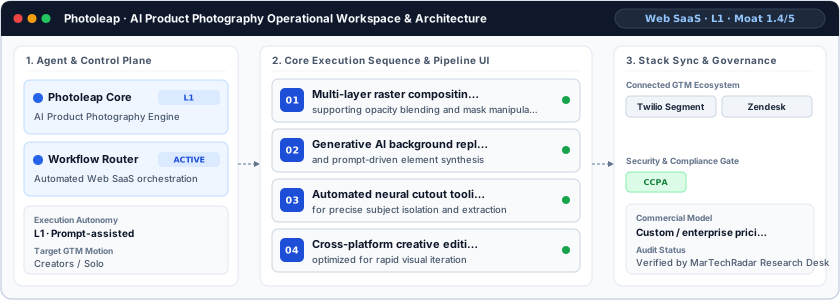
- Target ICP & Stack Fit: You operate as Creators / Solo requiring a Web SaaS deployment for AI Product Photography, with verified ecosystem connectivity for Twilio Segment, Zendesk.
- L1 Architecture & Defensibility: Deep computational photography IP from parent company Lightricks combined with accessible multi-layer raster compositing and on-device neural acceleration.
- Commercial Model Fit: Your procurement budget aligns with Custom / enterprise pricing.
Walk away from Photoleap if (Deal-Breakers)
- Walk away if you need published self-serve pricing: Photoleap is sold by custom quote.
- Walk away if your workflow cannot tolerate batch processing latency: The platform prioritizes single-canvas creative editing over programmatic bulk automation, creating operational friction for e-commerce catalogs requiring synchronous ingestion and retouching of thousands of SKUs.
- Walk away if resolution constraints is a deal-breaker for your team: Diffusion-based inpainting and generative fill modules can produce localized downsampling artifacts, requiring secondary upscaling passes for high-dpi print collateral.
Photoleap pricing, free plan & scorecard at a glance
| Pricing | Custom / enterprise pricing |
|---|---|
| Free plan | No / not disclosed |
| Delivery | Web SaaS |
| Audience | Creators / Solo |
| AI autonomy level | L1 · Prompt-assistedEditor-verified |
| Moat tier & score | 1.4 / 5.0 · Thin wrapperEditor-verified |
| Funding | Undisclosed |
| Ecosystem integrations | Twilio Segment, Zendesk |
| Compliance & governance | CCPA |
| Headquarters | United States |
| Last verified | Oct 15, 2026 |
Photoleap pros & cons: strengths vs. operational limitations
Pros: core strengths & capabilities
- Multi-layer raster compositing canvas: supporting opacity blending and mask manipulation
- Generative AI background replacement and prompt-driven element synthesis
- Automated neural cutout tooling: for precise subject isolation and extraction
- Cross-platform creative editing engine: optimized for rapid visual iteration
Cons: operational limitations & risks
- Batch Processing Latency: The platform prioritizes single-canvas creative editing over programmatic bulk automation, creating operational friction for e-commerce catalogs requiring synchronous ingestion and retouching of thousands of SKUs.
- Resolution Constraints: Diffusion-based inpainting and generative fill modules can produce localized downsampling artifacts, requiring secondary upscaling passes for high-dpi print collateral.
- Catalog Data Integration: The absence of direct connectors to enterprise product information management systems necessitates manual export and import workflows for creative teams.
Photoleap TCO & deal-breaker stress test
Simulate 12-month stepped TCO, hidden cost multipliers, contract lock-in exposure, and stack failure modes using only facts verified by MarTechRadar Research Desk on 2026-10-15.
Photoleap triggers high-severity friction under your 5-seat / $800/mo constraints. Benchmark the verified subtrack alternatives below before committing.
- Moat Score
- 1.4 / 5.0
- AI Autonomy
- L1
- Free Tier / Trial
- None disclosed
Triggered audit signals & failure modes
- Opaque Enterprise Quoting vs. SMB/Mid-Market BudgetVerified Pricing Ledger
Photoleap does not disclose a public self-serve floor (Custom / enterprise pricing). Buyers with a $800/mo cap face high sales-qualification friction.
- Sales-Gated Contract TermsFact-checked by MarTechRadar Research Desk
Commercial procurement for corporate deployments is structured via customized enterprise licensing agreements negotiated directly through sales representatives.
- Primary Operational Bottleneck: Batch Processing LatencyAudit by MarTechRadar Research Desk
The platform prioritizes single-canvas creative editing over programmatic bulk automation, creating operational friction for e-commerce catalogs requiring synchronous ingestion and retouching of thousands of SKUs.
Test a custom Photoleap budget or stack constraint
Lower 5-seat floor (~$23/mo vs. Custom Quote) · Transparent self-serve entry without mandatory annual lock-in
Lower 5-seat floor (~$9/mo vs. Custom Quote) · Transparent self-serve entry without mandatory annual lock-in
Photoleap integrations, API, security & compliance stack
Photoleap AI moat & AI Product Photography positioning
Deep computational photography IP from parent company Lightricks combined with accessible multi-layer raster compositing and on-device neural acceleration.
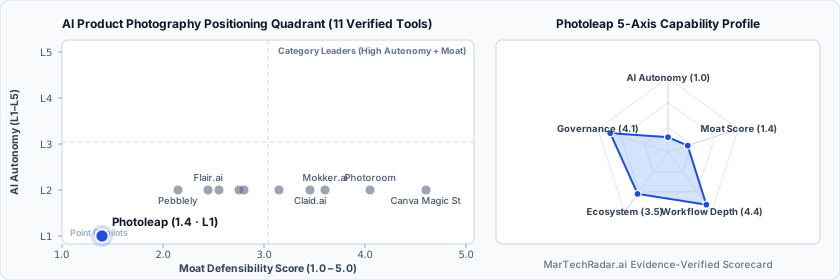
Photoleap in-depth review, pricing & architecture analysis
Editor sign-off: Oct 15, 2026. How profiles are made.
What is Photoleap? Overview & background
For visual marketing teams and digital creators tasked with generating studio-grade product imagery without expensive physical staging, Photoleap delivers an assisted digital compositing canvas. Developed under United States operations by visual technology developer Lightricks, the software bridges the operational divide between basic consumer filter applications and complex enterprise digital asset workstations. Operating within the product photography and visual retouching category, Photoleap targets creative directors, e-commerce merchandising specialists, and growth marketers who require precise multi-layer control over visual assets without operating dedicated desktop raster graphics suites.
How Photoleap works: architecture & workflow
At an operational Level 1 autonomy, Photoleap functions as an interactive copilot that requires human-guided manipulation across every editing stage. The application's technical architecture couples a proprietary client-side layer compositing engine with cloud-hosted diffusion models and neural edge-detection algorithms. When an operator imports a product photograph, deep learning segmentation networks isolate foreground subjects from background artifacts. Users execute localized inpainting, prompt-based background regeneration, and style transfers via natural language cues, while the underlying engine manages raster blending, lighting match curves, and alpha matte synthesis directly within an interactive multi-layer workspace, alongside native workflow integrations for Zendesk under verified CCPA governance controls.
Photoleap limitations, drawbacks & risks
Operational considerations and platform boundaries include:
- Batch Processing Latency: The platform prioritizes single-canvas creative editing over programmatic bulk automation, creating operational friction for e-commerce catalogs requiring synchronous ingestion and retouching of thousands of SKUs.
- Resolution Constraints: Diffusion-based inpainting and generative fill modules can produce localized downsampling artifacts, requiring secondary upscaling passes for high-dpi print collateral.
- Catalog Data Integration: The absence of direct connectors to enterprise product information management systems necessitates manual export and import workflows for creative teams.
Photoleap pricing, plans & cost breakdown
Commercial procurement for corporate deployments is structured via customized enterprise licensing agreements negotiated directly through sales representatives. Contract terms and seat-based licensing bands scale alongside team volume, user access permissions, and organizational asset storage requirements. Prospective business customers can test creative functionality through an initial trial period prior to finalizing custom multi-seat contracts. Pricing is available on request through tailored enterprise sales quotes, with custom enterprise tiers, subscription plans, and seat licenses structured around organizational scale and monthly workflow volume.
| Plan / Tier | Verified Price & Billing | Included Scope & Contract Terms |
|---|---|---|
| Enterprise / Custom | Custom quote | Custom-quoted plan; terms come from the vendor's sales team. |
How Photoleap compares vs. competitors & alternatives
Within the visual retouching landscape, Photoleap occupies a middle ground between hyper-specialized automated e-commerce pipelines and dedicated design tools within the AI Product Photography segment. Competitors such as Blunge emphasize automated programmatic background generation tailored specifically for retail conversion catalogs. Solutions like Caimera focus on rapid catalog staging presets, whereas platforms like clova lean heavily into regional image intelligence. Photoleap distinguishes itself through granular multi-layer control and expressive asset composition, making it best suited for creative brand teams producing bespoke campaign visuals rather than teams executing headless, high-volume catalog retouching.
Frequently asked questions about Photoleap
Does Photoleap publish pricing or require an enterprise quote?
Photoleap pricing: Custom / enterprise pricing. No free plan is publicly disclosed. Commercial procurement for corporate deployments is structured via customized enterprise licensing agreements negotiated directly through sales representatives.
What are the top Photoleap alternatives in AI Product Photography?
Verified AI Product Photography alternatives include clova ($23–$95/mo), Pebblely (From $9/mo), ImageToImage AI (Free plan · $7.50–$15/mo), Erase.bg (From $5 usage-based · Enterprise plan). Within the visual retouching landscape, Photoleap occupies a middle ground between hyper-specialized automated e-commerce pipelines and dedicated design tools within the AI Product Photography segment.
What are the main limitations and trade-offs of Photoleap?
Operational considerations and platform boundaries include: Batch Processing Latency: The platform prioritizes single-canvas creative editing over programmatic bulk automation, creating operational friction for e-commerce catalogs requiring synchronous ingestion and retouching of thousands of SKUs. Walk away if you need published self-serve pricing: Photoleap is sold by custom quote.
Verified sources & evidence trail
- Official product domain: https://photoleapapp.com
- Commercial pricing verification: Verified against official vendor pricing policy (Custom / enterprise pricing)
- Editor sign-off: Oct 15, 2026 (how profiles are made).
