Argil Review (2026): AI Avatar Pricing, Pros & Cons
Bottom line
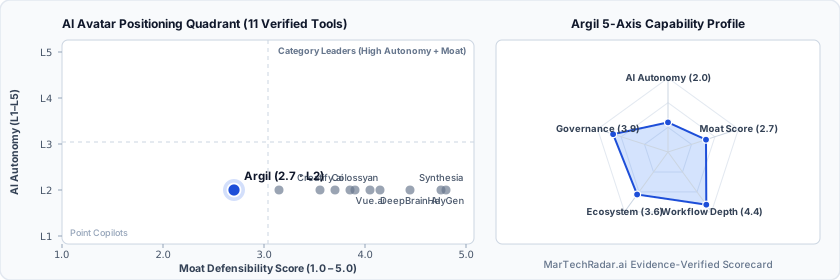
Argil is a Cloud SaaS Platform tool for AI Avatar (Digital Avatars & Presenters) in Visual & Creative Media. Pricing: $50–$2,500/mo · Enterprise plan. Best suited to B2B Marketing and Growth & Revenue Teams. Editor ratings: AI autonomy L2 (workflow copilot); moat score 2.7/5.0 (Workflow-embedded). Fact-checked by MarTechRadar Research Desk on Oct 26, 2026.
AI video production studio and creative agent platform enabling teams to generate brand-consistent avatar and generative videos across major models.
Is Argil worth it in 2026? Buyer fit & when to walk away
Choose Argil if (Best Fit)
- Target ICP & Stack Fit: You operate as B2B Marketing and Growth & Revenue Teams requiring a Cloud SaaS Platform deployment for AI Avatar, with verified ecosystem connectivity for Slack.
- L2 Architecture & Defensibility: Argil builds a defensible creative production moat through its unified multi-model video studio, Director creative agent, persistent character and world memory, and €4.9M in Seed funding backed by Y Combinator, Seedcamp, and EQT Ventures.
- Commercial Model Fit: Your procurement budget aligns with $50–$2,500/mo · Enterprise plan.
Walk away from Argil if (Deal-Breakers)
- Walk away if your workflow requires uncapped enterprise volume on the $50–$2,500/mo · Enterprise plan entry plan without upgrading tiers.
- Walk away if your workflow cannot tolerate primary operational trade-off: In practical enterprise deployments, the primary trade-off is that credit consumption scales rapidly when rendering multi-scene high-definition generative video and iterating across multiple underlying foundation models, requiring disciplined storyboard calibration before batch rendering.
- Walk away if functional scope boundary is a deal-breaker for your team: Argil is not built for live broadcast television switching, 3D CAD product engineering, or programmatic ad-exchange media buying.
Argil pricing, free plan & scorecard at a glance
| Pricing | $50–$2,500/mo · Enterprise planVendor pricing page |
|---|---|
| Free plan | No / not disclosed |
| Delivery | Cloud SaaS Platform |
| Audience | B2B Marketing, Growth & Revenue Teams |
| AI autonomy level | L2 · Workflow copilotEditor-verified |
| Moat tier & score | 2.7 / 5.0 · Workflow-embeddedEditor-verified |
| Funding | Seed |
| Total funding | €4.9MBacked by Y Combinator, Seedcamp, EQT Ventures, Axeleo Capital, Charles Gorintin |
| Founders | Brivael Le Pogam, Laodis Menard |
| Company size | 2-10 employees |
| Ecosystem integrations | Slack |
| Headquarters | Paris, Ile-de-France, France |
| Founded | 2023 |
| Last verified | Oct 26, 2026 |
Argil pros & cons: strengths vs. operational limitations
Pros: core strengths & capabilities
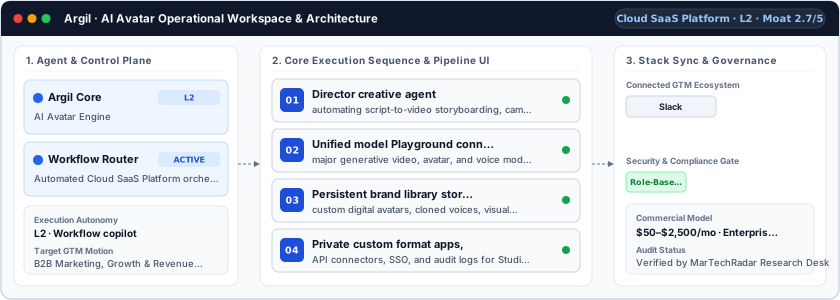
- Director creative agent: automating script-to-video storyboarding, camera framing, B-roll insertion, and multi-scene editing
- Unified model Playground connecting: major generative video, avatar, and voice models within a single studio workspace
- Persistent brand library storing: custom digital avatars, cloned voices, visual worlds, and reusable format apps
- Private custom format apps,: API connectors, SSO, and audit logs for Studio and Enterprise production teams
Cons: operational limitations & risks
- Primary Operational Trade-Off: In practical enterprise deployments, the primary trade-off is that credit consumption scales rapidly when rendering multi-scene high-definition generative video and iterating across multiple underlying foundation models, requiring disciplined storyboard calibration before batch rendering.
- Functional Scope Boundary: Argil is not built for live broadcast television switching, 3D CAD product engineering, or programmatic ad-exchange media buying.
- Deployment & Governance Considerations: Additionally, because custom private format apps and dedicated three-video calibration workflows are reserved for the $1,250/month Studio tier and above, solo creators on the entry plan face a steeper manual setup curve when standardizing complex multi-character visual series.
Argil TCO & deal-breaker stress test
Simulate 12-month stepped TCO, hidden cost multipliers, contract lock-in exposure, and stack failure modes using only facts verified by MarTechRadar Research Desk on 2026-10-26 · Capture SHA 27bdf6c5.
Argil aligns with your 5-seat / $800/mo profile. Review the walk-away triggers and contract levers below before deployment.
- Moat Score
- 2.7 / 5.0
- AI Autonomy
- L2
- Free Tier / Trial
- None disclosed
Triggered audit signals & failure modes
- Published Self-Serve Entry FloorVerified Pricing Ledger
Argil publishes a transparent entry point ($50–$2,500/mo · Enterprise plan) for initial validation before committing.
- Primary Operational Bottleneck: Primary Operational Trade-OffAudit by MarTechRadar Research Desk
In practical enterprise deployments, the primary trade-off is that credit consumption scales rapidly when rendering multi-scene high-definition generative video and iterating across multiple underlying foundation models, requiring disciplined storyboard calibration before batch rendering.
Test a custom Argil budget or stack constraint
Lower 5-seat floor (~$15/mo vs. From $50 / mo)
Lower 5-seat floor (~$5/mo vs. From $50 / mo)
Argil integrations, API, security & compliance stack
Argil AI moat & AI Avatar positioning
Argil builds a defensible creative production moat through its unified multi-model video studio, Director creative agent, persistent character and world memory, and €4.9M in Seed funding backed by Y Combinator, Seedcamp, and EQT Ventures.
Argil in-depth review, pricing & architecture analysis
Audited by MarTechRadar Research Desk (Evidence-Ledger Verified) on Oct 26, 2026.
What is Argil? Overview & background
Argil is an AI video production studio and creative agent platform designed for content marketing teams, creative agencies, and social media operators. Founded in 2023 by Brivael Le Pogam and Laodis Menard and headquartered in Paris, Ile-de-France, France, the Y Combinator (Summer 2024) company operates with 2 to 10 employees and has raised €4.9M (approximately $5.17M) across two Seed funding rounds backed by Y Combinator, Seedcamp, EQT Ventures, Axeleo Capital, and Charles Gorintin. Rather than forcing creators to stitch together disconnected text-to-video, lip-sync, and editing tools for every campaign, Argil centralizes every major generative video model and keeps brand characters, voices, and visual worlds on record, capturing high-intent demand around ai avatar video generator for marketing, argil ai pricing, and a heygen alternative.
How Argil works: architecture & workflow
At the technical core of Argil is a multi-model generative video production architecture coordinated by Director, the platform's autonomous creative agent. When a marketing operator inputs a brief or script within a Studio Session, Director decomposes the narrative into scenes, selects appropriate visual models from the integrated Playground, and applies pre-calibrated digital avatars, voice clones, and world assets from the shared Library. The rendering pipeline automates expressive body language, lip synchronization, dynamic camera angles, and B-roll transitions without manual timeline scrubbing. For larger creative organizations, Argil deploys private format-specific apps, custom connectors, Single Sign-On (SSO), and enterprise audit logs so teams and downstream AI agents can produce repeatable video series under strict brand governance.
Argil limitations, drawbacks & risks
Operational considerations and platform boundaries include:
- Primary Operational Trade-Off: In practical enterprise deployments, the primary trade-off is that credit consumption scales rapidly when rendering multi-scene high-definition generative video and iterating across multiple underlying foundation models, requiring disciplined storyboard calibration before batch rendering.
- Functional Scope Boundary: Argil is not built for live broadcast television switching, 3D CAD product engineering, or programmatic ad-exchange media buying.
- Deployment & Governance Considerations: Additionally, because custom private format apps and dedicated three-video calibration workflows are reserved for the $1,250/month Studio tier and above, solo creators on the entry plan face a steeper manual setup curve when standardizing complex multi-character visual series.
Argil pricing, plans & cost breakdown
Starts at $50/month (Pro), $1,250/month (Studio), Enterprise from $2,500/month. On its official pricing page (argil.ai/pricing), Argil offers a Pro plan starting at $50 per month (with a 17% discount on annual billing) that includes 2,000 monthly credits (equivalent to roughly eight 15-second videos), 1 seat, access to the Director creative agent, the multi-model Playground, and commercial usage rights. The Done-for-You Studio plan is priced at $1,250 per month (including $1,250 in monthly credits, private format app setup, three calibration videos, priority rendering, and a dedicated CSM with Slack support), while the Enterprise tier starts at $2,500 per month on an annual agreement with custom seats, SSO, audit logs, and custom connectors.
| Plan / Tier | Verified Price & Billing | Target Seat / Scale Fit | Included Scope & Contract Terms |
|---|---|---|---|
| Pro | $50/mo | 1–2 seats | Verified $50/mo Pro tier from vendor pricing schedule. |
| Enterprise / Custom | Custom quote | 15–50+ seats (Enterprise SLA) | Sales-negotiated annual contract for custom volume, SSO/RBAC governance, and dedicated SLA. |
| Contract Watchout: Credit & Usage Burn Multiplier | Workflows on Argil consume metered credits or usage quotas; voice/media minutes, multi-step synthesis, or high-frequency runs can exhaust base allocations and trigger mid-cycle top-up packs. | ||
How Argil compares vs. competitors & alternatives
In the AI avatar and generative video studio market, Argil competes with HeyGen, Synthesia, Creatify.ai, and Tavus within the Digital Avatars & Presenters segment, as well as multi-model video platforms such as VideoGen and Runway Gen-3. Compared to traditional talking-head avatar tools that restrict users to rigid slide templates and a single proprietary rendering model, Argil differentiates itself by combining a multi-model Playground with persistent character/world libraries and its autonomous Director agent. Growth marketing teams, creator studios, and agencies producing serialized social video and UGC ad formats should evaluate Argil for scalable video production.
Frequently asked questions about Argil
How much does Argil cost in 2026?
Argil pricing: $50–$2,500/mo · Enterprise plan. No free plan is publicly disclosed. Published tiers: Pro ($50/mo); Enterprise / Custom (Custom quote). Starts at $50/month (Pro), $1,250/month (Studio), Enterprise from $2,500/month.
What are the top Argil alternatives in AI Avatar?
Verified AI Avatar alternatives include Runway Gen-3 (Free plan · $15–$95/mo), sync. ($5–$249/mo · Enterprise plan), Elai.io (Custom / enterprise pricing), Knowlify (Custom / enterprise pricing). In the AI avatar and generative video studio market, Argil competes with HeyGen, Synthesia, Creatify.ai, and Tavus within the Digital Avatars & Presenters segment, as well as multi-model video platforms such as VideoGen and Runway Gen-3.
Verified sources & evidence trail
- Official product domain: https://www.argil.ai
- Commercial pricing verification: https://www.argil.ai/pricing
- Verified corporate entity profiles (
sameAs): LinkedIn Company Profile · Crunchbase Entity Record - Editorial audit sign-off: Audited by MarTechRadar Research Desk (Evidence-Ledger Verified) on Oct 26, 2026.
