VideoGen Review (2026): AI Video Generation Pricing, Pros & Cons
Bottom line
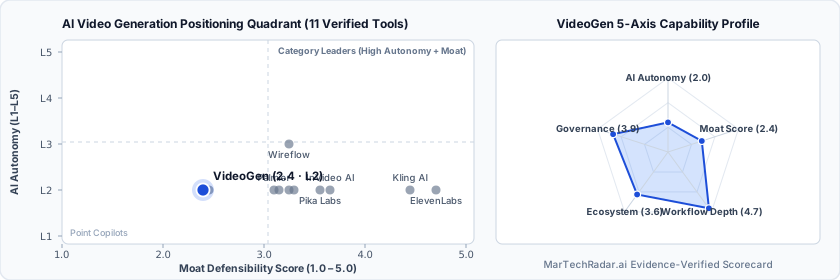
VideoGen is a Cloud SaaS Platform tool for AI Video Generation (Generative Commercial Video & Media) in Visual & Creative Media. Pricing: $19–$99/seat/mo. Best suited to B2B Marketing and Growth & Revenue Teams. Editor ratings: AI autonomy L2 (workflow copilot); moat score 2.4/5.0 (Workflow-embedded). Fact-checked by MarTechRadar Research Desk on Oct 26, 2026.
All-in-one AI video creation platform and API uniting major generative video, avatar, and voice models for marketing and content teams.
Is VideoGen worth it in 2026? Buyer fit & when to walk away
Choose VideoGen if (Best Fit)
- Target ICP & Stack Fit: You operate as B2B Marketing and Growth & Revenue Teams requiring a Cloud SaaS Platform deployment for AI Video Generation, with verified ecosystem connectivity for Model Context Protocol (MCP).
- L2 Architecture & Defensibility: VideoGen establishes a strong commercial video moat through its proprietary VideoGen Model 1 workflow, multi-model aggregation (including Seedance 2.5 and AI avatars), native API and MCP access across all paid tiers, and $3.3M in Seed funding from Y Combinator and a16z Scout Fund.
- Commercial Model Fit: Your procurement budget aligns with $19–$99/seat/mo.
Walk away from VideoGen if (Deal-Breakers)
- Walk away if your workflow requires uncapped enterprise volume on the $19–$99/seat/mo entry plan without upgrading tiers.
- Walk away if your workflow cannot tolerate primary operational trade-off: In practical enterprise deployments, the primary trade-off is the credit burn difference across rendering modes—for example, 6,000 monthly Pro credits yield approximately 37 minutes of still-image video but only around 4 minutes of full generative video or 7 minutes of AI avatar output.
- Walk away if functional scope boundary is a deal-breaker for your team: VideoGen is not built for frame-by-frame Hollywood VFX compositing, cinema color grading, or programmatic DSP ad bidding.
VideoGen pricing, free plan & scorecard at a glance
| Pricing | $19–$99/seat/moVendor pricing page |
|---|---|
| Free plan | No / not disclosed |
| Delivery | Cloud SaaS Platform |
| Audience | B2B Marketing, Growth & Revenue Teams |
| AI autonomy level | L2 · Workflow copilotEditor-verified |
| Moat tier & score | 2.4 / 5.0 · Workflow-embeddedEditor-verified |
| Funding | Seed |
| Total funding | $3.3MBacked by Y Combinator, Pioneer Fund, Rebel Fund, a16z Scout Fund, Unpopular Ventures |
| Founders | Anton Koenig, David Grossman |
| Company size | 2-10 employees |
| Ecosystem integrations | Model Context Protocol (MCP) |
| Headquarters | San Francisco, California, United States |
| Founded | 2023 |
| Last verified | Oct 26, 2026 |
VideoGen pros & cons: strengths vs. operational limitations
Pros: core strengths & capabilities
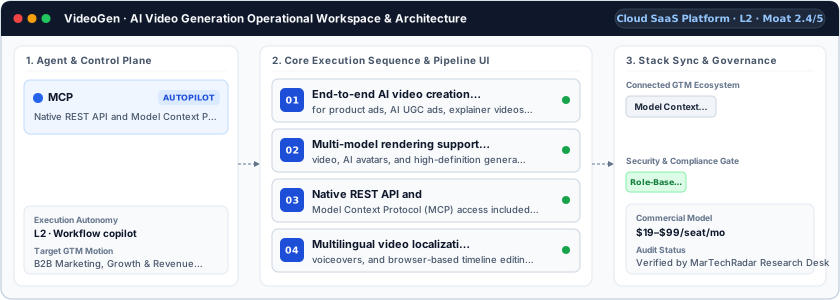
- End-to-end AI video creation workflows: for product ads, AI UGC ads, explainer videos, and e-commerce promos
- Multi-model rendering supporting still-image: video, AI avatars, and high-definition generative video (including Seedance 2.5)
- Native REST API and: Model Context Protocol (MCP) access included across Pro, Advanced, and Ultra tiers for automated content pipelines
- Multilingual video localization, text-to-speech: voiceovers, and browser-based timeline editing for Video SEO and AEO campaigns
Cons: operational limitations & risks
- Primary Operational Trade-Off: In practical enterprise deployments, the primary trade-off is the credit burn difference across rendering modes—for example, 6,000 monthly Pro credits yield approximately 37 minutes of still-image video but only around 4 minutes of full generative video or 7 minutes of AI avatar output.
- Functional Scope Boundary: VideoGen is not built for frame-by-frame Hollywood VFX compositing, cinema color grading, or programmatic DSP ad bidding.
- Deployment & Governance Considerations: Additionally, because maximum-quality frontier models (such as Seedance 2.5) and expanded cloud storage (100 GB to 2 TB) require upgrading to the Advanced or Ultra plans, high-volume performance marketing teams must plan credit allocation carefully across test variations.
VideoGen TCO & deal-breaker stress test
Simulate 12-month stepped TCO, hidden cost multipliers, contract lock-in exposure, and stack failure modes using only facts verified by MarTechRadar Research Desk on 2026-10-26 · Capture SHA 1df57689.
VideoGen is viable for 5 seats, but requires commercial or technical verification on the flagged items below.
- Moat Score
- 2.4 / 5.0
- AI Autonomy
- L2
- Free Tier / Trial
- None disclosed
Triggered audit signals & failure modes
- Published Self-Serve Entry FloorVerified Pricing Ledger
VideoGen publishes a transparent entry point ($19–$99/seat/mo) for initial validation before committing.
- Usage / Credit Burn VolatilityCommercial Model Audit
VideoGen uses credit or usage-metered billing ($19–$99/seat/mo). High-volume automated workflows across 5 seats can trigger mid-cycle overage charges.
- Primary Operational Bottleneck: Primary Operational Trade-OffAudit by MarTechRadar Research Desk
In practical enterprise deployments, the primary trade-off is the credit burn difference across rendering modes—for example, 6,000 monthly Pro credits yield approximately 37 minutes of still-image video but only around 4 minutes of full generative video or 7 minutes of AI avatar output.
Test a custom VideoGen budget or stack constraint
Lower 5-seat floor (~$6/mo vs. $95 / mo)
Lower 5-seat floor (~$10/mo vs. $95 / mo)
VideoGen integrations, API, security & compliance stack
Native REST API and Model Context Protocol access included across Pro, Advanced, and Ultra tiers for automated content pipelines
VideoGen AI moat & AI Video Generation positioning
VideoGen establishes a strong commercial video moat through its proprietary VideoGen Model 1 workflow, multi-model aggregation (including Seedance 2.5 and AI avatars), native API and MCP access across all paid tiers, and $3.3M in Seed funding from Y Combinator and a16z Scout Fund.
VideoGen in-depth review, pricing & architecture analysis
Audited by MarTechRadar Research Desk (Evidence-Ledger Verified) on Oct 26, 2026.
What is VideoGen? Overview & background
VideoGen is an all-in-one AI video creation platform and developer API built for performance marketers, e-commerce brands, and content automation teams. Founded in 2023 by Anton Koenig and David Grossman and headquartered in San Francisco, California, the Y Combinator (Summer 2024) company operates with 2 to 10 employees and has raised $3.3M in Seed funding from Y Combinator, Pioneer Fund, Rebel Fund, a16z Scout Fund, and Unpopular Ventures. Trusted by over 5 million creators and teams, VideoGen consolidates script generation, AI UGC ads, product demos, explainer videos, and Video SEO/AEO assets into a single workflow, addressing commercial search demand for ai video ad generator, videogen pricing, and a zebracat alternative.
How VideoGen works: architecture & workflow
At the technical core of VideoGen is a unified generative media orchestration pipeline powered by VideoGen Model 1 alongside third-party frontier video and avatar models such as Seedance 2.5. Users or autonomous agents submit a text prompt, URL, or slide deck, and VideoGen's AI agents decompose the input into a structured storyboard, synthesize natural multilingual voiceovers, and render either still-image motion sequences, lifelike AI avatar presenters, or full generative video clips. Crucially, VideoGen exposes native REST API and Model Context Protocol (MCP) endpoints across all subscription plans, allowing engineering and growth teams to trigger programmatic video generation, localization, and export directly from external agentic workflows and CMS databases.
VideoGen limitations, drawbacks & risks
Operational considerations and platform boundaries include:
- Primary Operational Trade-Off: In practical enterprise deployments, the primary trade-off is the credit burn difference across rendering modes—for example, 6,000 monthly Pro credits yield approximately 37 minutes of still-image video but only around 4 minutes of full generative video or 7 minutes of AI avatar output.
- Functional Scope Boundary: VideoGen is not built for frame-by-frame Hollywood VFX compositing, cinema color grading, or programmatic DSP ad bidding.
- Deployment & Governance Considerations: Additionally, because maximum-quality frontier models (such as Seedance 2.5) and expanded cloud storage (100 GB to 2 TB) require upgrading to the Advanced or Ultra plans, high-volume performance marketing teams must plan credit allocation carefully across test variations.
VideoGen pricing, plans & cost breakdown
Starts at $19/month per user billed yearly (Pro), $39/month (Advanced), $99/month (Ultra). According to VideoGen's official pricing page (videogen.io/pricing), annual billing saves 33% across three self-serve tiers, all of which include commercial usage rights plus API and MCP access: Pro at $19 per user/month billed yearly (6,000 credits/month and 15 GB storage), Advanced at $39 per user/month billed yearly (18,000 credits/month, 100 GB storage, and max-quality models), and Ultra at $99 per user/month billed yearly (60,000 credits/month, 2 TB storage, and max-quality models).
| Plan / Tier | Verified Price & Billing | Target Seat / Scale Fit | Included Scope & Contract Terms |
|---|---|---|---|
| Pro | $19/seat/mo | 1–2 seats | Verified $19/seat/mo Pro tier from vendor pricing schedule. |
| Advanced | $39/seat/mo | 5 seats | Verified $39/seat/mo Advanced tier from vendor pricing schedule. |
| Contract Watchout: Per-Seat Linear Scaling | VideoGen prices licenses on a per-user/seat basis ($19–$99/seat/mo); expanding from 2 to 15+ operators multiplies base recurring spend linearly. | ||
How VideoGen compares vs. competitors & alternatives
In the generative commercial video and ad creation market, VideoGen competes with Zebracat, Runway Gen-3, Pika Labs, and Kling AI in the Generative Commercial Video segment, alongside verified audio-visual synthesis peers such as Murf AI and ElevenLabs. Unlike standalone foundation model sandboxes that lack marketing templates, avatar presenters, or MCP automation hooks, VideoGen differentiates itself by combining still-image, avatar, and generative video modes with out-of-the-box API and MCP access starting at the entry tier. Performance marketers, SEO/AEO content teams, and developers automating video ad production should evaluate VideoGen.
Frequently asked questions about VideoGen
How much does VideoGen cost in 2026?
VideoGen pricing: $19–$99/seat/mo. No free plan is publicly disclosed. Published tiers: Pro ($19/seat/mo); Advanced ($39/seat/mo). Starts at $19/month per user billed yearly (Pro), $39/month (Advanced), $99/month (Ultra).
What are the top VideoGen alternatives in AI Video Generation?
Verified AI Video Generation alternatives include ElevenLabs (Free plan · $6–$990/mo · Enterprise plan), Kling AI (Usage-based pricing), Pika Labs (Free plan · $10–$50/mo), Zebracat (From $23/mo). In the generative commercial video and ad creation market, VideoGen competes with Zebracat, Runway Gen-3, Pika Labs, and Kling AI in the Generative Commercial Video segment, alongside verified audio-visual synthesis peers such as Murf AI and ElevenLabs.
Verified sources & evidence trail
- Official product domain: https://videogen.io
- Commercial pricing verification: https://videogen.io/pricing
- Verified corporate entity profiles (
sameAs): LinkedIn Company Profile · Crunchbase Entity Record - Editorial audit sign-off: Audited by MarTechRadar Research Desk (Evidence-Ledger Verified) on Oct 26, 2026.
