Wireflow Review (2026): AI Video Generation Pricing, Limits & Alternatives
Bottom line
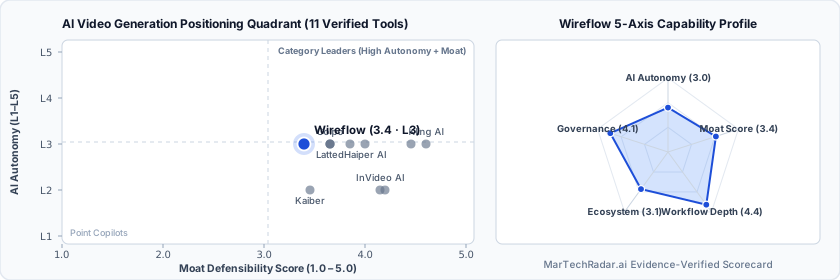
Wireflow is a Web SaaS tool for AI Video Generation (Generative Commercial Video & Media) in Visual & Creative Media. Pricing: Free plan · From $0/mo. Best suited to B2B SaaS and Growth Teams. Editor ratings: AI autonomy L3 (conditional automation); moat score 3.4/5.0 (Workflow-embedded (strong)). Fact-checked by Vasilia Xia on Oct 16, 2026.
Node-based multimodal creative canvas and Claude connector orchestrating 100+ generative video, image, and audio models for batch ad production.
Wireflow buyer fit verdict: when to choose vs. when to walk away
Choose Wireflow if (Best Fit)
- Target ICP & Stack Fit: You operate as B2B SaaS and Growth Teams requiring a Web SaaS deployment for AI Video Generation.
- L3 Architecture & Defensibility: Visual node-graph chaining across 100+ frontier video/image models paired with a direct Anthropic Claude execution connector provides composable flexibility that fixed-template ad tools lack.
- Commercial Model Fit: Your procurement budget aligns with Free plan · From $0/mo and want a self-serve free tier for zero-cost initial validation.
Walk away from Wireflow if (Deal-Breakers)
- Walk away if your workflow requires uncapped enterprise volume on the Free plan · From $0/mo entry plan without upgrading tiers.
- Walk away if your workflow cannot tolerate node-graph authoring learning curve: A key usability limitation is that wiring multi-branch generative node graphs requires a steeper learning curve in prompt chaining and pipeline logic than one-click URL-to-video tools.
- Walk away if diffusion rendering latency and credit bottleneck is a deal-breaker for your team: Chaining high-definition video diffusion models such as Veo and Kling across dozens of ad variations introduces a rendering latency bottleneck and rapid credit burn during batch runs.
Wireflow key facts & scorecard
| Pricing | Free plan · From $0/moVendor pricing page |
|---|---|
| Free plan | Yes |
| Delivery | Web SaaS |
| Audience | B2B SaaS, Growth Teams |
| AI autonomy level | L3 · Conditional automationEditor-verified |
| Moat tier & score | 3.4 / 5.0 · Workflow-embedded (strong)Editor-verified |
| Funding | Seed |
| Company size | 2-10 employees |
| Compliance & governance | SOC 2 |
| Governance & docs | Trust & Security ↗ · API & Docs ↗ · Terms ↗ · Privacy ↗ |
| Headquarters | Brisbane, Queensland |
| Founded | 2025 |
| Last verified |
Wireflow pros & cons: strengths vs. operational limitations
Pros: core strengths & capabilities
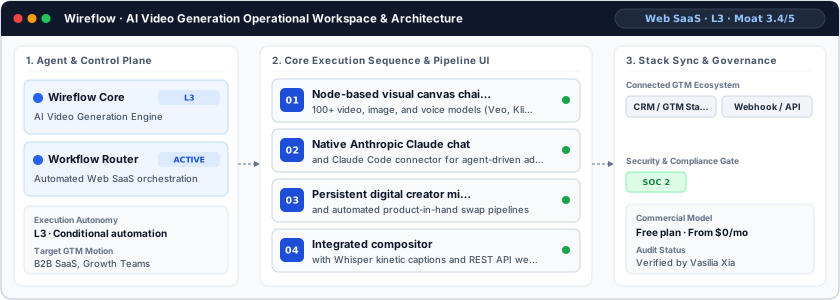
- Node-based visual canvas chaining: 100+ video, image, and voice models (Veo, Kling, Flux)
- Native Anthropic Claude chat: and Claude Code connector for agent-driven ad batching
- Persistent digital creator minting: and automated product-in-hand swap pipelines
- Integrated compositor: with Whisper kinetic captions and REST API webhook automation
Cons: operational limitations & risks
- Node-Graph Authoring Learning Curve: A key usability limitation is that wiring multi-branch generative node graphs requires a steeper learning curve in prompt chaining and pipeline logic than one-click URL-to-video tools.
- Diffusion Rendering Latency and Credit Bottleneck: Chaining high-definition video diffusion models such as Veo and Kling across dozens of ad variations introduces a rendering latency bottleneck and rapid credit burn during batch runs.
- Enterprise Compliance Governance Barrier: While infrastructure security enforces TLS 1.2+ encryption, encrypted AWS RDS/S3 storage, and Enterprise SAML SSO, regulated buyers face a governance barrier due to the absence of publicly posted SOC 2 audit reports.
Wireflow TCO & deal-breaker stress test
Simulate 12-month stepped TCO, hidden cost multipliers, contract lock-in exposure, and stack failure modes using only facts verified by Vasilia Xia on · Capture SHA 29a2f242.
Wireflow triggers high-severity friction under your 5-seat / $800/mo constraints. Benchmark the verified subtrack alternatives below before committing.
| Plan / Tier | Verified Rate | Scale Fit | Scope & Quota Notes |
|---|---|---|---|
| Free / Sandbox | $0 | 1–2 seats (Evaluation) | Entry free tier with capped usage or feature quotas for initial workflow testing. |
| Entry / Starter | $0.01/mo | 1–2 seats | Verified $0.01/mo tier from vendor pricing schedule. |
| Free | $10/mo | 5 seats | Unlimited workflows |
| Starter | $24/mo | 15 seats | For creators producing content occasionally |
- Moat Score
- 3.4 / 5.0
- AI Autonomy
- L3
- Free Tier / Trial
- Free plan
Triggered audit signals & failure modes
- Opaque Enterprise Quoting vs. SMB/Mid-Market BudgetVerified Pricing Ledger
Wireflow does not disclose a public self-serve floor (Free plan · From $0/mo). Buyers with a $800/mo cap face high sales-qualification friction.
- Published Self-Serve Entry FloorVerified Pricing Ledger
Wireflow publishes a transparent entry point (Free plan · From $0/mo) with a free tier for initial validation before committing.
- Usage / Credit Burn VolatilityCommercial Model Audit
Wireflow uses credit or usage-metered billing (Free plan · From $0/mo). High-volume automated workflows across 5 seats can trigger mid-cycle overage charges.
- Tier Fit for 5-Seat Scale: Entry / Starter ($0.01/mo)Verified Tier Schedule
Verified $0.01/mo tier from vendor pricing schedule.
Hidden TCO Multipliers & Quota Gates
- Credit & Usage Burn Multiplier: Automated workflows consume metered credits/usage quotas; multi-step enrichment, voice minutes, or high-frequency agent runs can trigger mid-cycle top-up packs.
- Enterprise Governance & Add-On Gating: Advanced capabilities such as Single Sign-On (SSO), custom role permissions, or specialized analytics modules are gated behind upper tiers or paid add-ons.
When to Walk Away & Negotiation Levers
- Walk away if your workflow requires uncapped enterprise volume on the Free plan · From $0/mo entry plan without upgrading tiers.
- Walk away if your workflow cannot tolerate node-graph authoring learning curve: A key usability limitation is that wiring multi-branch generative node graphs requires a steeper learning curve in prompt chaining and pipeline logic than one-click URL-to-video tools.
- Walk away if diffusion rendering latency and credit bottleneck is a deal-breaker for your team: Chaining high-definition video diffusion models such as Veo and Kling across dozens of ad variations introduces a rendering latency bottleneck and rapid credit burn during batch runs.
- Validate exact quota thresholds (seats, credits, or API calls) included in Wireflow's Free plan · From $0/mo tier before converting from monthly to annual billing.
- Require a sandbox proof-of-concept testing node-graph authoring learning curve against your live CRM/data schema before annual sign-off.
Ask a custom procurement or TCO stress-test question about Wireflow
Lower 5-seat floor (~$15/mo vs. Custom Quote)
Lower 5-seat floor (~$40/mo vs. Custom Quote)
Wireflow key entities, modules & ecosystem stack
Wireflow moat & subtrack positioning
Visual node-graph chaining across 100+ frontier video/image models paired with a direct Anthropic Claude execution connector provides composable flexibility that fixed-template ad tools lack.
Editorial review
Fact-checked by Vasilia Xia (E-Commerce, Lifecycle & Retention Marketing Analyst) on .
Background
Founded in 2025 and headquartered in Brisbane, Queensland, Australia, Wireflow (wireflow.ai) is a node-based multimodal creative canvas and generative ad production platform built for performance creative strategists, media buyers, and creative technologists. Operating with an agile engineering team of 2 to 10 employees, the company addresses the rigidity of template-locked AI video generators that confine marketers to repetitive talking-head layouts. Wireflow provides a programmable visual node graph where growth teams wire together more than 100 image, video, and voice synthesis models into reusable pipelines that turn product URLs and creative briefs into batch ad variations.
How Wireflow works
Wireflow operates at Level 3 autonomy by orchestrating frontier generative models—including Google Veo, Kling, Grok, MiniMax Hailuo, WAN, Seedance, and Flux—inside a collaborative node-to-node execution graph. Marketers mint persistent digital creators, automate product-in-hand visual swaps, and apply Whisper-powered kinetic captions within an integrated video compositor. Crucially, Wireflow includes a native Anthropic Claude connector (supporting both Claude chat and Claude Code) alongside a REST API and webhooks, enabling autonomous agents to construct node pipelines programmatically and trigger batch creative renders.
Limitations
Operational limitations and technical trade-offs include:
- Node-Graph Authoring Learning Curve: A key usability limitation is that wiring multi-branch generative node graphs requires a steeper learning curve in prompt chaining and pipeline logic than one-click URL-to-video tools.
- Diffusion Rendering Latency and Credit Bottleneck: Chaining high-definition video diffusion models such as Veo and Kling across dozens of ad variations introduces a rendering latency bottleneck and rapid credit burn during batch runs.
- Enterprise Compliance Governance Barrier: While infrastructure security enforces TLS 1.2+ encryption, encrypted AWS RDS/S3 storage, and Enterprise SAML SSO, regulated buyers face a governance barrier due to the absence of publicly posted SOC 2 audit reports.
Wireflow pricing
Wireflow offers a tiered credit subscription starting with a Free plan at $0 for initial canvas prototyping, with individual model executions metered from $0.01 to $1.2 per action and credit top-up packs starting at $10. Paid monthly plans include the Starter tier at $24/mo (1,600 credits), the Professional tier at $45/mo (4,300 credits), and the Team tier at $249/mo (4 seats and 21,500 credits), alongside custom Enterprise agreements featuring SAML single sign-on and dedicated concurrency.
How Wireflow compares
Within the AI Video Generation and Generative Commercial Video & Media category, Wireflow competes alongside specialized foundation models and creative studios such as Runway Gen-3, Kling AI, and MiniMax Hailuo. Whereas standalone model portals lock creative teams into a single vendor's generation engine, Wireflow differentiates itself by combining a 100+ model visual node canvas with a direct Anthropic Claude execution connector. Performance creative teams and growth agencies running multi-model ad experimentation favor Wireflow's composable graph architecture, while solo social media managers often prefer simpler template-based editors.
Frequently asked questions about Wireflow
How much does Wireflow cost and what pricing tiers are available?
Published pricing summary for Wireflow: Free plan · From $0/mo. Wireflow includes a free tier or sandbox entry point. Verified tier schedule: Free / Sandbox ($0 for 1–2 seats (Evaluation)); Entry / Starter ($0.01/mo for 1–2 seats); Free ($10/mo for 5 seats); Starter ($24/mo for 15 seats). Wireflow offers a tiered credit subscription starting with a Free plan at $0 for initial canvas prototyping, with individual model executions metered from $0.01 to $1.2 per action and credit top-up packs starting at $10.
How does Wireflow work and how autonomous is its AI architecture?
Node-based multimodal creative canvas and Claude connector orchestrating 100+ generative video, image, and audio models for batch ad production. Within AI Video Generation (Generative Commercial Video & Media), MarTechRadar rates its execution architecture at L3 · Conditional automation with a verified Moat Score of 3.4 / 5.0 (Workflow-embedded (strong)). Visual node-graph chaining across 100+ frontier video/image models paired with a direct Anthropic Claude execution connector provides composable flexibility that fixed-template ad tools lack. Corporate profile: operating at 2-10 employees scale.
What are the main limitations of Wireflow and when should buyers walk away?
Based on our editorial technical audit, key operational considerations and boundaries for Wireflow include: (1) Node-Graph Authoring Learning Curve: A key usability limitation is that wiring multi-branch generative node graphs requires a steeper learning curve in prompt chaining and pipeline logic than one-click URL-to-video tools. (2) Diffusion Rendering Latency and Credit Bottleneck: Chaining high-definition video diffusion models such as Veo and Kling across dozens of ad variations introduces a rendering latency bottleneck and rapid credit burn during batch runs. (3) Enterprise Compliance Governance Barrier: While infrastructure security enforces TLS 1.2+ encryption, encrypted AWS RDS/S3 storage, and Enterprise SAML SSO, regulated buyers face a governance barrier due to the absence of publicly posted SOC 2 audit reports. Primary procurement walk-away rule: Walk away if your workflow requires uncapped enterprise volume on the Free plan · From $0/mo entry plan without upgrading tiers.
What integrations, compliance certifications, and contract terms apply to Wireflow?
Documented security and governance attestations include SOC 2. First-party governance and developer endpoints verified on domain include: Trust/Security (https://www.wireflow.ai/security), API Docs (https://www.wireflow.ai/for/developers). Key TCO multiplier to watch: Credit & Usage Burn Multiplier (Automated workflows consume metered credits/usage quotas; multi-step enrichment, voice minutes, or high-frequency agent runs can trigger mid-cycle top-up packs.) Before signing a contract, procurement teams should validate exact quota thresholds (seats, credits, or API calls) included in Wireflow's Free plan · From $0/mo tier before converting from monthly to annual billing.
What are the best Wireflow alternatives and head-to-head competitors in 2026?
Top fact-checked alternatives to Wireflow in AI Video Generation (Generative Commercial Video & Media) include Kling AI (From $0.14), Runway Gen-3 (Free plan · $15–$95/mo), MiniMax Hailuo (Custom / enterprise pricing), Golpo (From $39.99/mo). Within the AI Video Generation and Generative Commercial Video & Media category, Wireflow competes alongside specialized foundation models and creative studios such as Runway Gen-3, Kling AI, and MiniMax Hailuo.
Verified sources & evidence trail
- Official product domain: https://wireflow.ai
- Commercial pricing verification: https://www.wireflow.ai/pricing
- Verified corporate entity profiles (
sameAs): LinkedIn Company Profile · Crunchbase Entity Record - First-party governance & documentation links: Trust & Security · API & Docs · Terms · Privacy
- Editorial audit sign-off: Fact-checked by Vasilia Xia on under the MarTechRadar Evidence-Ledger Protocol.