Runway Gen-3 Review (2026): AI Video Generation Pricing, Pros & Cons
Bottom line
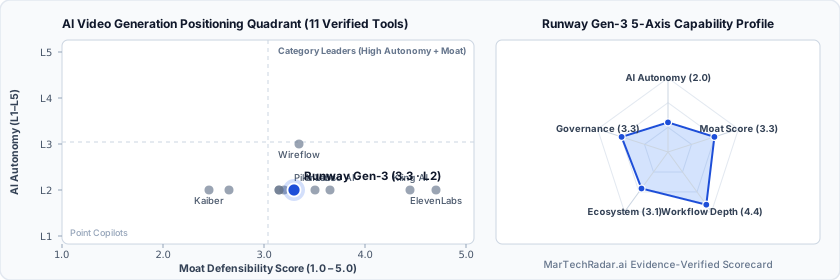
Runway Gen-3 is a Web SaaS tool for AI Video Generation (Generative Commercial Video & Media) in Visual & Creative Media. Pricing: Free plan · $15–$95/mo. Best suited to DTC / eCommerce, Enterprise Brands and Creators / Solo. Editor ratings: AI autonomy L2 (workflow copilot); moat score 3.3/5.0 (Workflow-embedded (strong)). Fact-checked by MarTechRadar Research Desk on Oct 12, 2026.
Multimodal video generation architecture and real-world intelligence foundation models delivering controllable camera trajectories and temporal visual.
Is Runway Gen-3 worth it in 2026? Buyer fit & when to walk away
Choose Runway Gen-3 if (Best Fit)
- Target ICP & Stack Fit: You operate as DTC / eCommerce, Enterprise Brands and Creators / Solo requiring a Web SaaS deployment for AI Video Generation, with verified ecosystem connectivity for Twilio Segment.
- L2 Architecture & Defensibility: Proprietary spatio-temporal video diffusion transformer models coupled with fine-grained motion controls, direct API access for programmatic pipelines, and high-fidelity video rendering infrastructure.
- Commercial Model Fit: Your procurement budget aligns with Free plan · $15–$95/mo and want a self-serve free tier for zero-cost initial validation.
Walk away from Runway Gen-3 if (Deal-Breakers)
- Walk away if your workflow cannot tolerate temporal drift and physics fidelity: Complex multi-actor interactions or rapid rotational physics can induce subtle anatomical deformations and frame-to-frame artifact accumulation over extended rendering windows.
- Walk away if determinism and seed reproducibility is a deal-breaker for your team: Exact seed recreation across iterative text prompts remains non-deterministic when altering fine motion parameters, complicating precise frame-level editorial revisions.
Runway Gen-3 pricing, free plan & scorecard at a glance
| Pricing | Free plan · $15–$95/moVendor pricing page |
|---|---|
| Free plan | Yes |
| Delivery | Web SaaS |
| Audience | DTC / eCommerce, Enterprise Brands, Creators / Solo |
| AI autonomy level | L2 · Workflow copilotEditor-verified |
| Moat tier & score | 3.3 / 5.0 · Workflow-embedded (strong)Editor-verified |
| Funding | Series C+ |
| Total funding | Series C+Backed by General Atlantic, Felicis, Google, NVIDIA |
| Ecosystem integrations | Twilio Segment |
| Governance & docs | System Status ↗ · API & Docs ↗ · Changelog ↗ · Terms ↗ · Privacy ↗ |
| Headquarters | New York, United States |
| Founded | 2018 |
| Last verified | Oct 12, 2026 |
Runway Gen-3 pros & cons: strengths vs. operational limitations
Pros: core strengths & capabilities
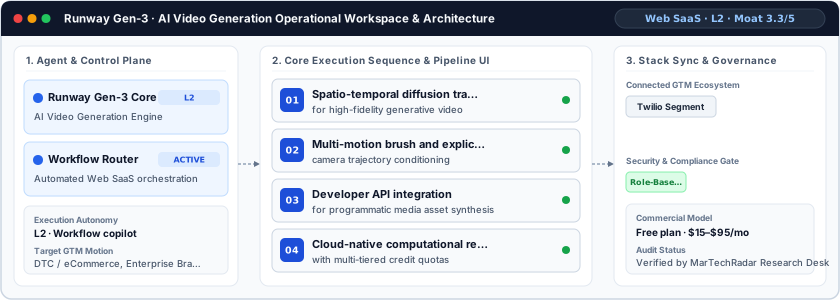
- Spatio-temporal diffusion transformer generation: for high-fidelity generative video
- Multi-motion brush and explicit: camera trajectory conditioning
- Developer API integration: for programmatic media asset synthesis
- Cloud-native computational rendering infrastructure: with multi-tiered credit quotas
Cons: operational limitations & risks
- Temporal drift and physics fidelity: Complex multi-actor interactions or rapid rotational physics can induce subtle anatomical deformations and frame-to-frame artifact accumulation over extended rendering windows.
- Determinism and seed reproducibility: Exact seed recreation across iterative text prompts remains non-deterministic when altering fine motion parameters, complicating precise frame-level editorial revisions.
- Computational rendering latency: Queueing and computational synthesis latency under peak GPU cluster loads prevent real-time feedback loops required for live broadcast or rapid collaborative assembly.
Runway Gen-3 TCO & deal-breaker stress test
Simulate 12-month stepped TCO, hidden cost multipliers, contract lock-in exposure, and stack failure modes using only facts verified by MarTechRadar Research Desk on 2026-10-12 · Capture SHA 3d051d94.
Runway Gen-3 is viable for 5 seats, but requires commercial or technical verification on the flagged items below.
- Moat Score
- 3.3 / 5.0
- AI Autonomy
- L2
- Free Tier / Trial
- Free plan
Triggered audit signals & failure modes
- Published Self-Serve Entry FloorVerified Pricing Ledger
Runway Gen-3 publishes a transparent entry point (Free plan · $15–$95/mo) with a free tier for initial validation before committing.
- Usage / Credit Burn VolatilityCommercial Model Audit
Runway Gen-3 uses credit or usage-metered billing (Free plan · $15–$95/mo). High-volume automated workflows across 5 seats can trigger mid-cycle overage charges.
- Tier Fit for 5-Seat Scale: Standard ($15/mo)Verified Tier Schedule
Billed annually. Save $36/year.
- Primary Operational Bottleneck: Temporal drift and physics fidelityAudit by MarTechRadar Research Desk
Complex multi-actor interactions or rapid rotational physics can induce subtle anatomical deformations and frame-to-frame artifact accumulation over extended rendering windows.
Test a custom Runway Gen-3 budget or stack constraint
Lower 5-seat floor (~$10/mo vs. $15 / mo)
Lower 5-seat floor (~$10/mo vs. $15 / mo)
Runway Gen-3 integrations, API, security & compliance stack
Runway Gen-3 AI moat & AI Video Generation positioning
Proprietary spatio-temporal video diffusion transformer models coupled with fine-grained motion controls, direct API access for programmatic pipelines, and high-fidelity video rendering infrastructure.
Runway Gen-3 in-depth review, pricing & architecture analysis
Editor sign-off: Oct 12, 2026. How profiles are made.
What is Runway Gen-3? Overview & background
Operating as a foundational video simulation architecture, Runway Gen-3 transitions commercial creative workflows from manual visual effects toward generative spatio-temporal synthesis. Established in 2018 and headquartered in New York, United States, the platform provides deep generative models aimed at enterprise creative directors, post-production studios, and brand media teams seeking programmatic visual generation. Rather than functioning as a standard video editing wrapper, the platform supplies foundational generative models engineered to simulate real-world motion, cinematic lighting, and physical environmental interactions across visual pipelines.
How Runway Gen-3 works: architecture & workflow
Under the hood, the system operates at an L2 workflow-copilot autonomy tier utilizing multimodal diffusion transformer networks trained across temporal visual data. Ingestion pipelines process multimodal input prompts—including descriptive text tokens, static reference imagery, and spatial motion brush coordinates—and project them into unified latent representations. Temporal attention layers govern inter-frame consistency, enforcing coherent vector trajectories and physical kinematics throughout dynamic camera paths. Synthetic rendering executes asynchronously across high-throughput GPU clusters, exposing programmatic REST API endpoints and web interfaces for iterative asset generation and export.
Runway Gen-3 limitations, drawbacks & risks
Operational considerations and platform boundaries include:
- Temporal drift and physics fidelity: Complex multi-actor interactions or rapid rotational physics can induce subtle anatomical deformations and frame-to-frame artifact accumulation over extended rendering windows.
- Determinism and seed reproducibility: Exact seed recreation across iterative text prompts remains non-deterministic when altering fine motion parameters, complicating precise frame-level editorial revisions.
- Computational rendering latency: Queueing and computational synthesis latency under peak GPU cluster loads prevent real-time feedback loops required for live broadcast or rapid collaborative assembly.
Runway Gen-3 pricing, plans & cost breakdown
Commercial procurement operates on a hybrid subscription and usage-based credit consumption model. Prospective teams can test model pipelines via a tier starting at $0 per month with introductory credits, before scaling into standard production tiers priced from $15 per month for individual builders up to $95 per month for higher computational quotas and team collaboration tiers. Extended production teams requiring programmatic batch volume or customized service levels license dedicated API credits alongside custom enterprise infrastructure contracts.
| Plan / Tier | Verified Price & Billing | Included Scope & Contract Terms | |
|---|---|---|---|
| Free / Sandbox | $0 | Free plan or free tier offered by the vendor. | |
| Standard | $15/mo | Billed annually. Save $36/year. | |
| Solo | $95/mo | Verified $95/mo Solo tier from vendor pricing schedule. | |
| Contract Watchout: Annual Billing Headline vs. Monthly Premium | The vendor pricing page advertises an annual-billing discount (Save $36/year); month-to-month billing carries a higher effective monthly rate. | ||
How Runway Gen-3 compares vs. competitors & alternatives
Within the generative video landscape, Runway Gen-3 positions directly against tools like InVideo AI, Kaiber, and Haiper AI within the AI Video Generation segment. While InVideo AI optimizes for template-driven social media script assembly and Kaiber emphasizes stylized audiovisual animation, Runway prioritizes granular cinematic fidelity and raw simulation physics. Furthermore, Haiper AI focuses on consumer-oriented prompt iteration, whereas Runway provides robust API infrastructure and direct camera steering controls. This architecture suits creative production houses requiring deterministic motion direction and production-grade cinematic asset rendering.
Frequently asked questions about Runway Gen-3
How much does Runway Gen-3 cost in 2026?
Runway Gen-3 pricing: Free plan · $15–$95/mo. A permanent free plan is available. Published tiers: Free / Sandbox ($0); Standard ($15/mo); Solo ($95/mo). Commercial procurement operates on a hybrid subscription and usage-based credit consumption model.
What are the top Runway Gen-3 alternatives in AI Video Generation?
Verified AI Video Generation alternatives include InVideo AI (Free plan · $20–$150/seat/mo), Kaiber ($10–$99/mo), Haiper AI (Custom / enterprise pricing), Kling AI (Usage-based pricing). Within the generative video landscape, Runway Gen-3 positions directly against tools like InVideo AI, Kaiber, and Haiper AI within the AI Video Generation segment.
What are the main limitations and trade-offs of Runway Gen-3?
Operational considerations and platform boundaries include: Temporal drift and physics fidelity: Complex multi-actor interactions or rapid rotational physics can induce subtle anatomical deformations and frame-to-frame artifact accumulation over extended rendering windows. Walk away if your workflow cannot tolerate temporal drift and physics fidelity: Complex multi-actor interactions or rapid rotational physics can induce subtle anatomical deformations and frame-to-frame artifact accumulation over extended rendering windows.
Verified sources & evidence trail
- Official product domain: https://runwayml.com
- Commercial pricing verification: https://runway.com/pricing
- First-party governance & documentation links: System Status · API & Docs · Changelog · Terms · Privacy
- Editor sign-off: Oct 12, 2026 (how profiles are made).
