Vue.ai Review (2026): AI Avatar Pricing, Pros & Cons
Bottom line
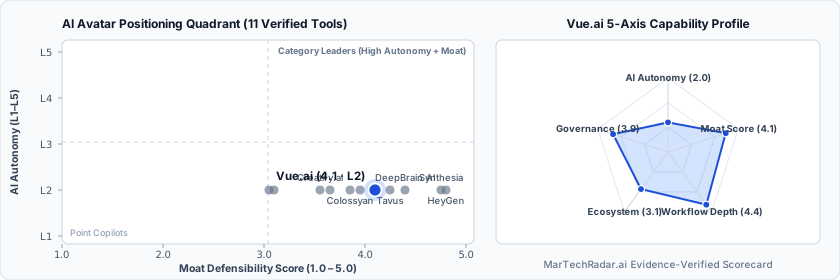
Vue.ai is a Web SaaS tool for AI Avatar (Digital Avatars & Presenters) in Visual & Creative Media. Pricing: Custom / enterprise pricing. Best suited to DTC / eCommerce and Enterprise Brands. Editor ratings: AI autonomy L2 (workflow copilot); moat score 4.1/5.0 (Proprietary moat). Fact-checked by MarTechRadar Research Desk on Oct 15, 2026.
Enterprise AI orchestration and computer vision platform automating digital catalog generation, synthetic models, and multi-channel visual content production.
Is Vue.ai worth it in 2026? Buyer fit & when to walk away
Choose Vue.ai if (Best Fit)
- Target ICP & Stack Fit: You operate as DTC / eCommerce and Enterprise Brands requiring a Web SaaS deployment for AI Avatar.
- L2 Architecture & Defensibility: Deep domain-specific neural rendering models tailored for retail visual merchandising, high-fidelity apparel draping pipelines, and enterprise-grade catalog integration pipelines.
- Commercial Model Fit: Your procurement budget aligns with Custom / enterprise pricing.
Walk away from Vue.ai if (Deal-Breakers)
- Walk away if you need published self-serve pricing: Vue.ai is sold by custom quote.
- Walk away if your workflow cannot tolerate high-fidelity complex silhouette distortion: The synthesis pipeline can introduce rendering artifacts on non-standard garment geometries, complex layered textures, and high-contrast reflective materials, requiring manual visual curation.
- Walk away if catalog ingestion schema rigidity is a deal-breaker for your team: Automated pose and drape alignment depends strictly on high-resolution input assets with precise silhouette extractions, introducing rendering failures when fed low-resolution legacy vendor imagery.
Vue.ai pricing, free plan & scorecard at a glance
| Pricing | Custom / enterprise pricing |
|---|---|
| Free plan | No / not disclosed |
| Delivery | Web SaaS |
| Audience | DTC / eCommerce, Enterprise Brands |
| AI autonomy level | L2 · Workflow copilotEditor-verified |
| Moat tier & score | 4.1 / 5.0 · Proprietary moatEditor-verified |
| Funding | AcquiredAcquired by M2P Fintech |
| Total funding | $17M |
| Founders | Anand Chandrasekaran, Ashwini Asokan, Costa Colbert |
| Company size | 201-500 employees |
| Governance & docs | Trust & Security ↗ · Privacy ↗ |
| Headquarters | Redwood City, California |
| Founded | 2016 |
| Last verified | Oct 15, 2026 |
Vue.ai pros & cons: strengths vs. operational limitations
Pros: core strengths & capabilities
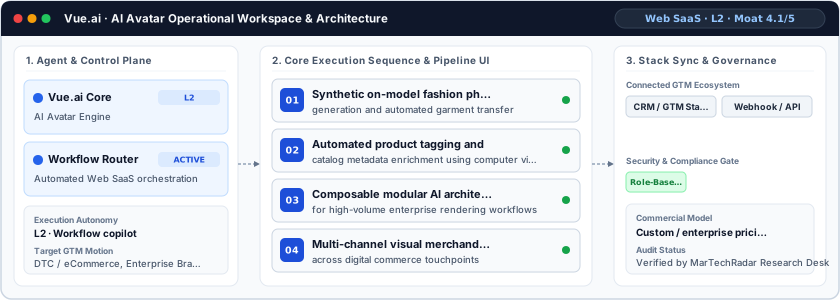
- Synthetic on-model fashion photography: generation and automated garment transfer
- Automated product tagging and catalog metadata enrichment using computer vision
- Composable modular AI architecture: for high-volume enterprise rendering workflows
- Multi-channel visual merchandising orchestration: across digital commerce touchpoints
Cons: operational limitations & risks
- High-Fidelity Complex Silhouette Distortion: The synthesis pipeline can introduce rendering artifacts on non-standard garment geometries, complex layered textures, and high-contrast reflective materials, requiring manual visual curation.
- Catalog Ingestion Schema Rigidity: Automated pose and drape alignment depends strictly on high-resolution input assets with precise silhouette extractions, introducing rendering failures when fed low-resolution legacy vendor imagery.
- Enterprise Integration Latency: High-throughput batch rendering jobs create queuing latency during bulk seasonal catalog refreshes, demanding pre-scheduled pipeline runs rather than dynamic on-demand generation.
Vue.ai TCO & deal-breaker stress test
Simulate 12-month stepped TCO, hidden cost multipliers, contract lock-in exposure, and stack failure modes using only facts verified by MarTechRadar Research Desk on 2026-10-15.
Vue.ai triggers high-severity friction under your 5-seat / $800/mo constraints. Benchmark the verified subtrack alternatives below before committing.
- Moat Score
- 4.1 / 5.0
- AI Autonomy
- L2
- Free Tier / Trial
- None disclosed
Triggered audit signals & failure modes
- Opaque Enterprise Quoting vs. SMB/Mid-Market BudgetVerified Pricing Ledger
Vue.ai does not disclose a public self-serve floor (Custom / enterprise pricing). Buyers with a $800/mo cap face high sales-qualification friction.
- Sales-Gated Contract TermsFact-checked by MarTechRadar Research Desk
Vue.ai structures its commercial model exclusively around direct enterprise contracts. Commercial pricing is available on request through tailored enterprise sales quotes based on organizational scale, SKU processing volumes, and deployed system modules.
- Primary Operational Bottleneck: High-Fidelity Complex Silhouette DistortionAudit by MarTechRadar Research Desk
The synthesis pipeline can introduce rendering artifacts on non-standard garment geometries, complex layered textures, and high-contrast reflective materials, requiring manual visual curation.
Test a custom Vue.ai budget or stack constraint
Lower 5-seat floor (~$24/mo vs. Custom Quote) · Transparent self-serve entry without mandatory annual lock-in
Lower 5-seat floor (~$14/mo vs. Custom Quote) · Transparent self-serve entry without mandatory annual lock-in
Vue.ai AI moat & AI Avatar positioning
Deep domain-specific neural rendering models tailored for retail visual merchandising, high-fidelity apparel draping pipelines, and enterprise-grade catalog integration pipelines.
Vue.ai in-depth review, pricing & architecture analysis
Editor sign-off: Oct 15, 2026. How profiles are made.
What is Vue.ai? Overview & background
Architected as a composable visual intelligence engine, Vue.ai delivers automated catalog and synthetic digital presenter infrastructure for high-velocity enterprise commerce teams. Headquartered in Redwood City, California, and established in 2016, the company accumulated $17M in venture backing prior to its acquisition by M2P Fintech. Designed for enterprise catalog operators, visual merchandisers, and digital commerce directors, the platform removes physical photography dependencies by generating high-fidelity synthetic representations across complex product catalogs.
How Vue.ai works: architecture & workflow
At its technical core, Vue.ai operates as an L3 automated media pipeline that ingests flat-lay garment imagery, structured metadata, and catalog feeds. The proprietary generative vision models execute automated garment transfer and photorealistic 3D human pose synthesis without requiring live physical studio shoots. The modular architecture standardizes lighting, fabric draping, skin rendering, and multi-angle perspectives across ingested asset tiers, orchestrating downstream export pipelines via enterprise API endpoints directly into customer commerce management systems.
Vue.ai limitations, drawbacks & risks
Operational considerations and platform boundaries include:
- High-Fidelity Complex Silhouette Distortion: The synthesis pipeline can introduce rendering artifacts on non-standard garment geometries, complex layered textures, and high-contrast reflective materials, requiring manual visual curation.
- Catalog Ingestion Schema Rigidity: Automated pose and drape alignment depends strictly on high-resolution input assets with precise silhouette extractions, introducing rendering failures when fed low-resolution legacy vendor imagery.
- Enterprise Integration Latency: High-throughput batch rendering jobs create queuing latency during bulk seasonal catalog refreshes, demanding pre-scheduled pipeline runs rather than dynamic on-demand generation.
Vue.ai pricing, plans & cost breakdown
Vue.ai structures its commercial model exclusively around direct enterprise contracts. Commercial pricing is available on request through tailored enterprise sales quotes based on organizational scale, SKU processing volumes, and deployed system modules. Deployment agreements typically incorporate dedicated implementation support, custom neural model fine-tuning for proprietary brand guidelines, and annual compute commitments tailored to seasonal merchandising cycles.
| Plan / Tier | Verified Price & Billing | Included Scope & Contract Terms |
|---|---|---|
| Enterprise / Custom | Custom quote | Custom-quoted plan; terms come from the vendor's sales team. |
How Vue.ai compares vs. competitors & alternatives
Compared to direct category competitors like Flair.ai and Photoroom, Vue.ai functions as an alternative focused on specialized workflow execution. Unlike general-purpose corporate avatar engines such as Synthesia, HeyGen, and Colossyan that focus on video-based talking presenters and training scripts, Vue.ai specializes in digital commerce automation, visual catalog synthesis, and apparel generation. While Synthesia and HeyGen lead corporate communication and multilingual presenter video generation via simple prompt interfaces, Vue.ai targets complex omnichannel retailers requiring structured SKU-level image pipelines and photorealistic on-model asset generation.
Direct competitors & market radar
Top algorithmic competitors based on category positioning, capability overlap, and ICP alignment.
Frequently asked questions about Vue.ai
Does Vue.ai publish pricing or require an enterprise quote?
Vue.ai pricing: Custom / enterprise pricing. No free plan is publicly disclosed. Vue.ai structures its commercial model exclusively around direct enterprise contracts.
What are the top Vue.ai alternatives in AI Avatar?
Verified AI Avatar alternatives include Veesual (From $40/mo), Hautech.ai (From $10), HeyGen (Free plan · $24–$149/mo), Synthesia (Free plan · $14–$89/mo). Compared to direct category competitors like Flair.ai and Photoroom, Vue.ai functions as an alternative focused on specialized workflow execution.
What are the main limitations and trade-offs of Vue.ai?
Operational considerations and platform boundaries include: High-Fidelity Complex Silhouette Distortion: The synthesis pipeline can introduce rendering artifacts on non-standard garment geometries, complex layered textures, and high-contrast reflective materials, requiring manual visual curation. Walk away if you need published self-serve pricing: Vue.ai is sold by custom quote.
Verified sources & evidence trail
- Official product domain: https://vue.ai
- Commercial pricing verification: Verified against official vendor pricing policy (Custom / enterprise pricing)
- Verified corporate entity profiles (
sameAs): LinkedIn Company Profile · Crunchbase Entity Record - First-party governance & documentation links: Trust & Security · Privacy
- Editor sign-off: Oct 15, 2026 (how profiles are made).
