Tavus Review (2026): AI Avatar Pricing, Pros & Cons
Bottom line
Tavus is a API / SDK tool for AI Avatar (Digital Avatars & Presenters) in Visual & Creative Media. Pricing: $22–$59/mo. Best suited to B2B SaaS, DTC / eCommerce and Enterprise Brands. Editor ratings: AI autonomy L2 (workflow copilot); moat score 4.2/5.0 (Proprietary moat). Fact-checked by MarTechRadar Research Desk on Oct 5, 2026.
Developer-first digital human platform generating real-time conversational avatars and automated 1:1 personalized video campaigns via proprietary neural.
Is Tavus worth it in 2026? Buyer fit & when to walk away
Choose Tavus if (Best Fit)
- Target ICP & Stack Fit: You operate as B2B SaaS, DTC / eCommerce and Enterprise Brands requiring a API / SDK deployment for AI Avatar.
- L2 Architecture & Defensibility: Tavus holds a competitive moat centered on its proprietary Griffin and Phoenix foundation models, delivering sub-second conversational latency and photorealistic facial synthesis over WebRTC APIs.
- Commercial Model Fit: Your procurement budget aligns with $22–$59/mo.
Walk away from Tavus if (Deal-Breakers)
- Walk away if your workflow cannot tolerate network latency sensitivity: Bidirectional conversational streaming requires stable packet delivery over WebRTC, where network jitter induces perceptible lip-flap desynchronization during live interactions.
- Walk away if training sample fidelity is a deal-breaker for your team: Digital twin accuracy depends on pristine base video capture, causing synthetic artifacts when input training data exhibits variable acoustic noise or uneven lighting.
Tavus pricing, free plan & scorecard at a glance
| Pricing | $22–$59/moVendor pricing page |
|---|---|
| Free plan | No / not disclosed |
| Delivery | API / SDK |
| Audience | B2B SaaS, DTC / eCommerce, Enterprise Brands |
| AI autonomy level | L2 · Workflow copilotEditor-verified |
| Moat tier & score | 4.2 / 5.0 · Proprietary moatEditor-verified |
| Funding | Series B |
| Total funding | $64.2MBacked by CRV, Scale Venture Partners, Sequoia Capital |
| Founders | Hassaan Raza, Quinn Favret |
| Company size | 51-200 employees |
| Governance & docs | API & Docs ↗ · Terms ↗ · Privacy ↗ |
| Headquarters | San Francisco, CA |
| Founded | 2020 |
| Last verified | Oct 5, 2026 |
Tavus pros & cons: strengths vs. operational limitations
Pros: core strengths & capabilities
- Griffin Human Interaction Model: for real-time conversational video streaming
- Phoenix neural rendering engine: for personalized asynchronous video generation
- Whitelabeled Conversational Video APIs: with multilingual lip-sync support
- Custom digital twin creation: with dynamic script and variable ingestion
Cons: operational limitations & risks
- Network latency sensitivity: Bidirectional conversational streaming requires stable packet delivery over WebRTC, where network jitter induces perceptible lip-flap desynchronization during live interactions.
- Training sample fidelity: Digital twin accuracy depends on pristine base video capture, causing synthetic artifacts when input training data exhibits variable acoustic noise or uneven lighting.
- Concurrency throughput ceilings: Executing real-time neural avatar rendering at scale introduces GPU resource competition, requiring strict rate limiting on concurrent interactive video sessions.
Tavus TCO & deal-breaker stress test
Simulate 12-month stepped TCO, hidden cost multipliers, contract lock-in exposure, and stack failure modes using only facts verified by MarTechRadar Research Desk on 2026-10-05 · Capture SHA 30136f43.
Tavus aligns with your 5-seat / $800/mo profile. Review the walk-away triggers and contract levers below before deployment.
- Moat Score
- 4.2 / 5.0
- AI Autonomy
- L2
- Free Tier / Trial
- None disclosed
Triggered audit signals & failure modes
- Published Self-Serve Entry FloorVerified Pricing Ledger
Tavus publishes a transparent entry point ($22–$59/mo) for initial validation before committing.
- Tier Fit for 5-Seat Scale: Growth ($397/mo)Verified Tier Schedule
For teams productionizing AI conversation experiences
- Primary Operational Bottleneck: Network latency sensitivityAudit by MarTechRadar Research Desk
Bidirectional conversational streaming requires stable packet delivery over WebRTC, where network jitter induces perceptible lip-flap desynchronization during live interactions.
Test a custom Tavus budget or stack constraint
Lower 5-seat floor (~$24/mo vs. $397 / mo)
Lower 5-seat floor (~$14/mo vs. $397 / mo)
Tavus AI moat & AI Avatar positioning
Tavus holds a competitive moat centered on its proprietary Griffin and Phoenix foundation models, delivering sub-second conversational latency and photorealistic facial synthesis over WebRTC APIs.
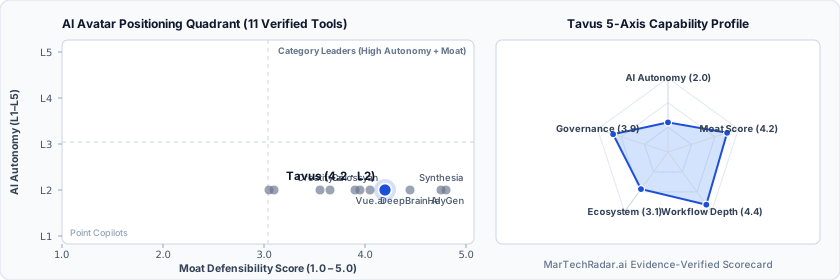
Tavus in-depth review, pricing & architecture analysis
Editor sign-off: Oct 5, 2026. How profiles are made.
What is Tavus? Overview & background
Backed by $64.2M in venture capital funding, Tavus was established in 2020 in San Francisco, CA, to eliminate asynchronous and interactive communication bottlenecks using synthetic digital humans. Built primarily for enterprise revenue teams, product engineers, and customer engagement architects, the platform replaces static video messaging and script recording with real-time generative avatar infrastructure. Positioned within modern conversational media workflows, Tavus targets organizations requiring programmatic 1:1 outbound generation alongside interactive synthetic video agents.
How Tavus works: architecture & workflow
At the architectural layer, the system conditional autonomy, Tavus pairs its proprietary Phoenix neural rendering engine with the Griffin Human Interaction Model to orchestrate both batched and real-time video outputs. The system ingests structured audio or text streams via developer APIs and parses dynamic merge tokens to align phonemes with facial micro-expressions. For live interactions, Tavus executes low-latency audio-to-video inference over WebRTC pipes, rendering bidirectional digital twins that react dynamically to user speech without pre-rendered video caches, alongside native workflow integrations for Salesforce and Slack under verified SOC 2 and HIPAA governance controls.
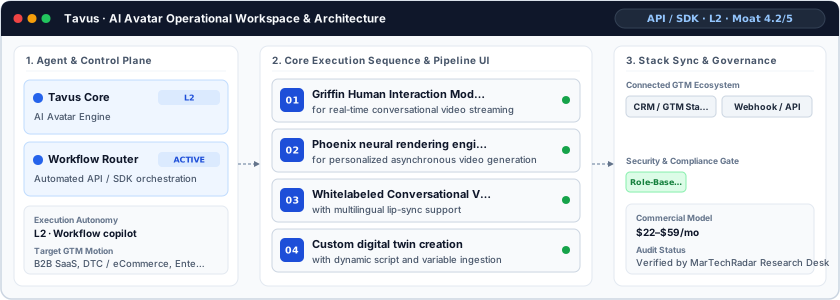
Tavus limitations, drawbacks & risks
Operational considerations and platform boundaries include:
- Network latency sensitivity: Bidirectional conversational streaming requires stable packet delivery over WebRTC, where network jitter induces perceptible lip-flap desynchronization during live interactions.
- Training sample fidelity: Digital twin accuracy depends on pristine base video capture, causing synthetic artifacts when input training data exhibits variable acoustic noise or uneven lighting.
- Concurrency throughput ceilings: Executing real-time neural avatar rendering at scale introduces GPU resource competition, requiring strict rate limiting on concurrent interactive video sessions.
Tavus pricing, plans & cost breakdown
Tavus distributes its infrastructure through tiered self-serve subscription plans alongside developer-focused API tiers. The platform provides a baseline entry tier starting at $22 per month for starter capacity, scaling up to standard tiers such as $59 per month for extended rendering minutes, custom face slots, and expanded interactive usage allowances. Enterprise volume contracts leverage custom commitments based on dedicated rendering capacity, elevated concurrent streams, and programmatic API call volume.
| Plan / Tier | Verified Price & Billing | Included Scope & Contract Terms |
|---|---|---|
| Starter | $22/mo | For builders starting to craft human-AI experiences |
| Growth | $397/mo | For teams productionizing AI conversation experiences |
How Tavus compares vs. competitors & alternatives
Within the synthetic avatar ecosystem, Tavus differentiates from studio-oriented competitors like Synthesia, Colossyan, and HeyGen by prioritizing real-time conversational streaming over templated presentation production within the AI Avatar segment. While Synthesia and Colossyan specialize in asynchronous corporate training and structured slide localization, Tavus targets programmatic, API-driven interactivity and bidirectional conversational agents. Buyers requiring structured internal enablement choose Synthesia, whereas development teams building autonomous video interaction pipelines adopt Tavus.
Direct competitors & market radar
Top algorithmic competitors based on category positioning, capability overlap, and ICP alignment.
Frequently asked questions about Tavus
How much does Tavus cost in 2026?
Tavus pricing: $22–$59/mo. No free plan is publicly disclosed. Published tiers: Starter ($22/mo); Growth ($397/mo). Tavus distributes its infrastructure through tiered self-serve subscription plans alongside developer-focused API tiers.
What are the top Tavus alternatives in AI Avatar?
Verified AI Avatar alternatives include HeyGen (Free plan · $24–$149/mo), Synthesia (Free plan · $14–$89/mo), Colossyan (From $27/mo), Naoma (From $249/mo). Within the synthetic avatar ecosystem, Tavus differentiates from studio-oriented competitors like Synthesia, Colossyan, and HeyGen by prioritizing real-time conversational streaming over templated presentation production within the AI Avatar segment.
What are the main limitations and trade-offs of Tavus?
Operational considerations and platform boundaries include: Network latency sensitivity: Bidirectional conversational streaming requires stable packet delivery over WebRTC, where network jitter induces perceptible lip-flap desynchronization during live interactions. Walk away if your workflow cannot tolerate network latency sensitivity: Bidirectional conversational streaming requires stable packet delivery over WebRTC, where network jitter induces perceptible lip-flap desynchronization during live interactions.
Verified sources & evidence trail
- Official product domain: https://tavus.io
- Commercial pricing verification: https://www.tavus.io/pricing
- Verified corporate entity profiles (
sameAs): LinkedIn Company Profile · Crunchbase Entity Record - First-party governance & documentation links: API & Docs · Terms · Privacy
- Editor sign-off: Oct 5, 2026 (how profiles are made).
