Colossyan Review (2026): AI Avatar Pricing, Pros & Cons
Bottom line
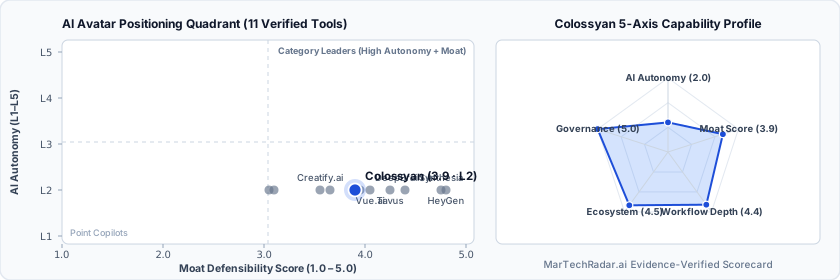
Colossyan is a Web SaaS tool for AI Avatar (Digital Avatars & Presenters) in Visual & Creative Media. Pricing: From $27/mo. Best suited to B2B SaaS, DTC / eCommerce and Enterprise Brands. Editor ratings: AI autonomy L2 (workflow copilot); moat score 3.9/5.0 (Proprietary moat). Fact-checked by MarTechRadar Research Desk on Oct 4, 2026.
AI-powered video generation platform purpose-built for enterprise learning, training, and corporate enablement workflows.
Is Colossyan worth it in 2026? Buyer fit & when to walk away
Choose Colossyan if (Best Fit)
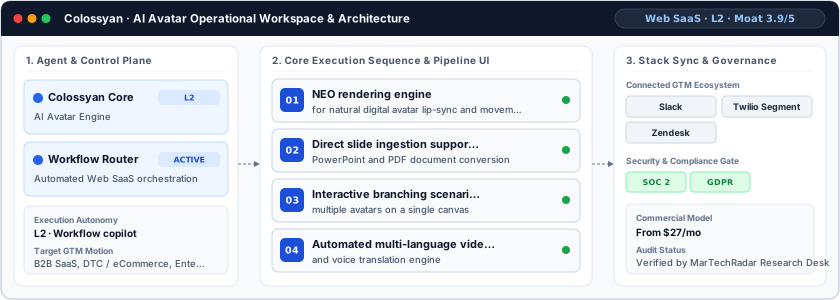
- Target ICP & Stack Fit: You operate as B2B SaaS, DTC / eCommerce and Enterprise Brands requiring a Web SaaS deployment for AI Avatar, with verified ecosystem connectivity for Slack, Twilio Segment, Zendesk.
- L2 Architecture & Defensibility: Proprietary NEO rendering engine tailored for multi-avatar interactions, SCORM-compliant training export paths, and automated slide-to-video ingestion pipelines.
- Commercial Model Fit: Your procurement budget aligns with From $27/mo.
Walk away from Colossyan if (Deal-Breakers)
- Walk away if your workflow cannot tolerate complex slide layout drift: Automated PowerPoint imports frequently encounter formatting regressions when parsing non-standard typography, complex vector shapes, or nested animations, requiring manual canvas readjustment.
- Walk away if rendering queue latency is a deal-breaker for your team: Generating high-definition multi-avatar sequences during peak usage windows induces asynchronous rendering bottlenecks, delaying rapid iteration loops during instructional module revisions.
Colossyan pricing, free plan & scorecard at a glance
| Pricing | From $27/moVendor pricing page |
|---|---|
| Free plan | No / not disclosed |
| Delivery | Web SaaS |
| Audience | B2B SaaS, DTC / eCommerce, Enterprise Brands |
| AI autonomy level | L2 · Workflow copilotEditor-verified |
| Moat tier & score | 3.9 / 5.0 · Proprietary moatEditor-verified |
| Funding | Series A |
| Total funding | $28.2MBacked by Lakestar, Launchub Ventures |
| Founders | Dominik Mate Kovacs, Kristof Szabo, Zoltan Kovacs |
| Company size | 51-200 employees |
| Ecosystem integrations | Slack, Twilio Segment, Zendesk |
| Compliance & governance | SOC 2, GDPR |
| Governance & docs | Trust & Security ↗ · System Status ↗ · Terms ↗ · Privacy ↗ |
| Headquarters | London, United Kingdom |
| Founded | 2020 |
| Last verified | Oct 4, 2026 |
Colossyan pros & cons: strengths vs. operational limitations
Pros: core strengths & capabilities
- NEO rendering engine: for natural digital avatar lip-sync and movement
- Direct slide ingestion supporting: PowerPoint and PDF document conversion
- Interactive branching scenarios and multiple avatars on a single canvas
- Automated multi-language video localization and voice translation engine
Cons: operational limitations & risks
- Complex Slide Layout Drift: Automated PowerPoint imports frequently encounter formatting regressions when parsing non-standard typography, complex vector shapes, or nested animations, requiring manual canvas readjustment.
- Rendering Queue Latency: Generating high-definition multi-avatar sequences during peak usage windows induces asynchronous rendering bottlenecks, delaying rapid iteration loops during instructional module revisions.
- Custom Gesture Rigidity: Synthetic actors lack contextual behavioral adaptability, limiting presenter bodily movements to predefined pose intervals rather than organic, content-responsive physical demonstrations.
Colossyan TCO & deal-breaker stress test
Simulate 12-month stepped TCO, hidden cost multipliers, contract lock-in exposure, and stack failure modes using only facts verified by MarTechRadar Research Desk on 2026-10-04 · Capture SHA f376de45.
Colossyan aligns with your 5-seat / $800/mo profile. Review the walk-away triggers and contract levers below before deployment.
- Moat Score
- 3.9 / 5.0
- AI Autonomy
- L2
- Free Tier / Trial
- None disclosed
Triggered audit signals & failure modes
- Published Self-Serve Entry FloorVerified Pricing Ledger
Colossyan publishes a transparent entry point (From $27/mo) for initial validation before committing.
- Primary Operational Bottleneck: Complex Slide Layout DriftAudit by MarTechRadar Research Desk
Automated PowerPoint imports frequently encounter formatting regressions when parsing non-standard typography, complex vector shapes, or nested animations, requiring manual canvas readjustment.
Test a custom Colossyan budget or stack constraint
Lower 5-seat floor (~$24/mo vs. $30 / mo)
Lower 5-seat floor (~$14/mo vs. $30 / mo)
Colossyan integrations, API, security & compliance stack
Colossyan AI moat & AI Avatar positioning
Proprietary NEO rendering engine tailored for multi-avatar interactions, SCORM-compliant training export paths, and automated slide-to-video ingestion pipelines.
Colossyan in-depth review, pricing & architecture analysis
Editor sign-off: Oct 4, 2026. How profiles are made.
What is Colossyan? Overview & background
To scale structured corporate enablement without recurring studio production costs, instructional designers require automated synthesis platforms that convert instructional text into interactive visual modules. Colossyan, established in 2020 and headquartered in London, United Kingdom, addresses this operational requirement for enterprise corporate learning and development teams. Backed by $28.2M in total venture funding, the company provides synthetic media tooling engineered specifically for training coordinators, compliance departments, and workforce development leads.
How Colossyan works: architecture & workflow
Colossyan operates at an L2 autonomy tier, utilizing its proprietary NEO rendering pipeline alongside neural text-to-speech and facial animation algorithms. The ingestion pipeline accepts raw instructional scripts, PDF files, or PowerPoint slide decks, mapping textual narration into synthetic voice streams with localized inflection. The system simultaneously sequences visual canvas elements, positioning digital avatars across single or multi-speaker layouts. Avatars perform phoneme-matched lip movements aligned with the synthesized audio tracks, outputting exportable MP4 training assets or SCORM-compliant interactive modules, alongside native workflow integrations for Slack and Zendesk under verified SOC 2 Type II and GDPR governance controls.
Colossyan limitations, drawbacks & risks
Operational considerations and platform boundaries include:
- Complex Slide Layout Drift: Automated PowerPoint imports frequently encounter formatting regressions when parsing non-standard typography, complex vector shapes, or nested animations, requiring manual canvas readjustment.
- Rendering Queue Latency: Generating high-definition multi-avatar sequences during peak usage windows induces asynchronous rendering bottlenecks, delaying rapid iteration loops during instructional module revisions.
- Custom Gesture Rigidity: Synthetic actors lack contextual behavioral adaptability, limiting presenter bodily movements to predefined pose intervals rather than organic, content-responsive physical demonstrations.
Colossyan pricing, plans & cost breakdown
Colossyan operates a recurring subscription model billed monthly or annually, with tiered tiers scaling by allocated rendering volume. Entry access begins with the Starter tier from $27 per month, which provisions core digital avatars and monthly video generation allotments. Mid-market and enterprise packages unlock expanded rendering limits, interactive scenario branching, custom avatar training, centralized brand kits, and shared corporate workspace administration.
| Plan / Tier | Verified Price & Billing | Included Scope & Contract Terms |
|---|---|---|
| Teams | $30/mo | /mo per additional member |
How Colossyan compares vs. competitors & alternatives
In the synthetic avatar sector, Colossyan contends directly against Synthesia, HeyGen, and Tavus within the AI Avatar segment. While Synthesia targets broad enterprise communications and HeyGen focuses heavily on short-form sales personalization and marketing assets, Colossyan specializes in structured learning architecture, featuring native course-building tools, side-by-side avatar dialogue, and interactive branching. Tavus differentiates through dynamic programmatic video APIs, making Colossyan the pragmatic choice for compliance officers and corporate trainers prioritizing turnkey, slide-driven educational curricula.
Direct competitors & market radar
Top algorithmic competitors based on category positioning, capability overlap, and ICP alignment.
Frequently asked questions about Colossyan
How much does Colossyan cost in 2026?
Colossyan pricing: From $27/mo. No free plan is publicly disclosed. Colossyan operates a recurring subscription model billed monthly or annually, with tiered tiers scaling by allocated rendering volume.
What are the top Colossyan alternatives in AI Avatar?
Verified AI Avatar alternatives include HeyGen (Free plan · $24–$149/mo), Synthesia (Free plan · $14–$89/mo), Tavus ($22–$59/mo), Naoma (From $249/mo). In the synthetic avatar sector, Colossyan contends directly against Synthesia, HeyGen, and Tavus within the AI Avatar segment.
What are the main limitations and trade-offs of Colossyan?
Operational considerations and platform boundaries include: Complex Slide Layout Drift: Automated PowerPoint imports frequently encounter formatting regressions when parsing non-standard typography, complex vector shapes, or nested animations, requiring manual canvas readjustment. Walk away if your workflow cannot tolerate complex slide layout drift: Automated PowerPoint imports frequently encounter formatting regressions when parsing non-standard typography, complex vector shapes, or nested animations, requiring manual canvas readjustment.
Verified sources & evidence trail
- Official product domain: https://colossyan.com
- Commercial pricing verification: https://www.colossyan.com/pricing/
- Verified corporate entity profiles (
sameAs): LinkedIn Company Profile · Crunchbase Entity Record - First-party governance & documentation links: Trust & Security · System Status · Terms · Privacy
- Editor sign-off: Oct 4, 2026 (how profiles are made).
