AppGrowing Review (2026): Marketing Attribution Pricing, Pros & Cons
Bottom line
AppGrowing is a Web SaaS tool for Marketing Attribution (Multi-Touch Attribution & eCommerce Dashboards) in Analytics & Attribution. Pricing: Custom / enterprise pricing. Best suited to DTC / eCommerce. Editor ratings: AI autonomy L2 (workflow copilot); moat score 1.5/5.0 (Thin wrapper). Fact-checked by MarTechRadar Research Desk on Oct 16, 2026.
Multi-touch attribution and eCommerce analytics platform tracking mobile ad performance, creative intelligence, and cross-channel conversion paths.
Is AppGrowing worth it in 2026? Buyer fit & when to walk away
Choose AppGrowing if (Best Fit)
- Target ICP & Stack Fit: You operate as DTC / eCommerce requiring a Web SaaS deployment for Marketing Attribution.
- L2 Architecture & Defensibility: Deep integration with mobile ad networks combined with algorithmic cross-device identity graphs and cross-platform creative attribution indices.
- Commercial Model Fit: Your procurement budget aligns with Custom / enterprise pricing.
Walk away from AppGrowing if (Deal-Breakers)
- Walk away if you need published self-serve pricing: AppGrowing is sold by custom quote.
- Walk away if your workflow cannot tolerate privacy framework degradation: Apple SKAdNetwork constraints and Google Privacy Sandbox policies limit granular deterministic matching on iOS and Android devices, introducing attribution window delays.
- Walk away if API schema drift is a deal-breaker for your team: Third-party ad network reporting endpoints periodically alter breakdown dimensions, requiring frequent data pipeline adjustments to prevent missing spend telemetry.
AppGrowing pricing, free plan & scorecard at a glance
| Pricing | Custom / enterprise pricing |
|---|---|
| Free plan | No / not disclosed |
| Delivery | Web SaaS |
| Audience | DTC / eCommerce |
| AI autonomy level | L2 · Workflow copilotEditor-verified |
| Moat tier & score | 1.5 / 5.0 · Thin wrapperEditor-verified |
| Funding | Bootstrapped |
| Headquarters | United States |
| Last verified | Oct 16, 2026 |
AppGrowing pros & cons: strengths vs. operational limitations
Pros: core strengths & capabilities
- Cross-channel multi-touch attribution modeling: across paid acquisition sources
- Real-time creative intelligence and ad performance benchmarking
- Unified eCommerce conversion dashboards and lifetime value tracking
- Server-side event streaming and ad spend reconciliation pipelines
Cons: operational limitations & risks
- Privacy framework degradation: Apple SKAdNetwork constraints and Google Privacy Sandbox policies limit granular deterministic matching on iOS and Android devices, introducing attribution window delays.
- API schema drift: Third-party ad network reporting endpoints periodically alter breakdown dimensions, requiring frequent data pipeline adjustments to prevent missing spend telemetry.
- Data volume overhead: High-velocity eCommerce stores generating millions of daily micro-events encounter compute latency during un-aggregated raw log queries and retroactive model recalibrations.
AppGrowing TCO & deal-breaker stress test
Simulate 12-month stepped TCO, hidden cost multipliers, contract lock-in exposure, and stack failure modes using only facts verified by MarTechRadar Research Desk on 2026-10-16.
AppGrowing triggers high-severity friction under your 5-seat / $800/mo constraints. Benchmark the verified subtrack alternatives below before committing.
- Moat Score
- 1.5 / 5.0
- AI Autonomy
- L2
- Free Tier / Trial
- None disclosed
Triggered audit signals & failure modes
- Opaque Enterprise Quoting vs. SMB/Mid-Market BudgetVerified Pricing Ledger
AppGrowing does not disclose a public self-serve floor (Custom / enterprise pricing). Buyers with a $800/mo cap face high sales-qualification friction.
- Sales-Gated Contract TermsFact-checked by MarTechRadar Research Desk
Pricing is available on request through tailored enterprise sales quotes, with custom enterprise tiers structured around organizational scale, user seats, and workflow volume.
- Primary Operational Bottleneck: Privacy framework degradationAudit by MarTechRadar Research Desk
Apple SKAdNetwork constraints and Google Privacy Sandbox policies limit granular deterministic matching on iOS and Android devices, introducing attribution window delays.
Test a custom AppGrowing budget or stack constraint
Offers a free tier (Custom / enterprise pricing) · Transparent self-serve entry without mandatory annual lock-in
Verified Marketing Attribution peer (Custom / enterprise pricing · Moat 2.1/5.0)
AppGrowing AI moat & Marketing Attribution positioning
Deep integration with mobile ad networks combined with algorithmic cross-device identity graphs and cross-platform creative attribution indices.
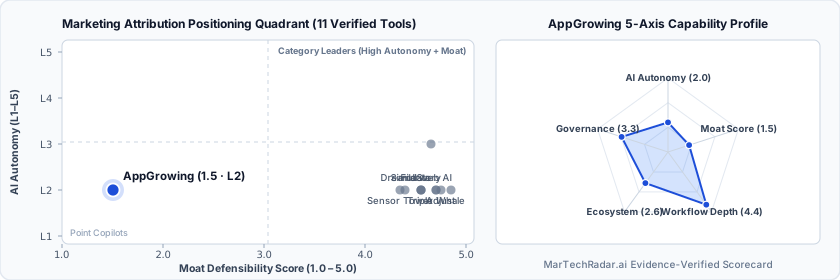
AppGrowing in-depth review, pricing & architecture analysis
Editor sign-off: Oct 16, 2026. How profiles are made.
What is AppGrowing? Overview & background
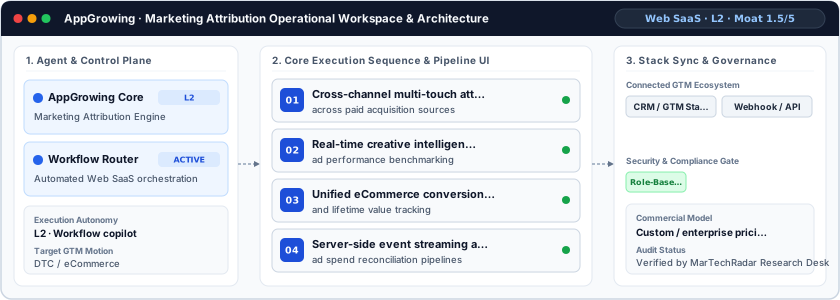
AppGrowing addresses the operational mandate of reconciling cross-channel mobile acquisition spend with downstream commerce revenue. Based in the United States, the platform provides eCommerce performance marketing leaders, user acquisition specialists, and growth analytics teams with unified measurement across fragmented advertising ecosystems. Rather than relying on siloed network reporting, the system captures full-funnel customer interaction histories to attribute incremental returns accurately across digital campaigns.
How AppGrowing works: architecture & workflow
The platform ingestion engine captures first-party transactional events through server-to-server endpoints alongside direct API feeds from ad networks. Collected interaction touchpoints pass through normalization pipelines that clean campaign metadata, track ad creatives, and align ad spend with user IDs. Conversion attribution executes algorithmic models—spanning first-touch, position-based, and probabilistic multi-touch formulas—to map post-install conversion behavior back to upstream creative placements. The architecture surfaces unified return-on-ad-spend metrics directly into automated analytics dashboards.
AppGrowing limitations, drawbacks & risks
Operational considerations and platform boundaries include:
- Privacy framework degradation: Apple SKAdNetwork constraints and Google Privacy Sandbox policies limit granular deterministic matching on iOS and Android devices, introducing attribution window delays.
- API schema drift: Third-party ad network reporting endpoints periodically alter breakdown dimensions, requiring frequent data pipeline adjustments to prevent missing spend telemetry.
- Data volume overhead: High-velocity eCommerce stores generating millions of daily micro-events encounter compute latency during un-aggregated raw log queries and retroactive model recalibrations.
AppGrowing pricing, plans & cost breakdown
Pricing is available on request through tailored enterprise sales quotes, with custom enterprise tiers structured around organizational scale, user seats, and workflow volume.
| Plan / Tier | Verified Price & Billing | Included Scope & Contract Terms |
|---|---|---|
| Enterprise / Custom | Custom quote | Custom-quoted plan; terms come from the vendor's sales team. |
How AppGrowing compares vs. competitors & alternatives
Within the performance analytics ecosystem, AppGrowing competes alongside pure-play mobile measurement providers like Adjust and AppsFlyer, as well as data integration platforms like Adverity. While Adjust and AppsFlyer center architectural focus on deep OS-level SDK attribution and fraud mitigation, AppGrowing emphasizes creative-level tracking and eCommerce purchase correlation. In contrast to Adverity, which functions as an un-opinionated ETL pipeline, AppGrowing delivers out-of-the-box attribution modeling suited for high-growth mobile-first retail brands.
Frequently asked questions about AppGrowing
Does AppGrowing publish pricing or require an enterprise quote?
AppGrowing pricing: Custom / enterprise pricing. No free plan is publicly disclosed. Pricing is available on request through tailored enterprise sales quotes, with custom enterprise tiers structured around organizational scale, user seats, and workflow volume.
What are the top AppGrowing alternatives in Marketing Attribution?
Verified Marketing Attribution alternatives include Nielsen ONE (Custom / enterprise pricing), Branch Metrics AI (Custom / enterprise pricing), PowerMyAnalytics (Custom / enterprise pricing), Adjust (Custom / enterprise pricing). Within the performance analytics ecosystem, AppGrowing competes alongside pure-play mobile measurement providers like Adjust and AppsFlyer, as well as data integration platforms like Adverity.
What are the main limitations and trade-offs of AppGrowing?
Operational considerations and platform boundaries include: Privacy framework degradation: Apple SKAdNetwork constraints and Google Privacy Sandbox policies limit granular deterministic matching on iOS and Android devices, introducing attribution window delays. Walk away if you need published self-serve pricing: AppGrowing is sold by custom quote.
Verified sources & evidence trail
- Official product domain: https://appgrowing.com
- Commercial pricing verification: Verified against official vendor pricing policy (Custom / enterprise pricing)
- Editor sign-off: Oct 16, 2026 (how profiles are made).
