Zime AI Review (2026): AI SDR Pricing, Limits & Alternatives
Bottom line
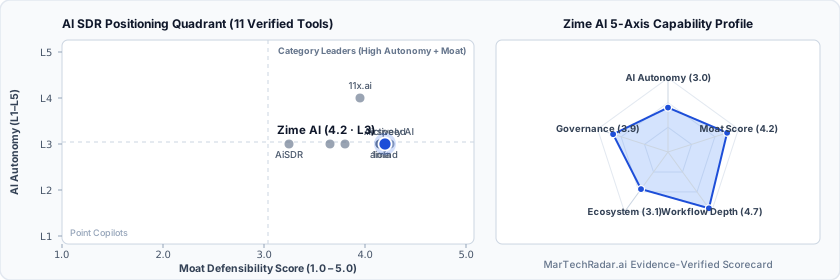
Zime AI is a Web SaaS tool for AI SDR (Autonomous B2B Sales Agents & AI BDRs) in AI SDR & Outbound. Pricing: Custom / enterprise pricing. Best suited to B2B Sales Leaders, SDR/BDR Teams and Revenue Operations (RevOps). Editor ratings: AI autonomy L3 (conditional automation); moat score 4.2/5.0 (Proprietary moat). Fact-checked by Anna Xia on Oct 11, 2026.
Behavioral AI sales execution platform operating via Behavior Graphs and context protocols to enforce playbook adherence and autonomous pipeline guidance.
Zime AI buyer fit verdict: when to choose vs. when to walk away
Choose Zime AI if (Best Fit)
- Target ICP & Stack Fit: You operate as B2B Sales Leaders, SDR/BDR Teams and Revenue Operations (RevOps) requiring a Web SaaS deployment for AI SDR.
- L3 Architecture & Defensibility: Proprietary Behavior Graph mapping seller-buyer interaction dynamics alongside context-aware Model Context Protocols (MCPs) for in-house enterprise sales agents.
- Commercial Model Fit: Your procurement budget aligns with Custom / enterprise pricing.
Walk away from Zime AI if (Deal-Breakers)
- Walk away if you require transparent self-serve monthly billing or your budget ceiling is under $1,000/mo (Zime AI requires sales-gated custom quoting).
- Walk away if your workflow cannot tolerate telemetry pipeline latency: Behavior Graph freshness is tethered to third-party call recording and meeting ingestion webhooks, creating analysis lag if meeting platform exports delay transcription processing.
- Walk away if schema and CRM drift is a deal-breaker for your team: Automated pipeline writebacks fail or create data validation errors when enterprise CRM custom object schemas, stage exit criteria, or essential validation rules mutate without synchronized field mappings.
Zime AI key facts & scorecard
| Pricing | Custom / enterprise pricing |
|---|---|
| Free plan | No / not disclosed |
| Delivery | Web SaaS |
| Audience | B2B Sales Leaders, SDR/BDR Teams, Revenue Operations (RevOps) |
| AI autonomy level | L3 · Conditional automationEditor-verified |
| Moat tier & score | 4.2 / 5.0 · Proprietary moatEditor-verified |
| Funding | Seed |
| Total funding | $2.5MBacked by AUM Ventures, z21 Ventures, Jolly VC |
| Founders | Kevin Staight, Sanchit Garg, Vishnu Khandelwal |
| Company size | 11-50 employees |
| Governance & docs | API & Docs ↗ · Privacy ↗ |
| Headquarters | San Jose, CA |
| Founded | 2023 |
| Last verified |
Zime AI pros & cons: strengths vs. operational limitations
Pros: core strengths & capabilities
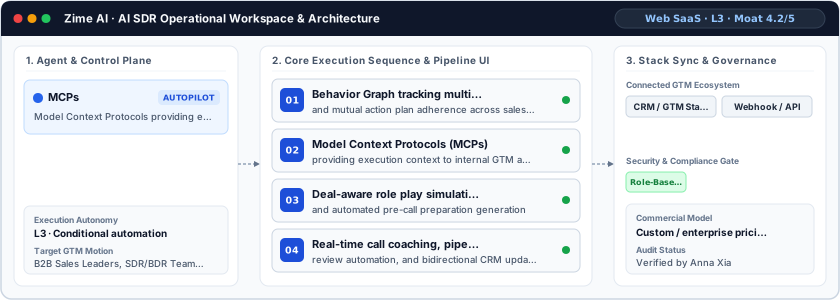
- Behavior Graph tracking multi-threading: and mutual action plan adherence across sales touchpoints
- Model Context Protocols (MCPs): providing execution context to internal GTM agents
- Deal-aware role play simulations: and automated pre-call preparation generation
- Real-time call coaching, pipeline: review automation, and bidirectional CRM updates
Cons: operational limitations & risks
- Telemetry Pipeline Latency: Behavior Graph freshness is tethered to third-party call recording and meeting ingestion webhooks, creating analysis lag if meeting platform exports delay transcription processing.
- Schema and CRM Drift: Automated pipeline writebacks fail or create data validation errors when enterprise CRM custom object schemas, stage exit criteria, or essential validation rules mutate without synchronized field mappings.
- Context Boundary Hallucinations: Autonomous role-play and coaching guidance degrade across complex, multi-product line enterprises where buyer personas diverge sharply from standard playbook training corpora.
Zime AI TCO & deal-breaker stress test
Simulate 12-month stepped TCO, hidden cost multipliers, contract lock-in exposure, and stack failure modes using only facts verified by Anna Xia on · Capture SHA 299208bd.
Zime AI triggers high-severity friction under your 5-seat / $800/mo constraints. Benchmark the verified subtrack alternatives below before committing.
| Plan / Tier | Verified Rate | Scale Fit | Scope & Quota Notes |
|---|---|---|---|
| Enterprise / Custom | Custom quote | 15–50+ seats (Enterprise SLA) | Sales-negotiated annual contract for custom volume, SSO/RBAC governance, and dedicated SLA. |
- Moat Score
- 4.2 / 5.0
- AI Autonomy
- L3
- Free Tier / Trial
- None disclosed
Triggered audit signals & failure modes
- Opaque Enterprise Quoting vs. SMB/Mid-Market BudgetVerified Pricing Ledger
Zime AI does not disclose a public self-serve floor (Custom / enterprise pricing). Buyers with a $800/mo cap face high sales-qualification friction.
- Sales-Gated Contract TermsFact-checked by Anna Xia
Zime AI distributes its platform under an enterprise B2B sales motion without published rate cards. Commercial access is structured via custom enterprise sales quotes based on organizational deployment scale, seat counts, and integration volume.
- Primary Operational Bottleneck: Telemetry Pipeline LatencyAudit by Anna Xia
Behavior Graph freshness is tethered to third-party call recording and meeting ingestion webhooks, creating analysis lag if meeting platform exports delay transcription processing.
Hidden TCO Multipliers & Quota Gates
- Telemetry Pipeline Latency: Behavior Graph freshness is tethered to third-party call recording and meeting ingestion webhooks, creating analysis lag if meeting platform exports delay transcription processing.
- Schema and CRM Drift: Automated pipeline writebacks fail or create data validation errors when enterprise CRM custom object schemas, stage exit criteria, or essential validation rules mutate without synchronized field mappings.
When to Walk Away & Negotiation Levers
- Walk away if you require transparent self-serve monthly billing or your budget ceiling is under $1,000/mo (Zime AI requires sales-gated custom quoting).
- Walk away if your workflow cannot tolerate telemetry pipeline latency: Behavior Graph freshness is tethered to third-party call recording and meeting ingestion webhooks, creating analysis lag if meeting platform exports delay transcription processing.
- Walk away if schema and CRM drift is a deal-breaker for your team: Automated pipeline writebacks fail or create data validation errors when enterprise CRM custom object schemas, stage exit criteria, or essential validation rules mutate without synchronized field mappings.
- Demand a 30- to 60-day paid pilot opt-out clause in the Zime AI order form before signing a 12-month enterprise commitment.
- Require a sandbox proof-of-concept testing telemetry pipeline latency against your live CRM/data schema before annual sign-off.
Ask a custom procurement or TCO stress-test question about Zime AI
Lower 5-seat floor (~$599/mo vs. Custom Quote) · Transparent self-serve entry without mandatory annual lock-in
Offers a free tier (Free plan · $0/mo · Enterprise plan) · Transparent self-serve entry without mandatory annual lock-in
Zime AI key entities, modules & ecosystem stack
Model Context Protocols providing execution context to internal GTM agents
Zime AI moat & subtrack positioning
Proprietary Behavior Graph mapping seller-buyer interaction dynamics alongside context-aware Model Context Protocols (MCPs) for in-house enterprise sales agents.
Editorial review
Fact-checked by Anna Xia (Senior B2B GTM & Revenue Systems Analyst) on .
Background
Architected to solve rep-level playbook divergence within enterprise go-to-market stacks, Zime AI operates as a behavioral artificial intelligence engine for sales execution. Headquartered in San Jose, CA, and founded in 2023, the startup secured $2.5M in venture capital funding to ground agentic automation directly in frontline selling motions. Targeted at sales leadership, revenue operations architects, and enablement teams, the platform ensures automated sales directives align with actual buyer interactions rather than theoretical pipeline blueprints.
How Zime AI works
Operating at an L3 autonomy tier, Zime AI ingests multi-channel telemetry from customer relationship management databases, communication logs, and conversation intelligence tools into a centralized Behavior Graph. The platform contextualizes seller activity against historical deal journeys, utilizing specialized Model Context Protocols (MCPs) to supply execution context to autonomous and internal sales agents. Based on continuous inference of stakeholder engagement, multi-threading health, and deal velocity, it programmatically generates pre-meeting briefs, real-time tactical interventions, and autonomous CRM updates without requiring manual sales rep prompting.
Limitations
Operational considerations and platform boundaries include:
- Telemetry Pipeline Latency: Behavior Graph freshness is tethered to third-party call recording and meeting ingestion webhooks, creating analysis lag if meeting platform exports delay transcription processing.
- Schema and CRM Drift: Automated pipeline writebacks fail or create data validation errors when enterprise CRM custom object schemas, stage exit criteria, or essential validation rules mutate without synchronized field mappings.
- Context Boundary Hallucinations: Autonomous role-play and coaching guidance degrade across complex, multi-product line enterprises where buyer personas diverge sharply from standard playbook training corpora.
Zime AI pricing
Zime AI distributes its platform under an enterprise B2B sales motion without published rate cards. Commercial access is structured via custom enterprise sales quotes based on organizational deployment scale, seat counts, and integration volume. Prospective buyers must engage the vendor directly for procurement scoping, customized proof-of-concept evaluations, and contract negotiations.
How Zime AI compares
Within the autonomous sales execution landscape, Zime AI differentiates by addressing post-pipeline interaction fidelity rather than pure outbound prospecting volume. Where platforms like 11x.ai deploy autonomous inbound and outbound SDR agents to generate top-of-funnel pipeline, Zime AI prioritizes mid-funnel deal governance and live behavioral steering. Compared to solutions like 1mind and Actively AI that automate programmatic buyer engagement sequences, Zime AI targets mid-market to enterprise revenue organizations requiring strict playbook adherence and granular context injection across distributed sales teams.
Direct competitors & market radar
Top algorithmic competitors based on category positioning, capability overlap, and ICP alignment.
Frequently asked questions about Zime AI
How much does Zime AI cost and does it require a custom enterprise quote?
Published pricing summary for Zime AI: Custom / enterprise pricing. A permanent free plan is not disclosed for Zime AI. Zime AI distributes its platform under an enterprise B2B sales motion without published rate cards. Commercial access is structured via custom enterprise sales quotes based on organizational deployment scale, seat counts, and integration volume.
How does Zime AI work and how autonomous is its AI architecture?
Behavioral AI sales execution platform operating via Behavior Graphs and context protocols to enforce playbook adherence and autonomous pipeline guidance. Within AI SDR (Autonomous B2B Sales Agents & AI BDRs), MarTechRadar rates its execution architecture at L3 · Conditional automation with a verified Moat Score of 4.2 / 5.0 (Proprietary moat). Proprietary Behavior Graph mapping seller-buyer interaction dynamics alongside context-aware Model Context Protocols (MCPs) for in-house enterprise sales agents. Corporate profile: Founded by Kevin Staight, Sanchit Garg, Vishnu Khandelwal, operating at 11-50 employees scale.
What are the main limitations of Zime AI and when should buyers walk away?
Based on our editorial technical audit, key operational considerations and boundaries for Zime AI include: (1) Telemetry Pipeline Latency: Behavior Graph freshness is tethered to third-party call recording and meeting ingestion webhooks, creating analysis lag if meeting platform exports delay transcription processing. (2) Schema and CRM Drift: Automated pipeline writebacks fail or create data validation errors when enterprise CRM custom object schemas, stage exit criteria, or essential validation rules mutate without synchronized field mappings. (3) Context Boundary Hallucinations: Autonomous role-play and coaching guidance degrade across complex, multi-product line enterprises where buyer personas diverge sharply from standard playbook training corpora. Primary procurement walk-away rule: Walk away if you require transparent self-serve monthly billing or your budget ceiling is under $1,000/mo (Zime AI requires sales-gated custom quoting).
What integrations, compliance certifications, and contract terms apply to Zime AI?
First-party governance and developer endpoints verified on domain include: API Docs (https://zime.ai/developers). Key TCO multiplier to watch: Telemetry Pipeline Latency (Behavior Graph freshness is tethered to third-party call recording and meeting ingestion webhooks, creating analysis lag if meeting platform exports delay transcription processing.) Before signing a contract, procurement teams should demand a 30- to 60-day paid pilot opt-out clause in the Zime AI order form before signing a 12-month enterprise commitment.
What are the best Zime AI alternatives and head-to-head competitors in 2026?
Top fact-checked alternatives to Zime AI in AI SDR (Autonomous B2B Sales Agents & AI BDRs) include YaVendio (From $4.99/mo), Zeliq (Free plan · $0/mo · Enterprise plan), SetSale (From $599/mo), ShiftUp (Custom / enterprise pricing). Within the autonomous sales execution landscape, Zime AI differentiates by addressing post-pipeline interaction fidelity rather than pure outbound prospecting volume.
Verified sources & evidence trail
- Official product domain: https://zime.ai/
- Commercial pricing verification: Verified against official vendor pricing policy (Custom / enterprise pricing)
- Verified corporate entity profiles (
sameAs): LinkedIn Company Profile · Crunchbase Entity Record - First-party governance & documentation links: API & Docs · Privacy
- Editorial audit sign-off: Fact-checked by Anna Xia on under the MarTechRadar Evidence-Ledger Protocol.