Wunderkind Review (2026): Email Marketing Pricing, Pros & Cons
Bottom line
Wunderkind is a Web SaaS tool for Email Marketing (AI Email Marketing & Lifecycle Journeys) in Lifecycle & CDP. Pricing: Custom / enterprise pricing. Best suited to DTC / eCommerce and Enterprise Brands. Editor ratings: AI autonomy L3 (conditional automation); moat score 4.5/5.0 (Proprietary moat (category leader)). Fact-checked by MarTechRadar Research Desk on Oct 12, 2026.
Performance marketing and identity resolution platform that de-anonymizes website visitors to trigger personalized lifecycle email and SMS campaigns.
Is Wunderkind worth it in 2026? Buyer fit & when to walk away
Choose Wunderkind if (Best Fit)
- Target ICP & Stack Fit: You operate as DTC / eCommerce and Enterprise Brands requiring a Web SaaS deployment for Email Marketing, with verified ecosystem connectivity for Twilio Segment, Klaviyo, Braze.
- L3 Architecture & Defensibility: Wunderkind maintains a defensive moat through its proprietary cross-brand Identity Network graph, which aggregates deterministic identity markers across participating merchants to match anonymous sessions with verified customer contact profiles.
- Commercial Model Fit: Your procurement budget aligns with Custom / enterprise pricing.
Walk away from Wunderkind if (Deal-Breakers)
- Walk away if you need published self-serve pricing: Wunderkind is sold by custom quote.
- Walk away if your workflow cannot tolerate consent architecture & privacy regulations: Heightened browser cookie partitioning and regional data governance frameworks (such as GDPR and CPRA) can degrade cross-site deterministic match rates and require continuous compliance auditing.
- Walk away if ESP deliverability and volume skew is a deal-breaker for your team: Injecting high volumes of triggered outbound messages into downstream email systems introduces domain reputation risks if sender frequency caps and unengaged recipient suppression thresholds are misconfigured.
Wunderkind pricing, free plan & scorecard at a glance
| Pricing | Custom / enterprise pricing |
|---|---|
| Free plan | No / not disclosed |
| Delivery | Web SaaS |
| Audience | DTC / eCommerce, Enterprise Brands |
| AI autonomy level | L3 · Conditional automationEditor-verified |
| Moat tier & score | 4.5 / 5.0 · Proprietary moat (category leader)Editor-verified |
| Funding | Series C+ |
| Total funding | $151.9MBacked by Neuberger Berman |
| Founders | Andreas Spartalis, Brooke Partelow, Cole Sharp, Namik Abdulzade |
| Company size | 501-1,000 employees |
| Ecosystem integrations | Twilio Segment, Klaviyo, Braze |
| Compliance & governance | GDPR |
| Governance & docs | Trust & Security ↗ · Terms ↗ · Privacy ↗ |
| Headquarters | New York, NY |
| Founded | 2010 |
| Last verified | Oct 12, 2026 |
Wunderkind pros & cons: strengths vs. operational limitations
Pros: core strengths & capabilities
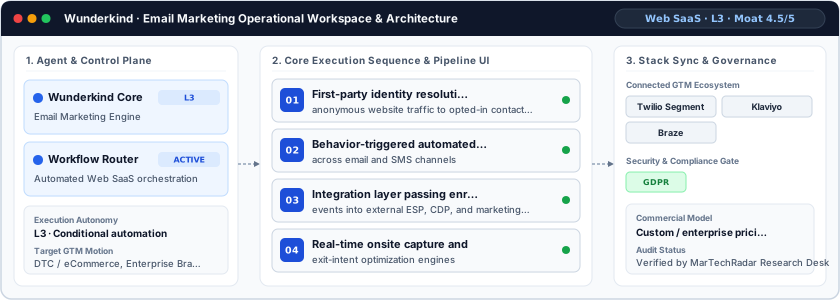
- First-party identity resolution matching: anonymous website traffic to opted-in contact profiles
- Behavior-triggered automated lifecycle messaging: across email and SMS channels
- Integration layer passing enriched: events into external ESP, CDP, and marketing automation stacks
- Real-time onsite capture and exit-intent optimization engines
Cons: operational limitations & risks
- Consent Architecture & Privacy Regulations: Heightened browser cookie partitioning and regional data governance frameworks (such as GDPR and CPRA) can degrade cross-site deterministic match rates and require continuous compliance auditing.
- ESP Deliverability and Volume Skew: Injecting high volumes of triggered outbound messages into downstream email systems introduces domain reputation risks if sender frequency caps and unengaged recipient suppression thresholds are misconfigured.
- Integration Pipeline Latency: Bidirectional event synchronization across legacy marketing automation tools often suffers from webhook throttling, causing cart abandonment messages to fire outside high-intent temporal windows.
Wunderkind TCO & deal-breaker stress test
Simulate 12-month stepped TCO, hidden cost multipliers, contract lock-in exposure, and stack failure modes using only facts verified by MarTechRadar Research Desk on 2026-10-12.
Wunderkind triggers high-severity friction under your 5-seat / $800/mo constraints. Benchmark the verified subtrack alternatives below before committing.
- Moat Score
- 4.5 / 5.0
- AI Autonomy
- L3
- Free Tier / Trial
- None disclosed
Triggered audit signals & failure modes
- Opaque Enterprise Quoting vs. SMB/Mid-Market BudgetVerified Pricing Ledger
Wunderkind does not disclose a public self-serve floor (Custom / enterprise pricing). Buyers with a $800/mo cap face high sales-qualification friction.
- Sales-Gated Contract TermsFact-checked by MarTechRadar Research Desk
Commercial licensing is available on request through tailored enterprise sales quotes based on organizational scale and seats.
- Primary Operational Bottleneck: Consent Architecture & Privacy RegulationsAudit by MarTechRadar Research Desk
Heightened browser cookie partitioning and regional data governance frameworks (such as GDPR and CPRA) can degrade cross-site deterministic match rates and require continuous compliance auditing.
Test a custom Wunderkind budget or stack constraint
Lower 5-seat floor (~$599/mo vs. Custom Quote) · Transparent self-serve entry without mandatory annual lock-in
Lower 5-seat floor (~$18/mo vs. Custom Quote) · Transparent self-serve entry without mandatory annual lock-in
Wunderkind integrations, API, security & compliance stack
Wunderkind AI moat & Email Marketing positioning
Wunderkind maintains a defensive moat through its proprietary cross-brand Identity Network graph, which aggregates deterministic identity markers across participating merchants to match anonymous sessions with verified customer contact profiles.
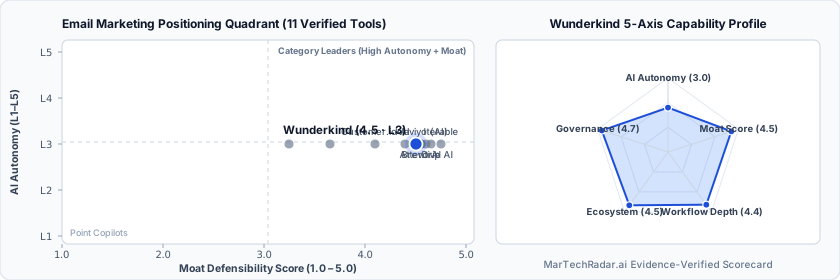
Wunderkind in-depth review, pricing & architecture analysis
Editor sign-off: Oct 12, 2026. How profiles are made.
What is Wunderkind? Overview & background
Established in 2010 in New York, NY, Wunderkind has raised $151.9M in total institutional funding to address anonymous session loss in digital commerce. Built for enterprise retail and consumer brand marketing executives, the platform focuses on identifying unauthenticated web traffic and monetizing high-intent behaviors. By de-anonymizing browsers without requiring active user logins, it functions as a behavioral trigger engine that sits alongside existing marketing technology stacks.
How Wunderkind works: architecture & workflow
Wunderkind operates at an L3 autonomy tier through its proprietary cross-merchant Identity Network. The platform deploys client-side tracking tags that capture browser signals, first-party cookie IDs, and navigation events, matching them against a deterministic identity graph of opted-in consumer records. Once an anonymous profile is resolved, the decisioning engine evaluates event streams against historical purchase behavior, determining timing, channel, and creative before triggering dispatch via direct integrations with existing email service providers and customer data platforms, alongside native workflow integrations for Klaviyo and Braze.
Wunderkind limitations, drawbacks & risks
Operational considerations and platform boundaries include:
- Consent Architecture & Privacy Regulations: Heightened browser cookie partitioning and regional data governance frameworks (such as GDPR and CPRA) can degrade cross-site deterministic match rates and require continuous compliance auditing.
- ESP Deliverability and Volume Skew: Injecting high volumes of triggered outbound messages into downstream email systems introduces domain reputation risks if sender frequency caps and unengaged recipient suppression thresholds are misconfigured.
- Integration Pipeline Latency: Bidirectional event synchronization across legacy marketing automation tools often suffers from webhook throttling, causing cart abandonment messages to fire outside high-intent temporal windows.
Wunderkind pricing, plans & cost breakdown
Commercial licensing is available on request through tailored enterprise sales quotes based on organizational scale and seats. Contracts operate primarily on performance-pegged enterprise models tied to guaranteed digital revenue generation, direct message volume tiers, and cross-channel identity match allocations, with full-service campaign management layered onto the core software platform.
| Plan / Tier | Verified Price & Billing | Included Scope & Contract Terms |
|---|---|---|
| Enterprise / Custom | Custom quote | Custom-quoted plan; terms come from the vendor's sales team. |
How Wunderkind compares vs. competitors & alternatives
Within customer lifecycle automation, alternatives diverge across architectural approaches within the Email Marketing segment. AB Tasty focuses strictly on client-side visual experimentation and personalization rather than cross-domain identity graphs. Ability.ai targets autonomous ad management rather than retention channels, while 10Web AI addresses synthetic site construction. Wunderkind remains optimal for high-traffic e-commerce brands with substantial anonymous visitor flow seeking triggered revenue capture without replacing their core email provider.
Direct competitors & market radar
Top algorithmic competitors based on category positioning, capability overlap, and ICP alignment.
Frequently asked questions about Wunderkind
Does Wunderkind publish pricing or require an enterprise quote?
Wunderkind pricing: Custom / enterprise pricing. No free plan is publicly disclosed. Commercial licensing is available on request through tailored enterprise sales quotes based on organizational scale and seats.
What are the top Wunderkind alternatives in Email Marketing?
Verified Email Marketing alternatives include MAI Agents (Custom / enterprise pricing), Sailthru (Custom / enterprise pricing), Inbox Zero (From $18/mo), Symmetri (Custom / enterprise pricing). Within customer lifecycle automation, alternatives diverge across architectural approaches within the Email Marketing segment.
What are the main limitations and trade-offs of Wunderkind?
Operational considerations and platform boundaries include: Consent Architecture & Privacy Regulations: Heightened browser cookie partitioning and regional data governance frameworks (such as GDPR and CPRA) can degrade cross-site deterministic match rates and require continuous compliance auditing. Walk away if you need published self-serve pricing: Wunderkind is sold by custom quote.
Verified sources & evidence trail
- Official product domain: https://wunderkind.co
- Commercial pricing verification: Verified against official vendor pricing policy (Custom / enterprise pricing)
- Verified corporate entity profiles (
sameAs): LinkedIn Company Profile · Crunchbase Entity Record - First-party governance & documentation links: Trust & Security · Terms · Privacy
- Editor sign-off: Oct 12, 2026 (how profiles are made).
