Inbox Zero Review (2026): Email Marketing Pricing, Limits & Alternatives
Bottom line
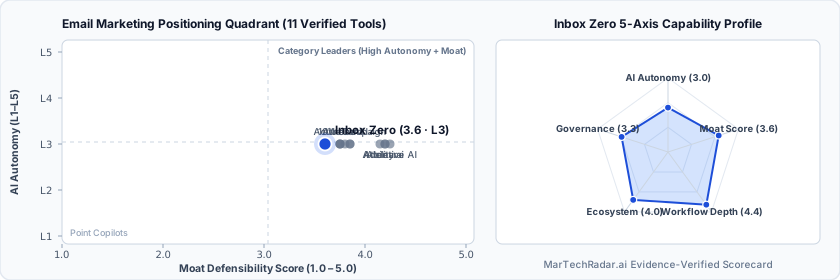
Inbox Zero is a Web SaaS tool for Email Marketing (AI Email Marketing & Lifecycle Journeys) in Lifecycle & CDP. Pricing: From $18/mo. Best suited to CRM & Lifecycle Marketers, eCommerce Growth Teams and Customer Experience Directors. Editor ratings: AI autonomy L3 (conditional automation); moat score 3.6/5.0 (Proprietary moat). Fact-checked by Tim Fenolz on Oct 14, 2026.
AI-powered email management and automation assistant that triages incoming messages, drafts contextual responses in the user's voice, and automates bulk.
Inbox Zero buyer fit verdict: when to choose vs. when to walk away
Choose Inbox Zero if (Best Fit)
- Target ICP & Stack Fit: You operate as CRM & Lifecycle Marketers, eCommerce Growth Teams and Customer Experience Directors requiring a Web SaaS deployment for Email Marketing, with verified ecosystem connectivity for Outreach, Gmail.
- L3 Architecture & Defensibility: Lightweight open-source core with specialized semantic classification models tailored for personal productivity and executive email triage, though defensibility relies heavily on underlying LLM inference providers and standard OAuth email hooks.
- Commercial Model Fit: Your procurement budget aligns with From $18/mo.
Walk away from Inbox Zero if (Deal-Breakers)
- Walk away if your workflow requires uncapped enterprise volume on the From $18/mo entry plan without upgrading tiers.
- Walk away if your workflow cannot tolerate API rate limits and provider quotas: Throughput is directly constrained by Gmail and email service provider API thresholds, causing latency backlogs during multi-thousand message cleanup routines.
- Walk away if contextual tone drift is a deal-breaker for your team: Draft generation models risk hallucinating commitments or misinterpreting nuanced client sentiment when inbound threads lack comprehensive historical context.
Inbox Zero key facts & scorecard
| Pricing | From $18/moVendor pricing page |
|---|---|
| Free plan | No / not disclosed |
| Delivery | Web SaaS |
| Audience | CRM & Lifecycle Marketers, eCommerce Growth Teams, Customer Experience Directors |
| AI autonomy level | L3 · Conditional automationEditor-verified |
| Moat tier & score | 3.6 / 5.0 · Proprietary moatEditor-verified |
| Funding | Pre-seed |
| Founders | Elie Steinbock |
| Company size | 0-1 employees |
| Ecosystem integrations | Outreach, Gmail |
| Governance & docs | API & Docs ↗ · Changelog ↗ · Terms ↗ · Privacy ↗ |
| Headquarters | New York, United States |
| Founded | 2023 |
| Last verified |
Inbox Zero pros & cons: strengths vs. operational limitations
Pros: core strengths & capabilities
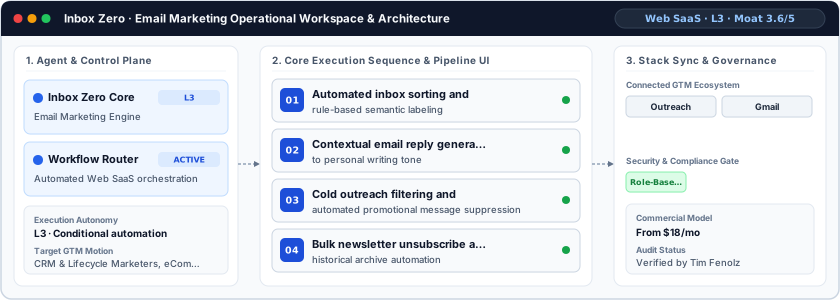
- Automated inbox sorting and: rule-based semantic labeling
- Contextual email reply generation tuned: to personal writing tone
- Cold outreach filtering and: automated promotional message suppression
- Bulk newsletter unsubscribe and: historical archive automation
Cons: operational limitations & risks
- API Rate Limits and Provider Quotas: Throughput is directly constrained by Gmail and email service provider API thresholds, causing latency backlogs during multi-thousand message cleanup routines.
- Contextual Tone Drift: Draft generation models risk hallucinating commitments or misinterpreting nuanced client sentiment when inbound threads lack comprehensive historical context.
- Third-Party Mail Protocol Support: Deep workflow automation relies heavily on specific cloud mail APIs, limiting deployment viability across legacy on-premises Exchange environments.
Inbox Zero TCO & deal-breaker stress test
Simulate 12-month stepped TCO, hidden cost multipliers, contract lock-in exposure, and stack failure modes using only facts verified by Tim Fenolz on · Capture SHA bd833464.
Inbox Zero aligns with your 5-seat / $800/mo profile. Review the walk-away triggers and contract levers below before deployment.
| Plan / Tier | Verified Rate | Scale Fit | Scope & Quota Notes |
|---|---|---|---|
| Starter | $18/mo | 1–2 seats | For individuals, entrepreneurs, and executives looking to buy back their time. |
| Plus | $28/mo | 5 seats | For power users who need integrations and deeper knowledge base support. |
- Moat Score
- 3.6 / 5.0
- AI Autonomy
- L3
- Free Tier / Trial
- None disclosed
Triggered audit signals & failure modes
- Published Self-Serve Entry FloorVerified Pricing Ledger
Inbox Zero publishes a transparent entry point (From $18/mo) for initial validation before committing.
- Tier Fit for 5-Seat Scale: Plus ($28/mo)Verified Tier Schedule
For power users who need integrations and deeper knowledge base support.
- Primary Operational Bottleneck: API Rate Limits and Provider QuotasAudit by Tim Fenolz
Throughput is directly constrained by Gmail and email service provider API thresholds, causing latency backlogs during multi-thousand message cleanup routines.
Hidden TCO Multipliers & Quota Gates
- Per-Seat Linear Scaling: Inbox Zero prices licenses on a per-user/seat basis (From $18/mo); expanding from 2 to 15+ operators multiplies base recurring spend linearly.
- Annual Billing Headline vs. Monthly Premium: Headline entry rates reflect annual billing commitments (Save 10%); month-to-month flexibility carries a higher effective monthly rate or requires annual prepayment.
- Credit & Usage Burn Multiplier: Automated workflows consume metered credits/usage quotas; multi-step enrichment, voice minutes, or high-frequency agent runs can trigger mid-cycle top-up packs.
When to Walk Away & Negotiation Levers
- Walk away if your workflow requires uncapped enterprise volume on the From $18/mo entry plan without upgrading tiers.
- Walk away if your workflow cannot tolerate API rate limits and provider quotas: Throughput is directly constrained by Gmail and email service provider API thresholds, causing latency backlogs during multi-thousand message cleanup routines.
- Walk away if contextual tone drift is a deal-breaker for your team: Draft generation models risk hallucinating commitments or misinterpreting nuanced client sentiment when inbound threads lack comprehensive historical context.
- Validate exact quota thresholds (seats, credits, or API calls) included in Inbox Zero's From $18/mo tier before converting from monthly to annual billing.
- Require a sandbox proof-of-concept testing API rate limits and provider quotas against your live CRM/data schema before annual sign-off.
Ask a custom procurement or TCO stress-test question about Inbox Zero
Fits within $800/mo budget (From $105/mo)
Lower 5-seat floor (~$15/mo vs. $28 / mo)
Inbox Zero key entities, modules & ecosystem stack
Inbox Zero moat & subtrack positioning
Lightweight open-source core with specialized semantic classification models tailored for personal productivity and executive email triage, though defensibility relies heavily on underlying LLM inference providers and standard OAuth email hooks.
Editorial review
Fact-checked by Tim Fenolz (Lead AdTech, Programmatic & Attribution Analyst) on .
Background
Modern knowledge workers and executives spend hours triaging message queues rather than executing strategic initiatives. Established in 2023 and headquartered in New York, United States, Inbox Zero addresses this bottleneck through an automated mail assistant architecture. Designed for corporate operators, entrepreneurs, and busy professionals, the platform replaces manual inbox sorting, cold outreach filtering, and routine correspondence with governed machine learning workflows.
How Inbox Zero works
At the architectural layer, the system autonomy, the system authenticates via secure email APIs to ingest raw message payloads, metadata headers, and interaction histories. Incoming messages pass through a classification pipeline that discerns transactional notifications, unsolicited cold pitches, and critical business correspondence. Parallel semantic models reference past sent mail to construct contextual draft replies matching the user's specific tone, while automated background workers execute batch unsubscribe actions, labeling, and rule-based archiving.
Limitations
Operational considerations and platform boundaries include:
- API Rate Limits and Provider Quotas: Throughput is directly constrained by Gmail and email service provider API thresholds, causing latency backlogs during multi-thousand message cleanup routines.
- Contextual Tone Drift: Draft generation models risk hallucinating commitments or misinterpreting nuanced client sentiment when inbound threads lack comprehensive historical context.
- Third-Party Mail Protocol Support: Deep workflow automation relies heavily on specific cloud mail APIs, limiting deployment viability across legacy on-premises Exchange environments.
Inbox Zero pricing
Inbox Zero offers tiered commercial access structured around user seats. The Starter tier is priced from $18 per month, delivering automated labeling, cold email blocking, analytics, and voice-calibrated drafting. Upgraded tiers, such as the Plus plan at $28 per month, introduce expanded integrations and extended knowledge base support for high-volume accounts.
How Inbox Zero compares
Within automated engagement workflows, Inbox Zero distinguishes itself by prioritizing inbox hygiene and message response generation over outbound campaign orchestration. While platforms like 10Web AI automate web assets and AB Tasty drives experimentation workflows, Inbox Zero focuses on inbound communication velocity. It remains best suited for individual executives and operational teams requiring streamlined message workflows rather than complex outbound journey builders like Ability.ai.
Direct competitors & market radar
Top algorithmic competitors based on category positioning, capability overlap, and ICP alignment.
Frequently asked questions about Inbox Zero
How much does Inbox Zero cost and what pricing tiers are available?
Published pricing summary for Inbox Zero: From $18/mo. A permanent free plan is not disclosed for Inbox Zero. Verified tier schedule: Starter ($18/mo for 1–2 seats); Plus ($28/mo for 5 seats). Inbox Zero offers tiered commercial access structured around user seats. The Starter tier is priced from $18 per month, delivering automated labeling, cold email blocking, analytics, and voice-calibrated drafting.
How does Inbox Zero work and how autonomous is its AI architecture?
AI-powered email management and automation assistant that triages incoming messages, drafts contextual responses in the user's voice, and automates bulk. Within Email Marketing (AI Email Marketing & Lifecycle Journeys), MarTechRadar rates its execution architecture at L3 · Conditional automation with a verified Moat Score of 3.6 / 5.0 (Proprietary moat). Lightweight open-source core with specialized semantic classification models tailored for personal productivity and executive email triage, though defensibility relies heavily on underlying LLM inference providers and standard OAuth email hooks. Corporate profile: Founded by Elie Steinbock, operating at 0-1 employees scale.
What are the main limitations of Inbox Zero and when should buyers walk away?
Based on our editorial technical audit, key operational considerations and boundaries for Inbox Zero include: (1) API Rate Limits and Provider Quotas: Throughput is directly constrained by Gmail and email service provider API thresholds, causing latency backlogs during multi-thousand message cleanup routines. (2) Contextual Tone Drift: Draft generation models risk hallucinating commitments or misinterpreting nuanced client sentiment when inbound threads lack comprehensive historical context. (3) Third-Party Mail Protocol Support: Deep workflow automation relies heavily on specific cloud mail APIs, limiting deployment viability across legacy on-premises Exchange environments. Primary procurement walk-away rule: Walk away if your workflow requires uncapped enterprise volume on the From $18/mo entry plan without upgrading tiers.
What integrations, compliance certifications, and contract terms apply to Inbox Zero?
Verified ecosystem and stack integrations include Outreach, Gmail. First-party governance and developer endpoints verified on domain include: API Docs (https://docs.getinboxzero.com). Key TCO multiplier to watch: Per-Seat Linear Scaling (Inbox Zero prices licenses on a per-user/seat basis (From $18/mo); expanding from 2 to 15+ operators multiplies base recurring spend linearly.) Before signing a contract, procurement teams should validate exact quota thresholds (seats, credits, or API calls) included in Inbox Zero's From $18/mo tier before converting from monthly to annual billing.
What are the best Inbox Zero alternatives and head-to-head competitors in 2026?
Top fact-checked alternatives to Inbox Zero in Email Marketing (AI Email Marketing & Lifecycle Journeys) include Superhuman AI (Free plan · $0/mo · Enterprise plan), Sailthru (Custom / enterprise pricing), Symmetri (Custom / enterprise pricing), Emma (From $105/mo). Within automated engagement workflows, Inbox Zero distinguishes itself by prioritizing inbox hygiene and message response generation over outbound campaign orchestration.
Verified sources & evidence trail
- Official product domain: https://www.getinboxzero.com
- Commercial pricing verification: https://www.getinboxzero.com/pricing
- Verified corporate entity profiles (
sameAs): LinkedIn Company Profile · Crunchbase Entity Record - First-party governance & documentation links: API & Docs · Changelog · Terms · Privacy
- Editorial audit sign-off: Fact-checked by Tim Fenolz on under the MarTechRadar Evidence-Ledger Protocol.