Emma Review (2026): Email Marketing Pricing, Pros & Cons
Bottom line
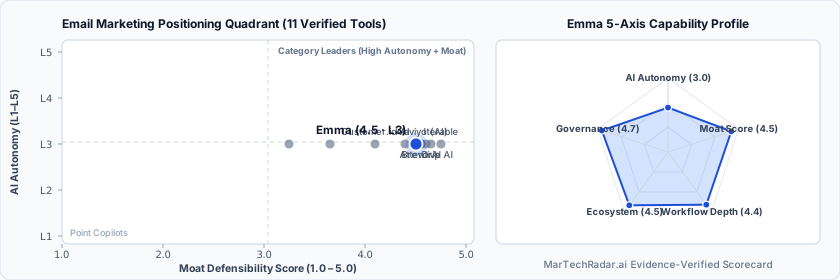
Emma is a Web SaaS tool for Email Marketing (AI Email Marketing & Lifecycle Journeys) in Lifecycle & CDP. Pricing: From $105/mo. Best suited to DTC / eCommerce and Enterprise Brands. Editor ratings: AI autonomy L3 (conditional automation); moat score 4.5/5.0 (Proprietary moat (category leader)). Fact-checked by MarTechRadar Research Desk on Oct 12, 2026.
Enterprise-grade distributed email marketing and lifecycle automation platform combining centralized brand governance with localized multi-account execution.
Is Emma worth it in 2026? Buyer fit & when to walk away
Choose Emma if (Best Fit)
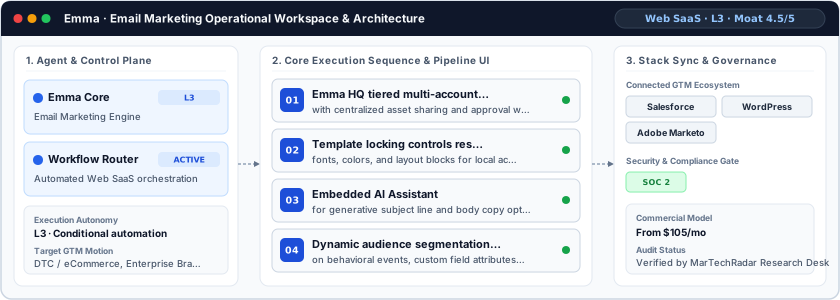
- Target ICP & Stack Fit: You operate as DTC / eCommerce and Enterprise Brands requiring a Web SaaS deployment for Email Marketing, with verified ecosystem connectivity for Salesforce, WordPress, Adobe Marketo.
- L3 Architecture & Defensibility: Deep multi-tenant account hierarchy (Emma HQ) paired with granular template lock-down controls, enabling corporate brand compliance across distributed franchises and universities.
- Commercial Model Fit: Your procurement budget aligns with From $105/mo.
Walk away from Emma if (Deal-Breakers)
- Walk away if your workflow cannot tolerate multi-tenant data siloing: Contact lists and engagement telemetry reside primarily within localized sub-accounts, creating data fragmentation when cross-account deduplication or unified roll-up attribution is required.
- Walk away if advanced logic constraints is a deal-breaker for your team: The journey automation engine lacks complex computational branching, restricting predictive scoring or dynamic real-time event triggers without external webhook mediation.
Emma pricing, free plan & scorecard at a glance
| Pricing | From $105/moVendor pricing page |
|---|---|
| Free plan | No / not disclosed |
| Delivery | Web SaaS |
| Audience | DTC / eCommerce, Enterprise Brands |
| AI autonomy level | L3 · Conditional automationEditor-verified |
| Moat tier & score | 4.5 / 5.0 · Proprietary moat (category leader)Editor-verified |
| Funding | AcquiredAcquired by Campaign Monitor |
| Total funding | $5MBacked by Council Capital |
| Founders | Clint Smith, Will Weaver |
| Company size | 1,001-5,000 employees |
| Ecosystem integrations | Salesforce, WordPress, Adobe Marketo |
| Compliance & governance | SOC 2 |
| Governance & docs | Trust & Security ↗ · Changelog ↗ · Privacy ↗ |
| Headquarters | Nashville, Tennessee |
| Founded | 2003 |
| Last verified | Oct 12, 2026 |
Emma pros & cons: strengths vs. operational limitations
Pros: core strengths & capabilities
- Emma HQ tiered multi-account management: with centralized asset sharing and approval workflows
- Template locking controls restricting: fonts, colors, and layout blocks for local account users
- Embedded AI Assistant: for generative subject line and body copy optimization
- Dynamic audience segmentation based: on behavioral events, custom field attributes, and list criteria
Cons: operational limitations & risks
- Multi-Tenant Data Siloing: Contact lists and engagement telemetry reside primarily within localized sub-accounts, creating data fragmentation when cross-account deduplication or unified roll-up attribution is required.
- Advanced Logic Constraints: The journey automation engine lacks complex computational branching, restricting predictive scoring or dynamic real-time event triggers without external webhook mediation.
- Template Lock Rigidity: Granular block-locking rules can prevent field marketers from adjusting basic responsive mobile layouts without requesting technical overrides from primary account administrators.
Emma TCO & deal-breaker stress test
Simulate 12-month stepped TCO, hidden cost multipliers, contract lock-in exposure, and stack failure modes using only facts verified by MarTechRadar Research Desk on 2026-10-12 · Capture SHA 5727d3c1.
Emma aligns with your 5-seat / $800/mo profile. Review the walk-away triggers and contract levers below before deployment.
- Moat Score
- 4.5 / 5.0
- AI Autonomy
- L3
- Free Tier / Trial
- None disclosed
Triggered audit signals & failure modes
- Published Self-Serve Entry FloorVerified Pricing Ledger
Emma publishes a transparent entry point (From $105/mo) for initial validation before committing.
- Primary Operational Bottleneck: Multi-Tenant Data SiloingAudit by MarTechRadar Research Desk
Contact lists and engagement telemetry reside primarily within localized sub-accounts, creating data fragmentation when cross-account deduplication or unified roll-up attribution is required.
Test a custom Emma budget or stack constraint
Lower 5-seat floor (~$15/mo vs. From $105 / mo)
Lower 5-seat floor (~$16/mo vs. From $105 / mo)
Emma integrations, API, security & compliance stack
Emma AI moat & Email Marketing positioning
Deep multi-tenant account hierarchy (Emma HQ) paired with granular template lock-down controls, enabling corporate brand compliance across distributed franchises and universities.
Emma in-depth review, pricing & architecture analysis
Editor sign-off: Oct 12, 2026. How profiles are made.
What is Emma? Overview & background
Within modern marketing stacks, multi-location organizations struggle to balance regional operational autonomy with centralized brand governance. Established in 2003 in Nashville, Tennessee, Emma addresses this operational tension with an enterprise email marketing platform backed by $5M in funding before joining the Marigold portfolio. Purpose-built for franchise networks, higher education institutions, and decentralized agency teams, Emma provides marketing leaders with coordinated messaging pipelines across distributed physical footprints.
How Emma works: architecture & workflow
Emma operates via a multi-tenant hub-and-spoke infrastructure governed by Emma HQ. Central administrators establish locked HTML design schemas, universal brand assets, and regulatory disclosures that cascade across child accounts. Regional operators customize designated editable regions via a drag-and-drop builder while maintaining corporate typography and palettes. The system ingests subscriber records through REST APIs and CRM connectors, evaluating custom profile properties and behavioral triggers to dispatch targeted sequences. Automated journey nodes execute branching logic based on recipient engagement, supported by an embedded AI Assistant for automated copy adjustments, alongside native workflow integrations for Salesforce and Marketo under verified SOC 2 governance controls.
Emma limitations, drawbacks & risks
Operational considerations and platform boundaries include:
- Multi-Tenant Data Siloing: Contact lists and engagement telemetry reside primarily within localized sub-accounts, creating data fragmentation when cross-account deduplication or unified roll-up attribution is required.
- Advanced Logic Constraints: The journey automation engine lacks complex computational branching, restricting predictive scoring or dynamic real-time event triggers without external webhook mediation.
- Template Lock Rigidity: Granular block-locking rules can prevent field marketers from adjusting basic responsive mobile layouts without requesting technical overrides from primary account administrators.
Emma pricing, plans & cost breakdown
Emma packages its commercial model through tiered subscriptions scaled by feature access and subscriber volume. The entry tier, Emma Lite, starts at $105 per month ($105/month) and supplies core visual email construction, audience segmentation, and the AI Assistant. The multi-location tier, Emma for Teams, begins at $205 per month ($205/month) and unlocks cross-departmental coordination, custom user permissions, and multi-account asset deployment.
How Emma compares vs. competitors & alternatives
Emma differs fundamentally from general web development or automated conversion optimization tools like 10Web AI, AB Tasty, and Ability.ai. While 10Web AI targets WordPress site automation and AB Tasty specializes in client-side experimentation, Emma focuses strictly on corporate messaging compliance across distributed teams. The platform suits multi-unit franchises, universities, and distributed retail networks needing controlled localization, rather than hyper-growth digital startups seeking raw programmatic event streams.
Frequently asked questions about Emma
How much does Emma cost in 2026?
Emma pricing: From $105/mo. No free plan is publicly disclosed. Emma packages its commercial model through tiered subscriptions scaled by feature access and subscriber volume.
What are the top Emma alternatives in Email Marketing?
Verified Email Marketing alternatives include Mailchimp Intuit Assist ($13–$350/mo), Benchmark Email (From $15/mo), GetResponse (From $15.58/mo), Seventh Sense (Custom / enterprise pricing). Emma differs fundamentally from general web development or automated conversion optimization tools like 10Web AI, AB Tasty, and Ability.ai.
What are the main limitations and trade-offs of Emma?
Operational considerations and platform boundaries include: Multi-Tenant Data Siloing: Contact lists and engagement telemetry reside primarily within localized sub-accounts, creating data fragmentation when cross-account deduplication or unified roll-up attribution is required. Walk away if your workflow cannot tolerate multi-tenant data siloing: Contact lists and engagement telemetry reside primarily within localized sub-accounts, creating data fragmentation when cross-account deduplication or unified roll-up attribution is required.
Verified sources & evidence trail
- Official product domain: https://myemma.com
- Commercial pricing verification: https://myemma.com/product/pricing/
- Verified corporate entity profiles (
sameAs): LinkedIn Company Profile · Crunchbase Entity Record - First-party governance & documentation links: Trust & Security · Changelog · Privacy
- Editor sign-off: Oct 12, 2026 (how profiles are made).
