GetResponse Review (2026): Email Marketing Pricing, Pros & Cons
Bottom line
GetResponse is a Web SaaS tool for Email Marketing (AI Email Marketing & Lifecycle Journeys) in Lifecycle & CDP. Pricing: From $15.58/mo. Best suited to B2B SaaS and DTC / eCommerce. Editor ratings: AI autonomy L3 (conditional automation); moat score 3.9/5.0 (Proprietary moat). Fact-checked by MarTechRadar Research Desk on Oct 14, 2026.
Comprehensive email marketing and lifecycle automation platform combining AI copy generation, landing pages, SMS, and behavioral workflows.
Is GetResponse worth it in 2026? Buyer fit & when to walk away
Choose GetResponse if (Best Fit)
- Target ICP & Stack Fit: You operate as B2B SaaS and DTC / eCommerce requiring a Web SaaS deployment for Email Marketing, with verified ecosystem connectivity for WordPress.
- L3 Architecture & Defensibility: Established deliverability network built over two decades, integrated web conversion tools, and low-cost multichannel lifecycle workflows.
- Commercial Model Fit: Your procurement budget aligns with From $15.58/mo.
Walk away from GetResponse if (Deal-Breakers)
- Walk away if your workflow cannot tolerate cross-system data latency: High-volume external API synchronizations risk delayed contact record updates, which can stall immediate condition-based automation branches.
- Walk away if complex relational modeling is a deal-breaker for your team: The schema relies primarily on flat subscriber lists and tag arrays, restricting complex multi-entity B2B relational data structures.
GetResponse pricing, free plan & scorecard at a glance
| Pricing | From $15.58/moVendor pricing page |
|---|---|
| Free plan | No / not disclosed |
| Delivery | Web SaaS |
| Audience | B2B SaaS, DTC / eCommerce |
| AI autonomy level | L3 · Conditional automationEditor-verified |
| Moat tier & score | 3.9 / 5.0 · Proprietary moatEditor-verified |
| Funding | Undisclosed |
| Founders | Simon Grabowski |
| Company size | 201-500 employees |
| Ecosystem integrations | WordPress |
| Governance & docs | API & Docs ↗ · Changelog ↗ · Privacy ↗ |
| Headquarters | Gdansk, Pomorskie, Poland |
| Founded | 1998 |
| Last verified | Oct 14, 2026 |
GetResponse pros & cons: strengths vs. operational limitations
Pros: core strengths & capabilities
- AI-assisted email generation and newsletter drafting
- Core capability: Visual marketing automation workflow builder
- Multichannel engagement: across email and SMS
- Hosted landing page and web form builder
Cons: operational limitations & risks
- Cross-System Data Latency: High-volume external API synchronizations risk delayed contact record updates, which can stall immediate condition-based automation branches.
- Complex Relational Modeling: The schema relies primarily on flat subscriber lists and tag arrays, restricting complex multi-entity B2B relational data structures.
- Deliverability Governance Overhead: Shared IP pool degradation can impact inbox placement rates unless teams actively maintain domain authentication and list hygiene.
GetResponse TCO & deal-breaker stress test
Simulate 12-month stepped TCO, hidden cost multipliers, contract lock-in exposure, and stack failure modes using only facts verified by MarTechRadar Research Desk on 2026-10-14 · Capture SHA 3f0e3723.
GetResponse aligns with your 5-seat / $800/mo profile. Review the walk-away triggers and contract levers below before deployment.
- Moat Score
- 3.9 / 5.0
- AI Autonomy
- L3
- Free Tier / Trial
- None disclosed
Triggered audit signals & failure modes
- Published Self-Serve Entry FloorVerified Pricing Ledger
GetResponse publishes a transparent entry point (From $15.58/mo) for initial validation before committing.
- Tier Fit for 5-Seat Scale: Starter ($15.58/mo)Verified Tier Schedule
Grow your list with AI-powered email marketing and unlimited monthly sends.
- Primary Operational Bottleneck: Cross-System Data LatencyAudit by MarTechRadar Research Desk
High-volume external API synchronizations risk delayed contact record updates, which can stall immediate condition-based automation branches.
Test a custom GetResponse budget or stack constraint
Lower 5-seat floor (~$15/mo vs. $16 / mo)
Lower 5-seat floor (~$13/mo vs. $16 / mo)
GetResponse integrations, API, security & compliance stack
GetResponse AI moat & Email Marketing positioning
Established deliverability network built over two decades, integrated web conversion tools, and low-cost multichannel lifecycle workflows.
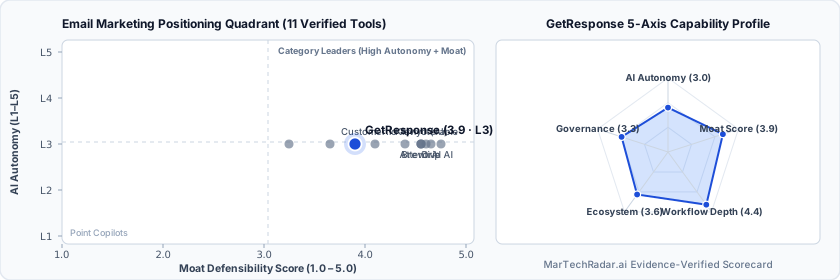
GetResponse in-depth review, pricing & architecture analysis
Editor sign-off: Oct 14, 2026. How profiles are made.
What is GetResponse? Overview & background
For digital growth teams tasked with capturing inbound demand and retaining customers across fragmented channels, GetResponse provides an integrated communications environment. Headquartered in Gdansk, Pomorskie, Poland, and founded in 1998, the platform addresses the operational overhead of connecting disparate conversion assets with messaging funnels. Serving small-to-midmarket marketing operators and e-commerce merchants, the system consolidates audience capture forms, standalone landing pages, and triggered multi-stage communications into a unified administrative console.
How GetResponse works: architecture & workflow
Operating at an L3 autonomy profile, GetResponse processes behavioral telemetry and inbound event webhooks to govern recipient journeys. When an end-user triggers a form submission or link click, the data pipeline updates profile attributes and evaluates downstream branching logic. The platform utilizes algorithmic scheduling to calculate recipient engagement patterns, dispatches transactional or broadcast emails, and executes automated SMS actions. In parallel, integrated generative AI microservices assist operators by drafting subject lines and promotional copy within predefined campaign templates.
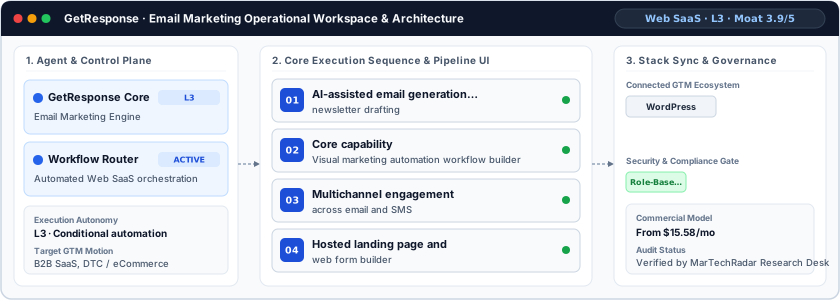
GetResponse limitations, drawbacks & risks
Operational considerations and platform boundaries include:
- Cross-System Data Latency: High-volume external API synchronizations risk delayed contact record updates, which can stall immediate condition-based automation branches.
- Complex Relational Modeling: The schema relies primarily on flat subscriber lists and tag arrays, restricting complex multi-entity B2B relational data structures.
- Deliverability Governance Overhead: Shared IP pool degradation can impact inbox placement rates unless teams actively maintain domain authentication and list hygiene.
GetResponse pricing, plans & cost breakdown
Commercial access is structured around multi-tiered monthly subscriptions indexed against contact list volume. Pricing is publicly documented from $15.58 per month, scaling upward across advanced automation tiers with an optional entry-level plan at $100 per month for larger enterprise deployments. Full access to dedicated account management, single sign-on security, and custom delivery configurations requires bespoke commercial scoping.
| Plan / Tier | Verified Price & Billing | Included Scope & Contract Terms | |
|---|---|---|---|
| Starter | $15.58/mo | Grow your list with AI-powered email marketing and unlimited monthly sends. | |
| Creator | $56.58/mo | Everything you need to create, market, and monetize your knowledge. | |
| Contract Watchout: Annual Billing Headline vs. Monthly Premium | The vendor pricing page advertises an annual-billing discount (save up to $41); month-to-month billing carries a higher effective monthly rate. | ||
How GetResponse compares vs. competitors & alternatives
Within the marketing automation landscape, GetResponse occupies a middle ground between monolithic platforms and niche builders. While 10Web AI targets WordPress automation and AB Tasty specializes in algorithmic split testing, GetResponse concentrates on full lifecycle funnels. Contrastingly, Ability.ai centers on autonomous agent orchestration rather than native transactional dispatch. GetResponse is best suited for lean e-commerce brands requiring turnkey conversion funnels without managing multi-vendor integration debt.
Direct competitors & market radar
Top algorithmic competitors based on category positioning, capability overlap, and ICP alignment.
Frequently asked questions about GetResponse
How much does GetResponse cost in 2026?
GetResponse pricing: From $15.58/mo. No free plan is publicly disclosed. Published tiers: Starter ($15.58/mo); Creator ($56.58/mo). Commercial access is structured around multi-tiered monthly subscriptions indexed against contact list volume.
What are the top GetResponse alternatives in Email Marketing?
Verified Email Marketing alternatives include Seventh Sense (Custom / enterprise pricing), Mailchimp Intuit Assist ($13–$350/mo), Benchmark Email (From $15/mo), Emma (From $105/mo). Within the marketing automation landscape, GetResponse occupies a middle ground between monolithic platforms and niche builders.
What are the main limitations and trade-offs of GetResponse?
Operational considerations and platform boundaries include: Cross-System Data Latency: High-volume external API synchronizations risk delayed contact record updates, which can stall immediate condition-based automation branches. Walk away if your workflow cannot tolerate cross-system data latency: High-volume external API synchronizations risk delayed contact record updates, which can stall immediate condition-based automation branches.
Verified sources & evidence trail
- Official product domain: https://getresponse.com
- Commercial pricing verification: https://www.getresponse.com/pricing/trial
- Verified corporate entity profiles (
sameAs): LinkedIn Company Profile · Crunchbase Entity Record - First-party governance & documentation links: API & Docs · Changelog · Privacy
- Editor sign-off: Oct 14, 2026 (how profiles are made).
