ThoughtSpot Sage Review (2026): Marketing Attribution Pricing, Pros & Cons
Bottom line
ThoughtSpot Sage is a Web SaaS tool for Marketing Attribution (Multi-Touch Attribution & eCommerce Dashboards) in Analytics & Attribution. Pricing: Custom / enterprise pricing. Best suited to DTC / eCommerce and Enterprise Brands. Editor ratings: AI autonomy L2 (workflow copilot); moat score 2.0/5.0 (Workflow-embedded). Fact-checked by MarTechRadar Research Desk on Oct 16, 2026.
Natural language search and generative AI analytics engine that converts conversational business prompts into real-time SQL queries over enterprise cloud.
Is ThoughtSpot Sage worth it in 2026? Buyer fit & when to walk away
Choose ThoughtSpot Sage if (Best Fit)
- Target ICP & Stack Fit: You operate as DTC / eCommerce and Enterprise Brands requiring a Web SaaS deployment for Marketing Attribution, with verified ecosystem connectivity for Snowflake, Google BigQuery, Databricks.
- L2 Architecture & Defensibility: Deeply patented natural language search-to-relational-query translation architecture combined with enterprise semantic governance that prevents hallucinated aggregations over complex schemas.
- Commercial Model Fit: Your procurement budget aligns with Custom / enterprise pricing.
Walk away from ThoughtSpot Sage if (Deal-Breakers)
- Walk away if you need published self-serve pricing: ThoughtSpot Sage is sold by custom quote.
- Walk away if your workflow cannot tolerate semantic governance dependency: LLM query accuracy degrades sharply if underlying data definitions, primary-foreign key relationships, and business logic synonyms are poorly defined in the semantic model.
- Walk away if warehouse compute cost escalation is a deal-breaker for your team: Unconstrained ad-hoc natural language querying on unclustered transaction tables triggers continuous push-down computations that escalate monthly cloud warehouse billing.
ThoughtSpot Sage pricing, free plan & scorecard at a glance
| Pricing | Custom / enterprise pricing |
|---|---|
| Free plan | No / not disclosed |
| Delivery | Web SaaS |
| Audience | DTC / eCommerce, Enterprise Brands |
| AI autonomy level | L2 · Workflow copilotEditor-verified |
| Moat tier & score | 2.0 / 5.0 · Workflow-embeddedEditor-verified |
| Funding | Undisclosed |
| Ecosystem integrations | Snowflake, Google BigQuery, Databricks |
| Headquarters | United States |
| Founded | 2012 |
| Last verified | Oct 16, 2026 |
ThoughtSpot Sage pros & cons: strengths vs. operational limitations
Pros: core strengths & capabilities
- Natural language: to SQL generation powered by enterprise-governed semantic models
- Direct live-query pushdown execution: into cloud data platforms like Snowflake and Databricks
- Automated anomaly detection and statistical root-cause exploration on commercial metrics
- Interactive conversational worksheet exploration: with business-tailored synonym libraries
Cons: operational limitations & risks
- Semantic Governance Dependency: LLM query accuracy degrades sharply if underlying data definitions, primary-foreign key relationships, and business logic synonyms are poorly defined in the semantic model.
- Warehouse Compute Cost Escalation: Unconstrained ad-hoc natural language querying on unclustered transaction tables triggers continuous push-down computations that escalate monthly cloud warehouse billing.
- Attribution Logic Complexity: Custom algorithmic multi-touch attribution models requiring complex Markov chains or path traversal struggle within standard conversational query formats, requiring upstream transformation.
ThoughtSpot Sage TCO & deal-breaker stress test
Simulate 12-month stepped TCO, hidden cost multipliers, contract lock-in exposure, and stack failure modes using only facts verified by MarTechRadar Research Desk on 2026-10-16.
ThoughtSpot Sage triggers high-severity friction under your 5-seat / $800/mo constraints. Benchmark the verified subtrack alternatives below before committing.
- Moat Score
- 2.0 / 5.0
- AI Autonomy
- L2
- Free Tier / Trial
- None disclosed
Triggered audit signals & failure modes
- Opaque Enterprise Quoting vs. SMB/Mid-Market BudgetVerified Pricing Ledger
ThoughtSpot Sage does not disclose a public self-serve floor (Custom / enterprise pricing). Buyers with a $800/mo cap face high sales-qualification friction.
- Sales-Gated Contract TermsFact-checked by MarTechRadar Research Desk
ThoughtSpot Sage is distributed through custom enterprise pricing available on request via sales engagements.
- Primary Operational Bottleneck: Warehouse Compute Cost EscalationAudit by MarTechRadar Research Desk
Unconstrained ad-hoc natural language querying on unclustered transaction tables triggers continuous push-down computations that escalate monthly cloud warehouse billing.
Test a custom ThoughtSpot Sage budget or stack constraint
Offers a free tier (Free plan · Usage-based pricing) · Transparent self-serve entry without mandatory annual lock-in
Transparent self-serve entry without mandatory annual lock-in
ThoughtSpot Sage integrations, API, security & compliance stack
ThoughtSpot Sage AI moat & Marketing Attribution positioning
Deeply patented natural language search-to-relational-query translation architecture combined with enterprise semantic governance that prevents hallucinated aggregations over complex schemas.
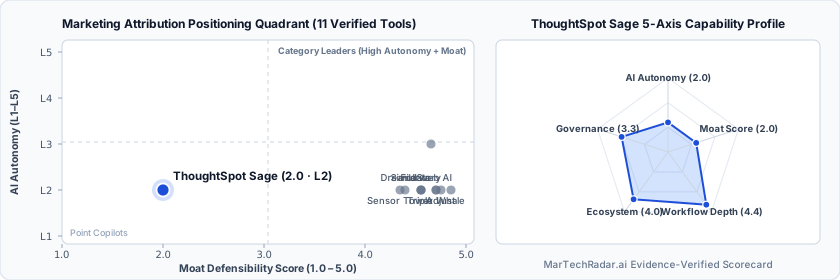
ThoughtSpot Sage in-depth review, pricing & architecture analysis
Editor sign-off: Oct 16, 2026. How profiles are made.
What is ThoughtSpot Sage? Overview & background
Headquartered in the United States, ThoughtSpot Sage addresses the core friction of data retrieval bottlenecks across digital commerce and performance analytics ecosystems. Designed for growth analytics directors, marketing scientists, and data engineering leads, the platform enables commercial teams to interrogate transaction tables and campaign datasets using natural language. Rather than relying on rigid, pre-aggregated business intelligence dashboards, it establishes an interactive querying interface that parses multi-touch conversion events directly on underlying cloud repositories.
How ThoughtSpot Sage works: architecture & workflow
Under the hood, ThoughtSpot Sage pairs large language models with a deterministic semantic graph to convert conversational input into optimized SQL. The engine executes live pushdown queries directly into cloud data warehouses such as Snowflake, Databricks, and Google BigQuery, leaving raw event records in place. At Level 2 autonomy, the system contextualizes user intent against governed data models, generates execution plans, retrieves tabular results, and synthesizes automated narrative summaries highlighting metric variations across conversion touchpoints without manual charting.
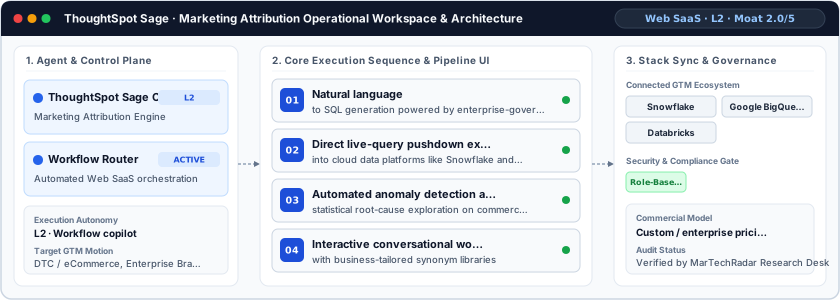
ThoughtSpot Sage limitations, drawbacks & risks
Operational considerations and platform boundaries include:
- Semantic Governance Dependency: LLM query accuracy degrades sharply if underlying data definitions, primary-foreign key relationships, and business logic synonyms are poorly defined in the semantic model.
- Warehouse Compute Cost Escalation: Unconstrained ad-hoc natural language querying on unclustered transaction tables triggers continuous push-down computations that escalate monthly cloud warehouse billing.
- Attribution Logic Complexity: Custom algorithmic multi-touch attribution models requiring complex Markov chains or path traversal struggle within standard conversational query formats, requiring upstream transformation.
ThoughtSpot Sage pricing, plans & cost breakdown
ThoughtSpot Sage is distributed through custom enterprise pricing available on request via sales engagements. Commercial agreements are structured around enterprise-scale requirements, compute capacity consumption, and active query-builder seat bands rather than off-the-shelf public tiers.
| Plan / Tier | Verified Price & Billing | Included Scope & Contract Terms |
|---|---|---|
| Enterprise / Custom | Custom quote | Custom-quoted plan; terms come from the vendor's sales team. |
How ThoughtSpot Sage compares vs. competitors & alternatives
Compared to direct category competitors like Adverity and Fivetran, ThoughtSpot Sage functions as an alternative focused on reliable workflow execution and transparent unit economics within the Marketing Attribution segment.
Frequently asked questions about ThoughtSpot Sage
Does ThoughtSpot Sage publish pricing or require an enterprise quote?
ThoughtSpot Sage pricing: Custom / enterprise pricing. No free plan is publicly disclosed. ThoughtSpot Sage is distributed through custom enterprise pricing available on request via sales engagements.
What are the top ThoughtSpot Sage alternatives in Marketing Attribution?
Verified Marketing Attribution alternatives include Fivetran (Free plan · Usage-based pricing), Whatagraph (From $812/mo · Enterprise plan), Zeit AI (Custom / enterprise pricing), Kantar BrandZ (Custom / enterprise pricing). Compared to direct category competitors like Adverity and Fivetran, ThoughtSpot Sage functions as an alternative focused on reliable workflow execution and transparent unit economics within the Marketing Attribution segment.
What are the main limitations and trade-offs of ThoughtSpot Sage?
Operational considerations and platform boundaries include: Semantic Governance Dependency: LLM query accuracy degrades sharply if underlying data definitions, primary-foreign key relationships, and business logic synonyms are poorly defined in the semantic model. Walk away if you need published self-serve pricing: ThoughtSpot Sage is sold by custom quote.
Verified sources & evidence trail
- Official product domain: https://thoughtspot.com
- Commercial pricing verification: Verified against official vendor pricing policy (Custom / enterprise pricing)
- Editor sign-off: Oct 16, 2026 (how profiles are made).
