Storydoc Review (2026): Pitch Deck Pricing, Limits & Alternatives
Bottom line
Storydoc is a SaaS Platform tool for Pitch Deck (Marketing Visuals & Pitch Decks) in Visual & Creative Media. Pricing: $19/seat/mo · Enterprise plan. Best suited to B2B Marketing & GTM Teams. Editor ratings: AI autonomy L3 (conditional automation); moat score 3.8/5.0 (Proprietary moat). Fact-checked by Jiacky Lee on Oct 25, 2026.
AI presentation and interactive sales deck builder with CRM personalization, scroll-based storytelling, and reader analytics.
Storydoc buyer fit verdict: when to choose vs. when to walk away
Choose Storydoc if (Best Fit)
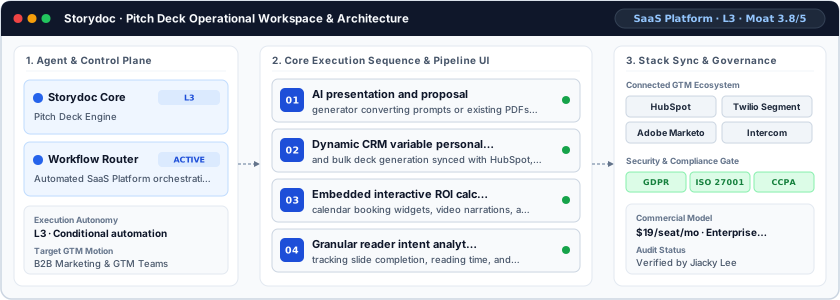
- Target ICP & Stack Fit: You operate as B2B Marketing & GTM Teams requiring a SaaS Platform deployment for Pitch Deck, with verified ecosystem connectivity for HubSpot, Twilio Segment, Adobe Marketo, Intercom.
- L3 Architecture & Defensibility: Storydoc replaces static PDF pitch decks with interactive, mobile-responsive web narratives that dynamically personalize variables from CRM records and track slide-by-slide buyer engagement.
- Commercial Model Fit: Your procurement budget aligns with $19/seat/mo · Enterprise plan.
Walk away from Storydoc if (Deal-Breakers)
- Walk away if your workflow requires uncapped enterprise volume on the $19/seat/mo · Enterprise plan entry plan without upgrading tiers.
- Walk away if your workflow cannot tolerate primary operational trade-off: In practical B2B sales and marketing workflows, the primary trade-off is that Storydoc's vertical scroll-based format differs from traditional horizontal slide decks required for offline conference projectors or strict corporate boardroom templates.
- Walk away if functional scope boundary is a deal-breaker for your team: It is not built for pixel-level freeform vector illustration or complex financial spreadsheet modeling.
Storydoc key facts & scorecard
| Pricing | $19/seat/mo · Enterprise planVendor pricing page |
|---|---|
| Free plan | No / not disclosed |
| Delivery | SaaS Platform |
| Audience | B2B Marketing & GTM Teams |
| AI autonomy level | L3 · Conditional automationEditor-verified |
| Moat tier & score | 3.8 / 5.0 · Proprietary moatEditor-verified |
| Funding | Bootstrapped |
| Founders | Daniel Macbubi, Itai Amoza, Yaacov Goldberg |
| Company size | 11-50 employees |
| Ecosystem integrations | HubSpot, Twilio Segment, Adobe Marketo, Intercom, Zapier, Stripe |
| Compliance & governance | GDPR, ISO 27001, CCPA |
| Headquarters | Tel Aviv, Tel Aviv, Israel |
| Founded | 2019 |
| Last verified |
Storydoc pros & cons: strengths vs. operational limitations
Pros: core strengths & capabilities
- AI presentation and proposal: generator converting prompts or existing PDFs into interactive, scroll-based web decks
- Dynamic CRM variable personalization: and bulk deck generation synced with HubSpot, Marketo, Segment, and Zapier
- Embedded interactive ROI calculators,: calendar booking widgets, video narrations, and live e-signature blocks
- Granular reader intent analytics: tracking slide completion, reading time, and forwarding behavior with ISO 27001, GDPR, and CCPA compliance
Cons: operational limitations & risks
- Primary Operational Trade-Off: In practical B2B sales and marketing workflows, the primary trade-off is that Storydoc's vertical scroll-based format differs from traditional horizontal slide decks required for offline conference projectors or strict corporate boardroom templates.
- Functional Scope Boundary: It is not built for pixel-level freeform vector illustration or complex financial spreadsheet modeling.
- Deployment & Governance Considerations: When exporting interactive Storydocs back to static PDF for legacy procurement archives, interactive calculators, animations, and embedded booking widgets lose their dynamic functionality, and teams must invest initial setup time to connect CRM merge fields for automated outbound sequences.
Are you a founder, co-founder, or product/growth lead at Storydoc? Verify your official @storydoc.com email to publish a factual architectural response or 2026 roadmap update below these limitations.
Storydoc TCO & deal-breaker stress test
Simulate 12-month stepped TCO, hidden cost multipliers, contract lock-in exposure, and stack failure modes using only facts verified by Jiacky Lee on · Capture SHA cdf0d73c.
Storydoc aligns with your 5-seat / $800/mo profile. Review the walk-away triggers and contract levers below before deployment.
| Plan / Tier | Verified Rate | Scale Fit | Scope & Quota Notes |
|---|---|---|---|
| Entry / Starter | $432/seat/mo | 1–2 seats | Verified $432/seat/mo tier from vendor pricing schedule. |
| Enterprise / Custom | Custom quote | 15–50+ seats (Enterprise SLA) | Sales-negotiated annual contract for custom volume, SSO/RBAC governance, and dedicated SLA. |
- Moat Score
- 3.8 / 5.0
- AI Autonomy
- L3
- Free Tier / Trial
- None disclosed
Triggered audit signals & failure modes
- Published Self-Serve Entry FloorVerified Pricing Ledger
Storydoc publishes a transparent entry point ($19/seat/mo · Enterprise plan) for initial validation before committing.
- Linear Per-Seat Scaling (5 Seats × $19/seat/mo)Commercial Model Audit
Base license scales linearly with operator headcount ($95/mo for 5 seats on Entry / Starter).
- Primary Operational Bottleneck: Primary Operational Trade-OffAudit by Jiacky Lee
In practical B2B sales and marketing workflows, the primary trade-off is that Storydoc's vertical scroll-based format differs from traditional horizontal slide decks required for offline conference projectors or strict corporate boardroom templates.
Hidden TCO Multipliers & Quota Gates
- Per-Seat Linear Scaling: Storydoc prices licenses on a per-user/seat basis ($19/seat/mo · Enterprise plan); expanding from 2 to 15+ operators multiplies base recurring spend linearly.
- Annual Billing Headline vs. Monthly Premium: Headline entry rates reflect annual billing commitments (Save 40%); month-to-month flexibility carries a higher effective monthly rate or requires annual prepayment.
- Credit & Usage Burn Multiplier: Automated workflows consume metered credits/usage quotas; multi-step enrichment, voice minutes, or high-frequency agent runs can trigger mid-cycle top-up packs.
When to Walk Away & Negotiation Levers
- Walk away if your workflow requires uncapped enterprise volume on the $19/seat/mo · Enterprise plan entry plan without upgrading tiers.
- Walk away if your workflow cannot tolerate primary operational trade-off: In practical B2B sales and marketing workflows, the primary trade-off is that Storydoc's vertical scroll-based format differs from traditional horizontal slide decks required for offline conference projectors or strict corporate boardroom templates.
- Walk away if functional scope boundary is a deal-breaker for your team: It is not built for pixel-level freeform vector illustration or complex financial spreadsheet modeling.
- Validate exact quota thresholds (seats, credits, or API calls) included in Storydoc's $19/seat/mo · Enterprise plan tier before converting from monthly to annual billing.
- Require a sandbox proof-of-concept testing primary operational trade-off against your live CRM/data schema before annual sign-off.
4 hard questions to ask on a Storydoc sales or technical demo
“Between Storydoc's Entry / Starter ($432/seat/mo) and Enterprise / Custom (Custom quote) tiers, what exact seat, workspace, or credit ceiling triggers a mandatory upgrade—and are mid-cycle overages billed at the base unit rate or forced onto an annual Enterprise / Custom commitment?”
Contract / Technical Proof to Require: Validate exact quota thresholds (seats, credits, or API calls) included in Storydoc's $19/seat/mo · Enterprise plan tier before converting from monthly to annual billing.
“Our technical audit of Storydoc flagged "Primary Operational Trade-Off" (In practical B2B sales and marketing workflows, the primary trade-off is that Storydoc's vertical scroll-based format differs from traditional horizontal slide decks required for offline conference projectors or strict corporate boardroom templates.). Can you demonstrate how Storydoc handles this scenario live against HubSpot without manual CSV workarounds or webhook latency?”
Contract / Technical Proof to Require: Walk away if your workflow requires uncapped enterprise volume on the $19/seat/mo · Enterprise plan entry plan without upgrading tiers.
“Because Storydoc operates at L3 · Conditional automation (Pitch Deck), how do operators prevent "Functional Scope Boundary" (It is not built for pixel-level freeform vector illustration or complex financial spreadsheet modeling.) during high-volume campaigns, and what human-in-the-loop approval gates are configurable?”
Contract / Technical Proof to Require: Require a sandbox proof-of-concept testing primary operational trade-off against your live CRM/data schema before annual sign-off.
“We see Storydoc documents GDPR, ISO 27001, CCPA. Can you provide the current audit report, sub-processor list, and written confirmation that customer inputs in Storydoc are never used to train shared foundation models?”
Contract / Technical Proof to Require: Attach a signed DPA with zero model-training rights and 30-day data deletion SLA upon contract termination.
Ask a custom procurement or TCO stress-test question about Storydoc
Generate your 4-role approval packet or request a custom Storydoc sandbox & Pitch Deck quote
Active spec: 5 Seats · ≤ $800/mo ceiling · Any Stack · No Annual Lock-in
Lower 5-seat floor (~$11/mo vs. $95 / mo)
Offers a free tier (Free plan · $0/seat/mo · Enterprise plan)
No public buyer quote requests logged in the current window for Storydoc. Be the first to lock a verified procurement specification above.
Storydoc key entities, modules & ecosystem stack
Storydoc moat & subtrack positioning
Storydoc replaces static PDF pitch decks with interactive, mobile-responsive web narratives that dynamically personalize variables from CRM records and track slide-by-slide buyer engagement.
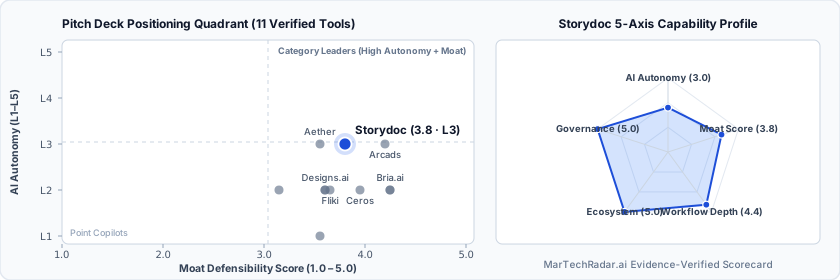
Editorial review
Fact-checked by Jiacky Lee (Managing Editor, AI Autonomy & Moat Methodology) on .
Background
Storydoc is an AI-powered interactive presentation, pitch deck, and sales proposal platform built for B2B sales teams, account executives, and marketing collateral designers. Founded in 2019 by Daniel Macbubi, Itai Amoza, and Yaacov Goldberg and headquartered in Tel Aviv, Israel, the company operates with 11 to 50 employees. It replaces static PowerPoint files and clunky PDF attachments—which are difficult to read on mobile devices and provide zero visibility into buyer engagement—with interactive, scroll-based web narratives engineered to close deals faster.
How Storydoc works
At the functional core of Storydoc is an AI design and storytelling engine that transforms text prompts, website URLs, or uploaded documents into responsive, interactive web decks. Instead of fixed 16:9 slide boxes, Storydoc renders scrollytelling layouts populated with interactive charts, ROI calculators, embedded demo videos, and live calendar booking widgets (such as Calendly or HubSpot Meetings) at the end of the narrative. Through native integrations with HubSpot, Marketo, Segment, Intercom, Stripe, and Zapier, sales reps can automatically generate personalized deck links at scale—injecting each prospect's logo, name, and pricing tier—while real-time telemetry logs exactly who opened the deck, how long they spent on each section, and which slides they skipped.
Limitations
Operational considerations and platform boundaries include:
- Primary Operational Trade-Off: In practical B2B sales and marketing workflows, the primary trade-off is that Storydoc's vertical scroll-based format differs from traditional horizontal slide decks required for offline conference projectors or strict corporate boardroom templates.
- Functional Scope Boundary: It is not built for pixel-level freeform vector illustration or complex financial spreadsheet modeling.
- Deployment & Governance Considerations: When exporting interactive Storydocs back to static PDF for legacy procurement archives, interactive calculators, animations, and embedded booking widgets lose their dynamic functionality, and teams must invest initial setup time to connect CRM merge fields for automated outbound sequences.
Storydoc pricing
Storydoc offers a tiered per-user subscription model starting with a 14-day free trial. On annual billing, the Starter plan is priced at $19 per user per month ($237.60 per year) for unlimited deck creation, AI assistant credits, and basic engagement analytics. The Pro plan costs $36 per user per month ($432 per year) and unlocks custom domain hosting, CRM integrations, dynamic personalization variables, and deeper intent tracking, while Team and Enterprise packages provide custom mass-personalization APIs and ISO 27001, GDPR, and CCPA compliance.
How Storydoc compares
Within the AI presentation and sales collateral space, Storydoc competes with Pitch, Gamma, Tome, and Qwilr, alongside verified subtrack peers such as Arcads. Compared to Pitch or PowerPoint—which preserve traditional horizontal slide canvases—Storydoc prioritizes mobile-native scrollytelling, interactive conversion widgets, and CRM-driven outbound personalization similar to Qwilr. B2B revenue and demand generation teams should evaluate Storydoc when turning static sales proposals and case studies into measurable, conversion-ready buyer experiences.
Frequently asked questions about Storydoc
How much does Storydoc cost per seat and does it have a free plan?
Published pricing summary for Storydoc: $19/seat/mo · Enterprise plan. A permanent free plan is not disclosed for Storydoc. Verified tier schedule: Entry / Starter ($432/seat/mo for 1–2 seats); Enterprise / Custom (Custom quote for 15–50+ seats (Enterprise SLA)). Storydoc offers a tiered per-user subscription model starting with a 14-day free trial. On annual billing, the Starter plan is priced at $19 per user per month ($237.60 per year) for unlimited deck creation, AI assistant credits, and basic engagement analytics.
How does Storydoc work and how autonomous is its AI architecture?
AI presentation and interactive sales deck builder with CRM personalization, scroll-based storytelling, and reader analytics. Within Pitch Deck (Marketing Visuals & Pitch Decks), MarTechRadar rates its execution architecture at L3 · Conditional automation with a verified Moat Score of 3.8 / 5.0 (Proprietary moat). Storydoc replaces static PDF pitch decks with interactive, mobile-responsive web narratives that dynamically personalize variables from CRM records and track slide-by-slide buyer engagement. Corporate profile: Founded by Daniel Macbubi, Itai Amoza, Yaacov Goldberg, operating at 11-50 employees scale.
What are the main limitations of Storydoc and when should buyers walk away?
Based on our editorial technical audit, key operational considerations and boundaries for Storydoc include: (1) Primary Operational Trade-Off: In practical B2B sales and marketing workflows, the primary trade-off is that Storydoc's vertical scroll-based format differs from traditional horizontal slide decks required for offline conference projectors or strict corporate boardroom templates. (2) Functional Scope Boundary: It is not built for pixel-level freeform vector illustration or complex financial spreadsheet modeling. (3) Deployment & Governance Considerations: When exporting interactive Storydocs back to static PDF for legacy procurement archives, interactive calculators, animations, and embedded booking widgets lose their dynamic functionality, and teams must invest initial setup time to connect CRM merge fields for automated outbound sequences. Primary procurement walk-away rule: Walk away if your workflow requires uncapped enterprise volume on the $19/seat/mo · Enterprise plan entry plan without upgrading tiers.
What integrations, compliance certifications, and contract terms apply to Storydoc?
Verified ecosystem and stack integrations include HubSpot, Twilio Segment, Adobe Marketo, Intercom, Zapier, Stripe. Documented security and governance attestations include GDPR, ISO 27001, CCPA. Key TCO multiplier to watch: Per-Seat Linear Scaling (Storydoc prices licenses on a per-user/seat basis ($19/seat/mo · Enterprise plan); expanding from 2 to 15+ operators multiplies base recurring spend linearly.) Before signing a contract, procurement teams should validate exact quota thresholds (seats, credits, or API calls) included in Storydoc's $19/seat/mo · Enterprise plan tier before converting from monthly to annual billing.
What are the best Storydoc alternatives and head-to-head competitors in 2026?
Top fact-checked alternatives to Storydoc in Pitch Deck (Marketing Visuals & Pitch Decks) include Pitch (Free plan · $0/seat/mo · Enterprise plan), Perceptis AI (Free plan · $0/mo · Enterprise plan), Presentations.AI (Free plan · $0/yr · Enterprise plan), Aether (Custom / enterprise pricing). Within the AI presentation and sales collateral space, Storydoc competes with Pitch, Gamma, Tome, and Qwilr, alongside verified subtrack peers such as Arcads.
Storydoc profile completeness & verified buyer trust checklist
Our analysts verified the first 5 baseline facts below from public captures. Founders and growth leads at Storydoc can reach 100% Gold Verified Transparency (and unlock priority buyer sandbox inquiries) by supplying workflow screenshots, customer ROI case studies, and direct support SLA contacts:
- 1. Corporate Identity & HQ: Founded 2019 · Tel Aviv, Tel Aviv, Israel · Founders: Daniel Macbubi, Itai Amoza
- 2. Team Scale & Backing: 11-50 employees · Bootstrapped / Undisclosed
- 3. Published Pricing Floor: $19/seat/mo · Enterprise plan (Sentinel S7 verified)
- 4. Free Trial & Onboarding: Demo / Sales onboarding
- 5. Stack & Compliance Signals: HubSpot, Twilio Segment, Adobe Marketo, Intercom · GDPR, ISO 27001, CCPA
- 6. Product Workflow Screenshots & Customer Case Studies: Upload 3 UI screenshots & verified ROI case study (+15% completeness) →
- 7. Direct Support SLA, Hotline & Reader Perk Code: Add official support email/phone, SLA & exclusive buyer trial perk (+10% completeness) →
Verified sources & evidence trail
- Official product domain: https://storydoc.com
- Commercial pricing verification: https://www.storydoc.com/pricing
- Verified corporate entity profiles (
sameAs): LinkedIn Company Profile · Crunchbase Entity Record - Editorial audit sign-off: Fact-checked by Jiacky Lee on under the MarTechRadar Evidence-Ledger Protocol.