Topview.ai Review (2026): Pitch Deck Pricing, Pros & Cons
Bottom line
Topview.ai is a Web SaaS tool for Pitch Deck (Marketing Visuals & Pitch Decks) in Visual & Creative Media. Pricing: $6.70–$18/mo. Best suited to DTC / eCommerce. Editor ratings: AI autonomy L3 (conditional automation); moat score 3.4/5.0 (Workflow-embedded (strong)). Fact-checked by MarTechRadar Research Desk on Oct 15, 2026.
Autonomous agentic video generation platform translating product URLs, scripts, and media references into edited marketing video assets.
Is Topview.ai worth it in 2026? Buyer fit & when to walk away
Choose Topview.ai if (Best Fit)
- Target ICP & Stack Fit: You operate as DTC / eCommerce requiring a Web SaaS deployment for Pitch Deck, with verified ecosystem connectivity for Shopify, Stripe.
- L3 Architecture & Defensibility: Proprietary multi-model orchestration routing between visual diffusion backends (MiniMax H3, Wan 3.0, Seedance 2.5) paired with automated direct-response storyboarding and canvas-based post-generation shot editing.
- Commercial Model Fit: Your procurement budget aligns with $6.70–$18/mo.
Walk away from Topview.ai if (Deal-Breakers)
- Walk away if your workflow cannot tolerate multi-model artifact inconsistency: Routing across disparate generative backends introduces visual stylistic drift between contiguous shots, requiring manual scene regeneration to maintain uniform character and product fidelity.
- Walk away if dynamic URL scraping failures is a deal-breaker for your team: Heavy Javascript or bot-protected product landing pages frequently truncate asset ingestion, forcing users into manual image and copy uploads.
Topview.ai pricing, free plan & scorecard at a glance
| Pricing | $6.70–$18/moVendor pricing page |
|---|---|
| Free plan | No / not disclosed |
| Delivery | Web SaaS |
| Audience | DTC / eCommerce |
| AI autonomy level | L3 · Conditional automationEditor-verified |
| Moat tier & score | 3.4 / 5.0 · Workflow-embedded (strong)Editor-verified |
| Funding | Seed |
| Total funding | $13.9M |
| Founders | Albert Chen, Jensen Wu |
| Company size | 51-200 employees |
| Ecosystem integrations | Shopify, Stripe |
| Governance & docs | Terms ↗ · Privacy ↗ |
| Headquarters | 20 Collyer Quay, 20-03, Singapore, 049319, SG |
| Founded | 2024 |
| Last verified | Oct 15, 2026 |
Topview.ai pros & cons: strengths vs. operational limitations
Pros: core strengths & capabilities
- Multi-agent script-to-video workflow parsing: product URLs into direct-response storyboards
- Multi-model generation routing: across Wan 3.0, MiniMax H3, Seedance 2.5, and GPT Image 2.5
- Node-based interactive Canvas: enabling shot-level replacement, timing edits, and asset re-generation
- Drama Studio and 3D Builder modules: for narrative short-form marketing and episodic content sequences
Cons: operational limitations & risks
- Multi-Model Artifact Inconsistency: Routing across disparate generative backends introduces visual stylistic drift between contiguous shots, requiring manual scene regeneration to maintain uniform character and product fidelity.
- Dynamic URL Scraping Failures: Heavy Javascript or bot-protected product landing pages frequently truncate asset ingestion, forcing users into manual image and copy uploads.
- Credit Burn Under Complex Iterations: Fine-tuning shot-level motions on the interactive Canvas rapidly depletes base rendering balances during heavy iterative direct-response testing.
Topview.ai TCO & deal-breaker stress test
Simulate 12-month stepped TCO, hidden cost multipliers, contract lock-in exposure, and stack failure modes using only facts verified by MarTechRadar Research Desk on 2026-10-15 · Capture SHA 1ca71041.
Topview.ai is viable for 5 seats, but requires commercial or technical verification on the flagged items below.
- Moat Score
- 3.4 / 5.0
- AI Autonomy
- L3
- Free Tier / Trial
- None disclosed
Triggered audit signals & failure modes
- Published Self-Serve Entry FloorVerified Pricing Ledger
Topview.ai publishes a transparent entry point ($6.70–$18/mo) for initial validation before committing.
- Usage / Credit Burn VolatilityCommercial Model Audit
Topview.ai uses credit or usage-metered billing ($6.70–$18/mo). High-volume automated workflows across 5 seats can trigger mid-cycle overage charges.
- Primary Operational Bottleneck: Credit Burn Under Complex IterationsAudit by MarTechRadar Research Desk
Fine-tuning shot-level motions on the interactive Canvas rapidly depletes base rendering balances during heavy iterative direct-response testing.
Test a custom Topview.ai budget or stack constraint
Fits within $800/mo budget (From $10/mo)
Fits within $800/mo budget (Free plan · $20–$150/seat/mo)
Topview.ai integrations, API, security & compliance stack
Topview.ai AI moat & Pitch Deck positioning
Proprietary multi-model orchestration routing between visual diffusion backends (MiniMax H3, Wan 3.0, Seedance 2.5) paired with automated direct-response storyboarding and canvas-based post-generation shot editing.
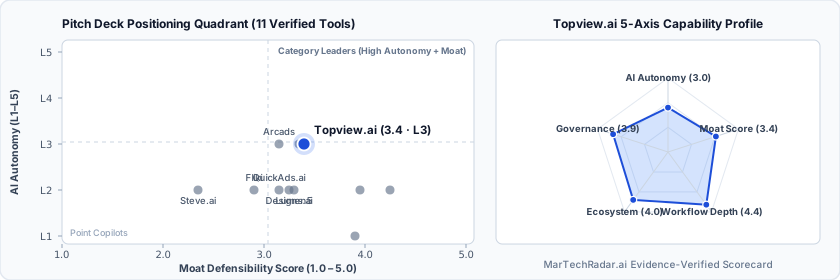
Topview.ai in-depth review, pricing & architecture analysis
Editor sign-off: Oct 15, 2026. How profiles are made.
What is Topview.ai? Overview & background
Established in 2024 and headquartered at 20 Collyer Quay, Singapore, Topview.ai entered the visual automation market backed by $13.9M in total funding. Designed specifically for performance marketing teams, digital agencies, and eCommerce growth operators, the platform replaces manual commercial video creation pipelines with autonomous multi-agent production. By abstracting prompt engineering into deterministic workflows, it targets direct-to-consumer operators who require continuous video iteration across paid social acquisition channels.
How Topview.ai works: architecture & workflow
Topview operates as an agentic video generation environment running conditional generation tasks. The ingestion engine extracts structured metadata, selling points, and visual assets directly from Amazon, Shopify, or TikTok Shop URLs, alongside raw user footage. Its orchestration pipeline parses this input into direct-response scripts, provisions b-roll, and directs visual generation across multiple diffusion models including Seedance 2.5, Wan 3.0, and MiniMax H3. Generated scenes assemble on a timeline-based Canvas where users maintain shot-level control over prompts, motion framing, and voiceover timing, alongside native workflow integrations for Stripe.
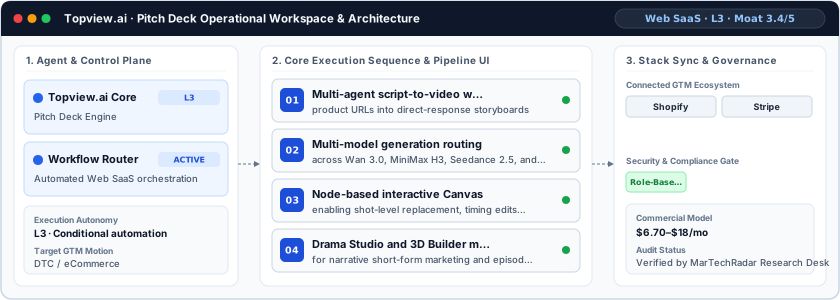
Topview.ai limitations, drawbacks & risks
Operational considerations and platform boundaries include:
- Multi-Model Artifact Inconsistency: Routing across disparate generative backends introduces visual stylistic drift between contiguous shots, requiring manual scene regeneration to maintain uniform character and product fidelity.
- Dynamic URL Scraping Failures: Heavy Javascript or bot-protected product landing pages frequently truncate asset ingestion, forcing users into manual image and copy uploads.
- Credit Burn Under Complex Iterations: Fine-tuning shot-level motions on the interactive Canvas rapidly depletes base rendering balances during heavy iterative direct-response testing.
Topview.ai pricing, plans & cost breakdown
Topview employs a usage-based credit subscription model featuring annual starter access at $6.70 per month ($80 billed annually) and $18 per month on standard tiers, while per-second video rendering consumes credits across integrated models like GPT Image 2.5 and Seedance 2.5. Higher capacity packages provide larger monthly credit quotas alongside discounted consumption rates on specialized video diffusion infrastructure.
How Topview.ai compares vs. competitors & alternatives
Compared to direct category competitors like Flair.ai and Photoroom, Topview.ai functions as an alternative focused on specialized workflow execution within the Pitch Deck segment. Within visual asset production, Topview diverges from interactive web canvas tools like Ceros by focusing entirely on automated timeline video rather than vector microsites. Against image-centric generative suites such as Fotor AI and Picmaker, Topview emphasizes full direct-response video assembly over static graphic design. It serves mid-market and enterprise performance marketing units that prioritize automated multi-shot video throughput over bespoke manual creative direction.
Direct competitors & market radar
Top algorithmic competitors based on category positioning, capability overlap, and ICP alignment.
Frequently asked questions about Topview.ai
How much does Topview.ai cost in 2026?
Topview.ai pricing: $6.70–$18/mo. No free plan is publicly disclosed. Topview employs a usage-based credit subscription model featuring annual starter access at $6.70 per month ($80 billed annually) and $18 per month on standard tiers, while per-second video rendering consumes credits across integrated models like GPT Image 2.5 and Seedance 2.5.
What are the top Topview.ai alternatives in Pitch Deck?
Verified Pitch Deck alternatives include InVideo AI (Free plan · $20–$150/seat/mo), Veed.io AI (From $10/mo), Fotor AI (Free plan · $10.99–$23.99/mo), Fliki (Custom / enterprise pricing). Compared to direct category competitors like Flair.ai and Photoroom, Topview.ai functions as an alternative focused on specialized workflow execution within the Pitch Deck segment.
What are the main limitations and trade-offs of Topview.ai?
Operational considerations and platform boundaries include: Multi-Model Artifact Inconsistency: Routing across disparate generative backends introduces visual stylistic drift between contiguous shots, requiring manual scene regeneration to maintain uniform character and product fidelity. Walk away if your workflow cannot tolerate multi-model artifact inconsistency: Routing across disparate generative backends introduces visual stylistic drift between contiguous shots, requiring manual scene regeneration to maintain uniform character and product fidelity.
Verified sources & evidence trail
- Official product domain: https://topview.ai
- Commercial pricing verification: https://www.topview.ai/pricing
- Verified corporate entity profiles (
sameAs): LinkedIn Company Profile · Crunchbase Entity Record - First-party governance & documentation links: Terms · Privacy
- Editor sign-off: Oct 15, 2026 (how profiles are made).
