QuickAds.ai Review (2026): Pitch Deck Pricing, Pros & Cons
Bottom line
QuickAds.ai is a Web SaaS tool for Pitch Deck (Marketing Visuals & Pitch Decks) in Visual & Creative Media. Pricing: Custom / enterprise pricing. Best suited to DTC / eCommerce. Editor ratings: AI autonomy L2 (workflow copilot); moat score 3.1/5.0 (Workflow-embedded (strong)). Fact-checked by MarTechRadar Research Desk on Oct 15, 2026.
AI-driven ad creative generation platform that automates multi-format performance visual production and copy alignment.
Is QuickAds.ai worth it in 2026? Buyer fit & when to walk away
Choose QuickAds.ai if (Best Fit)
- Target ICP & Stack Fit: You operate as DTC / eCommerce requiring a Web SaaS deployment for Pitch Deck, with verified ecosystem connectivity for Google Ads, Meta Ads, TikTok Ads.
- L2 Architecture & Defensibility: Proprietary catalog indexing ad creatives combined with automated dynamic aspect-ratio layout assembly, though long-term defensive moats remain constrained by reliance on foundational image models.
- Commercial Model Fit: Your procurement budget aligns with Custom / enterprise pricing and want a self-serve free tier for zero-cost initial validation.
Walk away from QuickAds.ai if (Deal-Breakers)
- Walk away if you need published self-serve pricing: QuickAds.ai is sold by custom quote.
- Walk away if your workflow cannot tolerate algorithmic layout rigidity: Generated creative variations frequently rely on fixed component matrices, causing brand aesthetics to appear templated without granular manual intervention.
- Walk away if vector asset fidelity loss is a deal-breaker for your team: Complex brand vectors and fine typography often experience rasterization artifacts or visual clipping during automated cross-ratio batch exports.
QuickAds.ai pricing, free plan & scorecard at a glance
| Pricing | Custom / enterprise pricingVendor pricing page |
|---|---|
| Free plan | Yes |
| Delivery | Web SaaS |
| Audience | DTC / eCommerce |
| AI autonomy level | L2 · Workflow copilotEditor-verified |
| Moat tier & score | 3.1 / 5.0 · Workflow-embedded (strong)Editor-verified |
| Funding | Seed |
| Total funding | $1.7M |
| Company size | 51-200 employees |
| Ecosystem integrations | Google Ads, Meta Ads, TikTok Ads |
| Governance & docs | Terms ↗ · Privacy ↗ |
| Headquarters | Dallas, Texas |
| Founded | 2023 |
| Last verified | Oct 15, 2026 |
QuickAds.ai pros & cons: strengths vs. operational limitations
Pros: core strengths & capabilities
- Automated cross-platform ad creative: generation across multiple standard display aspect ratios
- Brand kit parsing: for automated font, color, and asset compliance across assets
- Ad inspiration repository indexing: past performance patterns across digital channels
- Multi-channel export pipeline structured: for programmatic and paid social deployment
Cons: operational limitations & risks
- Algorithmic layout rigidity: Generated creative variations frequently rely on fixed component matrices, causing brand aesthetics to appear templated without granular manual intervention.
- Vector asset fidelity loss: Complex brand vectors and fine typography often experience rasterization artifacts or visual clipping during automated cross-ratio batch exports.
- Closed-loop feedback absence: The system lacks live attribution and real-time ad network performance telemetry, requiring media buyers to benchmark winning variants externally.
QuickAds.ai TCO & deal-breaker stress test
Simulate 12-month stepped TCO, hidden cost multipliers, contract lock-in exposure, and stack failure modes using only facts verified by MarTechRadar Research Desk on 2026-10-15 · Capture SHA f3b26f5f.
QuickAds.ai is viable for 5 seats, but requires commercial or technical verification on the flagged items below.
- Moat Score
- 3.1 / 5.0
- AI Autonomy
- L2
- Free Tier / Trial
- Free plan
Triggered audit signals & failure modes
- Opaque Enterprise Quoting vs. SMB/Mid-Market BudgetVerified Pricing Ledger
QuickAds.ai does not disclose a public self-serve floor (Custom / enterprise pricing). Buyers with a $800/mo cap face high sales-qualification friction.
- Published Self-Serve Entry FloorVerified Pricing Ledger
QuickAds.ai publishes a transparent entry point (Custom / enterprise pricing) with a free tier for initial validation before committing.
- Primary Operational Bottleneck: Algorithmic layout rigidityAudit by MarTechRadar Research Desk
Generated creative variations frequently rely on fixed component matrices, causing brand aesthetics to appear templated without granular manual intervention.
Test a custom QuickAds.ai budget or stack constraint
Lower 5-seat floor (~$11/mo vs. Custom Quote)
Lower 5-seat floor (~$7/mo vs. Custom Quote)
QuickAds.ai integrations, API, security & compliance stack
QuickAds.ai AI moat & Pitch Deck positioning
Proprietary catalog indexing ad creatives combined with automated dynamic aspect-ratio layout assembly, though long-term defensive moats remain constrained by reliance on foundational image models.
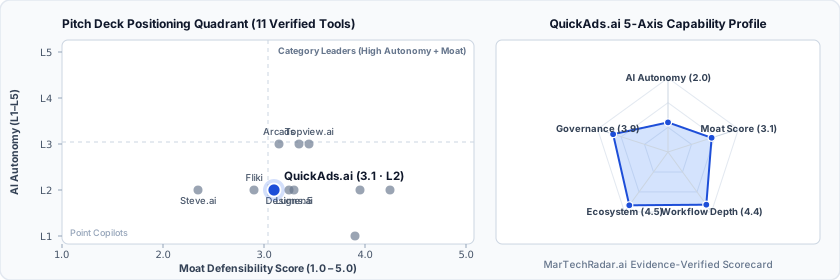
QuickAds.ai in-depth review, pricing & architecture analysis
Editor sign-off: Oct 15, 2026. How profiles are made.
What is QuickAds.ai? Overview & background
Established in 2023 and headquartered in Dallas, Texas, QuickAds.ai secured $1.7M in venture backing to target operational inefficiencies in creative production pipelines. Tailored for growth marketers, performance media buyers, and digital agencies, the platform addresses the multi-channel asset sprawl demanded by modern programmatic networks and social ad platforms. Rather than relying on manual design cycles for every banner variation, marketing teams deploy the system to synthesize campaign-ready visual collateral rapidly across standard display dimensions.
How QuickAds.ai works: architecture & workflow
At an architectural level, QuickAds.ai operates as an L2 task automation engine for performance collateral. The platform ingests brand parameters—such as brand logos, typography, color palettes, and source product URLs—and passes these assets into a layout synthesis model. Combining structured design templates with prompt-conditioned diffusion models, the system programmatically generates static visuals mapped to standard social ratios (1:1, 9:16, 16:9). Algorithmic copy suggestions are layered over visual layouts using predefined safety zones, ensuring creative assets meet channel-specific text-to-image distribution compliance rules, alongside native workflow integrations for Google Ads, Meta Ads, and TikTok Ads.
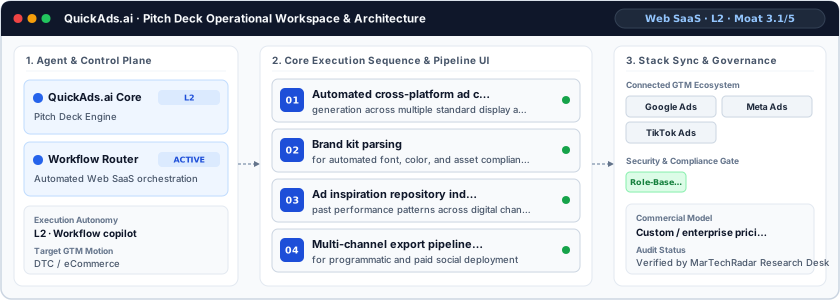
QuickAds.ai limitations, drawbacks & risks
Operational considerations and platform boundaries include:
- Algorithmic layout rigidity: Generated creative variations frequently rely on fixed component matrices, causing brand aesthetics to appear templated without granular manual intervention.
- Vector asset fidelity loss: Complex brand vectors and fine typography often experience rasterization artifacts or visual clipping during automated cross-ratio batch exports.
- Closed-loop feedback absence: The system lacks live attribution and real-time ad network performance telemetry, requiring media buyers to benchmark winning variants externally.
QuickAds.ai pricing, plans & cost breakdown
QuickAds.ai deploys a hybrid commercial model spanning product-led discovery and managed services. Self-serve onboarding begins with an entry tier at $0 to evaluate creative discovery tools. Upgraded self-serve tiers transition into volume-based production caps, while larger programmatic agencies access custom enterprise agreements designed for high-throughput batch generation and dedicated support pipelines.
| Plan / Tier | Verified Price & Billing | Included Scope & Contract Terms |
|---|---|---|
| Free / Sandbox | $0 | Free plan or free tier offered by the vendor. |
| Enterprise / Custom | Custom quote | Custom-quoted plan; terms come from the vendor's sales team. |
How QuickAds.ai compares vs. competitors & alternatives
Within the performance visual landscape, QuickAds.ai competes against interactive design suites like Ceros, broad visual engines like Fotor AI, and automated layout utilities like Picmaker within the Pitch Deck segment. While Ceros focuses on complex bespoke enterprise web experiences, QuickAds.ai optimizes strictly for high-velocity paid media formats. It trades Picmaker's generalist design workspace for structured ad compliance, making it optimal for mid-market direct-to-consumer brands that require continuous multivariant creative testing over bespoke editorial design.
Direct competitors & market radar
Top algorithmic competitors based on category positioning, capability overlap, and ICP alignment.
Frequently asked questions about QuickAds.ai
Does QuickAds.ai publish pricing or require an enterprise quote?
QuickAds.ai pricing: Custom / enterprise pricing. A permanent free plan is available. Published tiers: Free / Sandbox ($0); Enterprise / Custom (Custom quote). QuickAds.ai deploys a hybrid commercial model spanning product-led discovery and managed services. Self-serve onboarding begins with an entry tier at $0 to evaluate creative discovery tools.
What are the top QuickAds.ai alternatives in Pitch Deck?
Verified Pitch Deck alternatives include Arcads (Custom / enterprise pricing), Bluma (Custom / enterprise pricing), Fotor AI (Free plan · $10.99–$23.99/mo), Ceros (Custom / enterprise pricing). Within the performance visual landscape, QuickAds.ai competes against interactive design suites like Ceros, broad visual engines like Fotor AI, and automated layout utilities like Picmaker within the Pitch Deck segment.
What are the main limitations and trade-offs of QuickAds.ai?
Operational considerations and platform boundaries include: Algorithmic layout rigidity: Generated creative variations frequently rely on fixed component matrices, causing brand aesthetics to appear templated without granular manual intervention. Walk away if you need published self-serve pricing: QuickAds.ai is sold by custom quote.
Verified sources & evidence trail
- Official product domain: https://quickads.ai
- Commercial pricing verification: https://www.quickads.ai/pricing
- Verified corporate entity profiles (
sameAs): LinkedIn Company Profile · Crunchbase Entity Record - First-party governance & documentation links: Terms · Privacy
- Editor sign-off: Oct 15, 2026 (how profiles are made).
