Bluma Review (2026): DCO Pricing, Limits & Alternatives
Bottom line
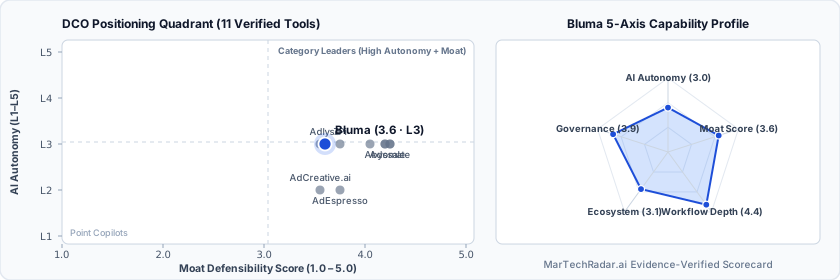
Bluma is a Web SaaS tool for DCO (Dynamic Creative Optimization / DCO) in AdTech & Paid Media. Pricing: Custom / enterprise pricing. Best suited to Performance Marketing Directors, Ad Agencies and Retail Media Advertisers. Editor ratings: AI autonomy L3 (conditional automation); moat score 3.6/5.0 (Proprietary moat). Fact-checked by Tim Fenolz on Oct 14, 2026.
AI video creation and dynamic creative engine designed to deconstruct, adapt, and generate short-form UGC video ads for paid social channels.
Bluma buyer fit verdict: when to choose vs. when to walk away
Choose Bluma if (Best Fit)
- Target ICP & Stack Fit: You operate as Performance Marketing Directors, Ad Agencies and Retail Media Advertisers requiring a Web SaaS deployment for DCO.
- L3 Architecture & Defensibility: Proprietary reverse-engineering workflow that extracts timing, pacing, and motion templates from viral social URLs to automate high-velocity UGC video variant rendering.
- Commercial Model Fit: Your procurement budget aligns with Custom / enterprise pricing.
Walk away from Bluma if (Deal-Breakers)
- Walk away if you require transparent self-serve monthly billing or your budget ceiling is under $1,000/mo (Bluma requires sales-gated custom quoting).
- Walk away if your workflow cannot tolerate algorithmic ingestion drift: Deconstructing third-party social URLs relies on external network accessibility; platform layout shifts or aggressive scrap-blocking mechanisms can degrade automatic timeline parsing.
- Walk away if generative video artifacting is a deal-breaker for your team: Automated motion replacement and synthetic actor lip-sync occasionally yield visual uncanny-valley anomalies, requiring manual editorial inspection before media allocation.
Bluma key facts & scorecard
| Pricing | Custom / enterprise pricing |
|---|---|
| Free plan | No / not disclosed |
| Delivery | Web SaaS |
| Audience | Performance Marketing Directors, Ad Agencies, Retail Media Advertisers |
| AI autonomy level | L3 · Conditional automationEditor-verified |
| Moat tier & score | 3.6 / 5.0 · Proprietary moatEditor-verified |
| Funding | Pre-seed |
| Total funding | $500K |
| Founders | Alisa Wu, Stephen Ni |
| Company size | 2-10 employees |
| Governance & docs | Terms ↗ · Privacy ↗ |
| Headquarters | San Francisco, California |
| Founded | 2025 |
| Last verified |
Bluma pros & cons: strengths vs. operational limitations
Pros: core strengths & capabilities
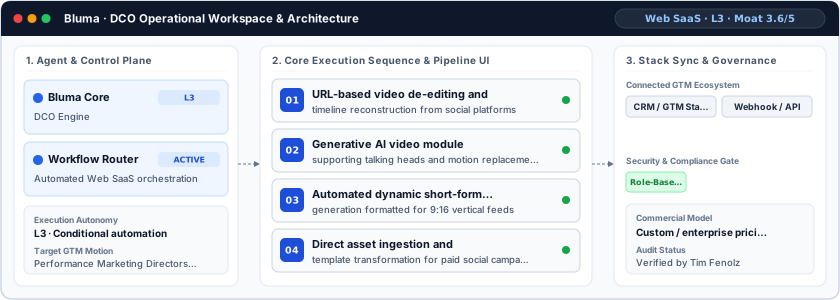
- URL-based video de-editing and: timeline reconstruction from social platforms
- Generative AI video module: supporting talking heads and motion replacement
- Automated dynamic short-form asset: generation formatted for 9:16 vertical feeds
- Direct asset ingestion and: template transformation for paid social campaigns
Cons: operational limitations & risks
- Algorithmic Ingestion Drift: Deconstructing third-party social URLs relies on external network accessibility; platform layout shifts or aggressive scrap-blocking mechanisms can degrade automatic timeline parsing.
- Generative Video Artifacting: Automated motion replacement and synthetic actor lip-sync occasionally yield visual uncanny-valley anomalies, requiring manual editorial inspection before media allocation.
- Rendering Pipeline Latency: High-resolution neural video generation introduces synchronous queuing bottlenecks during burst production cycles, constraining real-time ad variation turnaround times.
Bluma TCO & deal-breaker stress test
Simulate 12-month stepped TCO, hidden cost multipliers, contract lock-in exposure, and stack failure modes using only facts verified by Tim Fenolz on · Capture SHA 1e2538fc.
Bluma triggers high-severity friction under your 5-seat / $800/mo constraints. Benchmark the verified subtrack alternatives below before committing.
| Plan / Tier | Verified Rate | Scale Fit | Scope & Quota Notes |
|---|---|---|---|
| Starter | $29/mo | 1–2 seats | ($348/year) per month, billed annually |
| Starter | $36/mo | 5 seats | ($348/year) per month, billed annually |
| Pro | $79/mo | 15 seats | ($948/year) per month, billed annually |
| Enterprise / Custom | Custom quote | 15–50+ seats (Enterprise SLA) | Sales-negotiated annual contract for custom volume, SSO/RBAC governance, and dedicated SLA. |
- Moat Score
- 3.6 / 5.0
- AI Autonomy
- L3
- Free Tier / Trial
- None disclosed
Triggered audit signals & failure modes
- Opaque Enterprise Quoting vs. SMB/Mid-Market BudgetVerified Pricing Ledger
Bluma does not disclose a public self-serve floor (Custom / enterprise pricing). Buyers with a $800/mo cap face high sales-qualification friction.
- Sales-Gated Contract TermsFact-checked by Tim Fenolz
Commercial procurement for Bluma is managed directly via tailored enterprise agreements.
- Tier Fit for 5-Seat Scale: Starter ($29/mo)Verified Tier Schedule
($348/year) per month, billed annually
- Primary Operational Bottleneck: Algorithmic Ingestion DriftAudit by Tim Fenolz
Deconstructing third-party social URLs relies on external network accessibility; platform layout shifts or aggressive scrap-blocking mechanisms can degrade automatic timeline parsing.
Hidden TCO Multipliers & Quota Gates
- Annual Billing Headline vs. Monthly Premium: Headline entry rates reflect annual billing commitments (Save 20%); month-to-month flexibility carries a higher effective monthly rate or requires annual prepayment.
- Credit & Usage Burn Multiplier: Automated workflows consume metered credits/usage quotas; multi-step enrichment, voice minutes, or high-frequency agent runs can trigger mid-cycle top-up packs.
When to Walk Away & Negotiation Levers
- Walk away if you require transparent self-serve monthly billing or your budget ceiling is under $1,000/mo (Bluma requires sales-gated custom quoting).
- Walk away if your workflow cannot tolerate algorithmic ingestion drift: Deconstructing third-party social URLs relies on external network accessibility; platform layout shifts or aggressive scrap-blocking mechanisms can degrade automatic timeline parsing.
- Walk away if generative video artifacting is a deal-breaker for your team: Automated motion replacement and synthetic actor lip-sync occasionally yield visual uncanny-valley anomalies, requiring manual editorial inspection before media allocation.
- Demand a 30- to 60-day paid pilot opt-out clause in the Bluma order form before signing a 12-month enterprise commitment.
- Require a sandbox proof-of-concept testing algorithmic ingestion drift against your live CRM/data schema before annual sign-off.
Ask a custom procurement or TCO stress-test question about Bluma
Lower 5-seat floor (~$14/mo vs. Custom Quote) · Transparent self-serve entry without mandatory annual lock-in
Lower 5-seat floor (~$36/mo vs. Custom Quote) · Transparent self-serve entry without mandatory annual lock-in
Bluma moat & subtrack positioning
Proprietary reverse-engineering workflow that extracts timing, pacing, and motion templates from viral social URLs to automate high-velocity UGC video variant rendering.
Editorial review
Fact-checked by Tim Fenolz (Lead AdTech, Programmatic & Attribution Analyst) on .
Background
E-commerce and performance marketing teams face severe creative fatigue when producing short-form video variants across paid social channels. Established in 2025 and headquartered in San Francisco, California, Bluma addresses this bottleneck through an automated video creation engine. Operating with $500K in venture capital backing, the company targets growth marketers and creative strategists who require continuous creative iterations without maintaining linear video editing pipelines. Within dynamic creative optimization ecosystems, Bluma bridges raw product assets and generative short-form video assembly.
How Bluma works
Bluma operates at an L3 conditional autonomy tier by decoupling reference creative structures from underlying digital assets. Users input TikTok or Meta advertisement URLs, which the system ingests and algorithmically de-edits into discrete structural components: pacing, motion cues, voiceovers, and frame transitions. The system then pairs generative video models, such as Veo 3.1, with product catalogs to synthesize new vertical video assets. It automates talking-head generation, replaces motion paths, and renders production-ready 9:16 variations tailored for direct-response media algorithms.
Limitations
Operational considerations and platform boundaries include:
- Algorithmic Ingestion Drift: Deconstructing third-party social URLs relies on external network accessibility; platform layout shifts or aggressive scrap-blocking mechanisms can degrade automatic timeline parsing.
- Generative Video Artifacting: Automated motion replacement and synthetic actor lip-sync occasionally yield visual uncanny-valley anomalies, requiring manual editorial inspection before media allocation.
- Rendering Pipeline Latency: High-resolution neural video generation introduces synchronous queuing bottlenecks during burst production cycles, constraining real-time ad variation turnaround times.
Bluma pricing
Commercial procurement for Bluma is managed directly via tailored enterprise agreements. Software access is not distributed through published modular subscriptions; instead, commercial pricing is available on request through tailored enterprise sales quotes based on organizational scale and seats. These custom contractual agreements typically align enterprise capacity with dedicated rendering compute quotas, video generation volume thresholds, and dedicated administrative support channels.
How Bluma compares
Within the creative optimization market, Bluma occupies a specialized niche distinct from traditional banner engines like Abyssale or multi-format display generators like AdCreative.ai. While Abyssale focuses on deterministic API-driven image and banner automation, and 7Pi targets cross-network feed-based creative variations, Bluma concentrates specifically on dynamic generative short-form video deconstruction. Direct-to-consumer digital brands spending across vertical video networks represent the primary fit, trading manual timeline control for automated creative testing volume.
Direct competitors & market radar
Top algorithmic competitors based on category positioning, capability overlap, and ICP alignment.
Frequently asked questions about Bluma
How much does Bluma cost and does it require a custom enterprise quote?
Published pricing summary for Bluma: Custom / enterprise pricing. A permanent free plan is not disclosed for Bluma. Verified tier schedule: Starter ($29/mo for 1–2 seats); Starter ($36/mo for 5 seats); Pro ($79/mo for 15 seats); Enterprise / Custom (Custom quote for 15–50+ seats (Enterprise SLA)). Commercial procurement for Bluma is managed directly via tailored enterprise agreements. Software access is not distributed through published modular subscriptions; instead, commercial pricing is available on request through tailored enterprise sales quotes based on organizational scale and seats.
How does Bluma work and how autonomous is its AI architecture?
AI video creation and dynamic creative engine designed to deconstruct, adapt, and generate short-form UGC video ads for paid social channels. Within DCO (Dynamic Creative Optimization / DCO), MarTechRadar rates its execution architecture at L3 · Conditional automation with a verified Moat Score of 3.6 / 5.0 (Proprietary moat). Proprietary reverse-engineering workflow that extracts timing, pacing, and motion templates from viral social URLs to automate high-velocity UGC video variant rendering. Corporate profile: Founded by Alisa Wu, Stephen Ni, operating at 2-10 employees scale.
What are the main limitations of Bluma and when should buyers walk away?
Based on our editorial technical audit, key operational considerations and boundaries for Bluma include: (1) Algorithmic Ingestion Drift: Deconstructing third-party social URLs relies on external network accessibility; platform layout shifts or aggressive scrap-blocking mechanisms can degrade automatic timeline parsing. (2) Generative Video Artifacting: Automated motion replacement and synthetic actor lip-sync occasionally yield visual uncanny-valley anomalies, requiring manual editorial inspection before media allocation. (3) Rendering Pipeline Latency: High-resolution neural video generation introduces synchronous queuing bottlenecks during burst production cycles, constraining real-time ad variation turnaround times. Primary procurement walk-away rule: Walk away if you require transparent self-serve monthly billing or your budget ceiling is under $1,000/mo (Bluma requires sales-gated custom quoting).
What integrations, compliance certifications, and contract terms apply to Bluma?
Key TCO multiplier to watch: Annual Billing Headline vs. Monthly Premium (Headline entry rates reflect annual billing commitments (Save 20%); month-to-month flexibility carries a higher effective monthly rate or requires annual prepayment.) Before signing a contract, procurement teams should demand a 30- to 60-day paid pilot opt-out clause in the Bluma order form before signing a 12-month enterprise commitment.
What are the best Bluma alternatives and head-to-head competitors in 2026?
Top fact-checked alternatives to Bluma in DCO (Dynamic Creative Optimization / DCO) include QuickAds.ai (Free plan · $0/mo · Enterprise plan), Pencil (From $14/mo), Adzooma (From $0/mo), Protaigé (Free plan · $0/mo · Enterprise plan). Within the creative optimization market, Bluma occupies a specialized niche distinct from traditional banner engines like Abyssale or multi-format display generators like AdCreative.ai.
Verified sources & evidence trail
- Official product domain: https://www.getbluma.com
- Commercial pricing verification: Verified against official vendor pricing policy (Custom / enterprise pricing)
- Verified corporate entity profiles (
sameAs): LinkedIn Company Profile · Crunchbase Entity Record - First-party governance & documentation links: Terms · Privacy
- Editorial audit sign-off: Fact-checked by Tim Fenolz on under the MarTechRadar Evidence-Ledger Protocol.