Bria.ai Review (2026): Pitch Deck Pricing, Pros & Cons
Bottom line
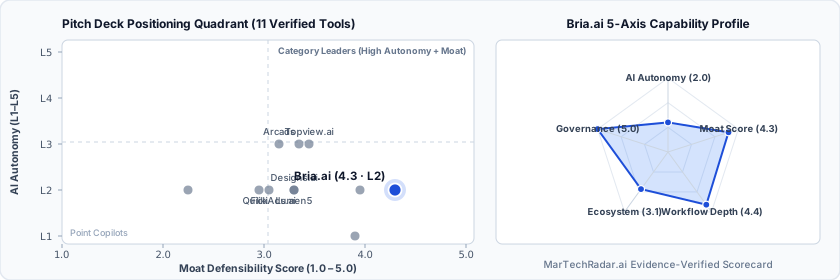
Bria.ai is a API / SDK tool for Pitch Deck (Marketing Visuals & Pitch Decks) in Visual & Creative Media. Pricing: Usage-based pricing. Best suited to DTC / eCommerce and Enterprise Brands. Editor ratings: AI autonomy L2 (workflow copilot); moat score 4.3/5.0 (Proprietary moat (category leader)). Fact-checked by MarTechRadar Research Desk on Oct 15, 2026.
Enterprise visual generative AI platform delivering commercially safe foundation models trained solely on licensed datasets with complete legal.
Is Bria.ai worth it in 2026? Buyer fit & when to walk away
Choose Bria.ai if (Best Fit)
- Target ICP & Stack Fit: You operate as DTC / eCommerce and Enterprise Brands requiring a API / SDK deployment for Pitch Deck.
- L2 Architecture & Defensibility: Proprietary attribution and royalty-tracking engine coupled with 100% licensed training datasets, providing full commercial indemnity against copyright infringement claims.
- Commercial Model Fit: Your procurement budget aligns with Usage-based pricing.
Walk away from Bria.ai if (Deal-Breakers)
- Walk away if you need published self-serve pricing: Bria.ai is sold by custom quote.
- Walk away if your workflow cannot tolerate training domain constraints: Restricting model training strictly to licensed datasets narrows the generative vocabulary, resulting in reduced visual variance on niche concepts compared to unconstrained web-scraped foundation models.
- Walk away if throughput and latency is a deal-breaker for your team: High-resolution multi-pass generative synthesis via API introduces latency bottlenecks, requiring asynchronous webhook pipelines rather than synchronous front-end execution under heavy concurrent loads.
Bria.ai pricing, free plan & scorecard at a glance
| Pricing | Usage-based pricingVendor pricing page |
|---|---|
| Free plan | No / not disclosed |
| Delivery | API / SDK |
| Audience | DTC / eCommerce, Enterprise Brands |
| AI autonomy level | L2 · Workflow copilotEditor-verified |
| Moat tier & score | 4.3 / 5.0 · Proprietary moat (category leader)Editor-verified |
| Funding | Venture-backed |
| Total funding | $66.5M |
| Founders | Assa Eldar, Dr. Yair Adato |
| Company size | 51-200 employees |
| Compliance & governance | SOC 2, GDPR, ISO 27001 |
| Governance & docs | System Status ↗ · API & Docs ↗ · Terms ↗ · Privacy ↗ |
| Headquarters | New York, US |
| Founded | 2020 |
| Last verified | Oct 15, 2026 |
Bria.ai pros & cons: strengths vs. operational limitations
Pros: core strengths & capabilities
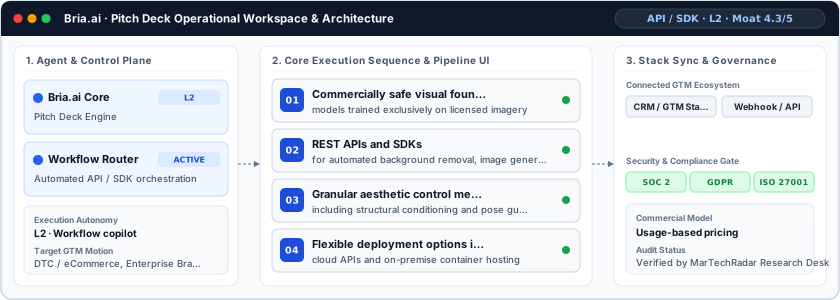
- Commercially safe visual foundation: models trained exclusively on licensed imagery
- REST APIs and SDKs: for automated background removal, image generation, and expansion
- Granular aesthetic control mechanisms: including structural conditioning and pose guidance
- Flexible deployment options including: cloud APIs and on-premise container hosting
Cons: operational limitations & risks
- Training Domain Constraints: Restricting model training strictly to licensed datasets narrows the generative vocabulary, resulting in reduced visual variance on niche concepts compared to unconstrained web-scraped foundation models.
- Throughput and Latency: High-resolution multi-pass generative synthesis via API introduces latency bottlenecks, requiring asynchronous webhook pipelines rather than synchronous front-end execution under heavy concurrent loads.
- Integration Engineering Overhead: Embedding Bria.ai into internal digital asset pipelines demands technical developer resources to configure custom prompt conditioning, bounding box coordinates, and token authentication.
Bria.ai TCO & deal-breaker stress test
Simulate 12-month stepped TCO, hidden cost multipliers, contract lock-in exposure, and stack failure modes using only facts verified by MarTechRadar Research Desk on 2026-10-15 · Capture SHA 15541ef4.
Bria.ai triggers high-severity friction under your 5-seat / $800/mo constraints. Benchmark the verified subtrack alternatives below before committing.
- Moat Score
- 4.3 / 5.0
- AI Autonomy
- L2
- Free Tier / Trial
- None disclosed
Triggered audit signals & failure modes
- Opaque Enterprise Quoting vs. SMB/Mid-Market BudgetVerified Pricing Ledger
Bria.ai does not disclose a public self-serve floor (Usage-based pricing). Buyers with a $800/mo cap face high sales-qualification friction.
- Sales-Gated Contract TermsFact-checked by MarTechRadar Research Desk
Commercial access is structured around usage-based consumption tiers and enterprise software licensing. Self-serve API and web platform entry tiers start from $0.01 per unit transaction across generative API calls, scaling upward according to visual output volume and model type.
- Usage / Credit Burn VolatilityCommercial Model Audit
Bria.ai uses credit or usage-metered billing (Usage-based pricing). High-volume automated workflows across 5 seats can trigger mid-cycle overage charges.
- Primary Operational Bottleneck: Training Domain ConstraintsAudit by MarTechRadar Research Desk
Restricting model training strictly to licensed datasets narrows the generative vocabulary, resulting in reduced visual variance on niche concepts compared to unconstrained web-scraped foundation models.
Test a custom Bria.ai budget or stack constraint
Lower 5-seat floor (~$8/mo vs. Custom Quote) · Transparent self-serve entry without mandatory annual lock-in
Lower 5-seat floor (~$10/mo vs. Custom Quote) · Transparent self-serve entry without mandatory annual lock-in
Bria.ai integrations, API, security & compliance stack
Bria.ai AI moat & Pitch Deck positioning
Proprietary attribution and royalty-tracking engine coupled with 100% licensed training datasets, providing full commercial indemnity against copyright infringement claims.
Bria.ai in-depth review, pricing & architecture analysis
Editor sign-off: Oct 15, 2026. How profiles are made.
What is Bria.ai? Overview & background
Backed by $66.5M in venture funding and headquartered in New York, US, Bria.ai was founded in 2020 to solve the legal copyright liabilities inherent in generative visual synthesis. The company provides commercially cleared generative foundation models tailored for enterprise creative directors, technical product managers, and software developers who require full copyright indemnity. Unlike consumer-oriented image generators trained on scraped web media, Bria.ai builds its architecture exclusively on fully licensed training data with integrated attribution accounting.
How Bria.ai works: architecture & workflow
At an architectural level, Bria.ai operates at Level 2 autonomy through a dual framework: an API engine and the Bria Create interface. The foundational diffusion models ingest parameter prompts and structural conditioning signals to execute text-to-image synthesis, automated object modification, expansion, and background removal. Media generation pipelines leverage modular endpoints that support both cloud inference and self-hosted on-premise container deployment. A built-in attribution registry tracks source components to automate royalty allocation back to participating visual rights holders under verified SOC 2 Type II, GDPR, and ISO 27001 governance controls.
Bria.ai limitations, drawbacks & risks
Operational considerations and platform boundaries include:
- Training Domain Constraints: Restricting model training strictly to licensed datasets narrows the generative vocabulary, resulting in reduced visual variance on niche concepts compared to unconstrained web-scraped foundation models.
- Throughput and Latency: High-resolution multi-pass generative synthesis via API introduces latency bottlenecks, requiring asynchronous webhook pipelines rather than synchronous front-end execution under heavy concurrent loads.
- Integration Engineering Overhead: Embedding Bria.ai into internal digital asset pipelines demands technical developer resources to configure custom prompt conditioning, bounding box coordinates, and token authentication.
Bria.ai pricing, plans & cost breakdown
Commercial access is structured around usage-based consumption tiers and enterprise software licensing. Self-serve API and web platform entry tiers start from $0.01 per unit transaction across generative API calls, scaling upward according to visual output volume and model type. Organizations running dedicated instances or on-premise container deployments negotiate custom annual software contracts based on GPU infrastructure requirements, service-level agreements, and tailored indemnification scopes.
| Plan / Tier | Verified Price & Billing | Included Scope & Contract Terms |
|---|---|---|
| Enterprise / Custom | Custom quote | Custom-quoted plan; terms come from the vendor's sales team. |
How Bria.ai compares vs. competitors & alternatives
Compared to direct category competitors like Flair.ai and Photoroom, Bria.ai functions as an alternative focused on specialized workflow execution within the Pitch Deck segment. Within visual asset production, Bria.ai diverges sharply from presentation platforms like Ceros, Fotor AI, and Picmaker. While Fotor AI and Picmaker prioritize template-driven, drag-and-drop consumer editing, and Ceros delivers interactive digital web experiences, Bria.ai functions primarily as an infrastructure layer. It is built for regulated enterprises and software builders who prioritize strict copyright clearance and programmatic control over casual, browser-based graphic assembly.
Direct competitors & market radar
Top algorithmic competitors based on category positioning, capability overlap, and ICP alignment.
Frequently asked questions about Bria.ai
How does Bria.ai usage pricing work in 2026?
Bria.ai pricing: Usage-based pricing. No free plan is publicly disclosed. Commercial access is structured around usage-based consumption tiers and enterprise software licensing.
What are the top Bria.ai alternatives in Pitch Deck?
Verified Pitch Deck alternatives include Photoroom (Free plan · $7.50–$82.50/mo), Picmaker (From $9/mo), Lumen5 (From $19/mo), Pixlr AI ($9.99–$49.99/mo). Compared to direct category competitors like Flair.ai and Photoroom, Bria.ai functions as an alternative focused on specialized workflow execution within the Pitch Deck segment.
What are the main limitations and trade-offs of Bria.ai?
Operational considerations and platform boundaries include: Training Domain Constraints: Restricting model training strictly to licensed datasets narrows the generative vocabulary, resulting in reduced visual variance on niche concepts compared to unconstrained web-scraped foundation models. Walk away if you need published self-serve pricing: Bria.ai is sold by custom quote.
Verified sources & evidence trail
- Official product domain: https://bria.ai
- Commercial pricing verification: https://bria.ai/pricing
- Verified corporate entity profiles (
sameAs): LinkedIn Company Profile · Crunchbase Entity Record - First-party governance & documentation links: System Status · API & Docs · Terms · Privacy
- Editor sign-off: Oct 15, 2026 (how profiles are made).
