ShiftUp Review (2026): AI SDR Pricing, Limits & Alternatives
Bottom line
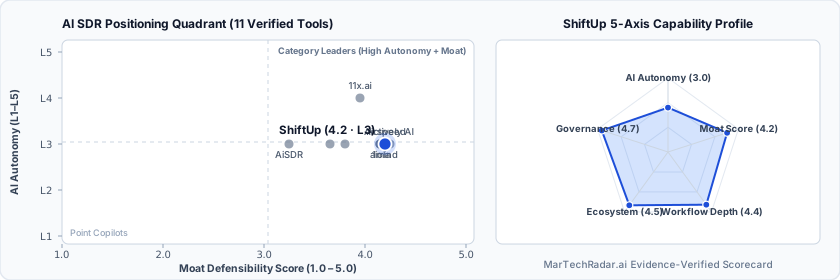
ShiftUp is a Web SaaS tool for AI SDR (Autonomous B2B Sales Agents & AI BDRs) in AI SDR & Outbound. Pricing: Custom / enterprise pricing. Best suited to B2B Sales Leaders, SDR/BDR Teams and Revenue Operations (RevOps). Editor ratings: AI autonomy L3 (conditional automation); moat score 4.2/5.0 (Proprietary moat). Fact-checked by Jiacky Lee on Oct 12, 2026.
Native Salesforce autonomous AI sales development agents that prospect target accounts, qualify leads, and generate enterprise pipeline directly within.
ShiftUp buyer fit verdict: when to choose vs. when to walk away
Choose ShiftUp if (Best Fit)
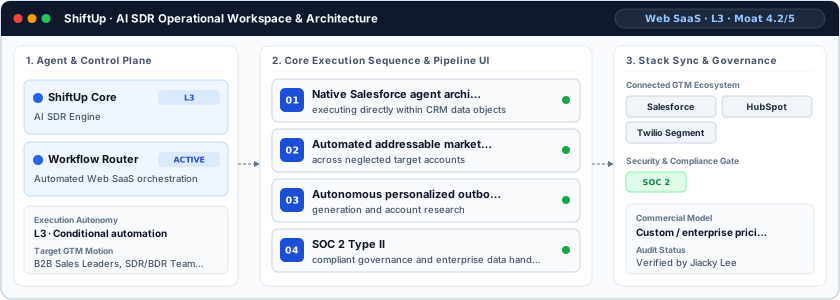
- Target ICP & Stack Fit: You operate as B2B Sales Leaders, SDR/BDR Teams and Revenue Operations (RevOps) requiring a Web SaaS deployment for AI SDR, with verified ecosystem connectivity for Salesforce, HubSpot, Twilio Segment.
- L3 Architecture & Defensibility: Direct CRM-native execution inside Salesforce minimizes external data sync vulnerabilities and vendor overhead, backed by SOC 2 Type II compliance controls.
- Commercial Model Fit: Your procurement budget aligns with Custom / enterprise pricing.
Walk away from ShiftUp if (Deal-Breakers)
- Walk away if you require transparent self-serve monthly billing or your budget ceiling is under $1,000/mo (ShiftUp requires sales-gated custom quoting).
- Walk away if your workflow cannot tolerate CRM schema dependency: Because the execution logic relies on native Salesforce infrastructure, organizations with heavily customized or unhygienic object architectures face complex configuration cycles before agent execution stabilizes.
- Walk away if domain warming and mailbox throttling is a deal-breaker for your team: Automated engagement cadences remain subject to enterprise email service provider rate limits and domain reputation boundaries, necessitating manual throttle controls during initial rollout.
ShiftUp key facts & scorecard
| Pricing | Custom / enterprise pricing |
|---|---|
| Free plan | No / not disclosed |
| Delivery | Web SaaS |
| Audience | B2B Sales Leaders, SDR/BDR Teams, Revenue Operations (RevOps) |
| AI autonomy level | L3 · Conditional automationEditor-verified |
| Moat tier & score | 4.2 / 5.0 · Proprietary moatEditor-verified |
| Funding | Seed |
| Total funding | $3MBacked by Highway 12 Ventures |
| Founders | Ken Valla, Nick Valla, Ryan Adamson |
| Company size | 11-50 employees |
| Ecosystem integrations | Salesforce, HubSpot, Twilio Segment |
| Compliance & governance | SOC 2 |
| Governance & docs | Trust & Security ↗ · System Status ↗ · API & Docs ↗ · Privacy ↗ |
| Headquarters | Phoenix, Arizona |
| Founded | 2025 |
| Last verified |
ShiftUp pros & cons: strengths vs. operational limitations
Pros: core strengths & capabilities
- Native Salesforce agent architecture: executing directly within CRM data objects
- Automated addressable market prospecting: across neglected target accounts
- Autonomous personalized outbound sequence: generation and account research
- SOC 2 Type II: compliant governance and enterprise data handling protocols
Cons: operational limitations & risks
- CRM Schema Dependency: Because the execution logic relies on native Salesforce infrastructure, organizations with heavily customized or unhygienic object architectures face complex configuration cycles before agent execution stabilizes.
- Domain Warming and Mailbox Throttling: Automated engagement cadences remain subject to enterprise email service provider rate limits and domain reputation boundaries, necessitating manual throttle controls during initial rollout.
- Ecosystem Platform Lock-In: The deep architectural alignment with Salesforce restricts operational portability for revenue teams utilizing alternative systems such as HubSpot or specialized standalone orchestration tools.
ShiftUp TCO & deal-breaker stress test
Simulate 12-month stepped TCO, hidden cost multipliers, contract lock-in exposure, and stack failure modes using only facts verified by Jiacky Lee on · Capture SHA a47f1aaa.
ShiftUp triggers high-severity friction under your 5-seat / $800/mo constraints. Benchmark the verified subtrack alternatives below before committing.
| Plan / Tier | Verified Rate | Scale Fit | Scope & Quota Notes |
|---|---|---|---|
| Enterprise / Custom | Custom quote | 15–50+ seats (Enterprise SLA) | Sales-negotiated annual contract for custom volume, SSO/RBAC governance, and dedicated SLA. |
- Moat Score
- 4.2 / 5.0
- AI Autonomy
- L3
- Free Tier / Trial
- None disclosed
Triggered audit signals & failure modes
- Opaque Enterprise Quoting vs. SMB/Mid-Market BudgetVerified Pricing Ledger
ShiftUp does not disclose a public self-serve floor (Custom / enterprise pricing). Buyers with a $800/mo cap face high sales-qualification friction.
- Sales-Gated Contract TermsFact-checked by Jiacky Lee
Commercial procurement for ShiftUp operates through a direct sales structure, with licensing available on request through tailored enterprise sales quotes based on organizational scale and seats.
- Primary Operational Bottleneck: Ecosystem Platform Lock-InAudit by Jiacky Lee
The deep architectural alignment with Salesforce restricts operational portability for revenue teams utilizing alternative systems such as HubSpot or specialized standalone orchestration tools.
Hidden TCO Multipliers & Quota Gates
- CRM Schema Dependency: Because the execution logic relies on native Salesforce infrastructure, organizations with heavily customized or unhygienic object architectures face complex configuration cycles before agent execution stabilizes.
- Domain Warming and Mailbox Throttling: Automated engagement cadences remain subject to enterprise email service provider rate limits and domain reputation boundaries, necessitating manual throttle controls during initial rollout.
When to Walk Away & Negotiation Levers
- Walk away if you require transparent self-serve monthly billing or your budget ceiling is under $1,000/mo (ShiftUp requires sales-gated custom quoting).
- Walk away if your workflow cannot tolerate CRM schema dependency: Because the execution logic relies on native Salesforce infrastructure, organizations with heavily customized or unhygienic object architectures face complex configuration cycles before agent execution stabilizes.
- Walk away if domain warming and mailbox throttling is a deal-breaker for your team: Automated engagement cadences remain subject to enterprise email service provider rate limits and domain reputation boundaries, necessitating manual throttle controls during initial rollout.
- Demand a 30- to 60-day paid pilot opt-out clause in the ShiftUp order form before signing a 12-month enterprise commitment.
- Require a sandbox proof-of-concept testing CRM schema dependency against your live CRM/data schema before annual sign-off.
Ask a custom procurement or TCO stress-test question about ShiftUp
Lower 5-seat floor (~$20/mo vs. Custom Quote) · Transparent self-serve entry without mandatory annual lock-in
Lower 5-seat floor (~$599/mo vs. Custom Quote) · Transparent self-serve entry without mandatory annual lock-in
ShiftUp key entities, modules & ecosystem stack
ShiftUp moat & subtrack positioning
Direct CRM-native execution inside Salesforce minimizes external data sync vulnerabilities and vendor overhead, backed by SOC 2 Type II compliance controls.
Editorial review
Fact-checked by Jiacky Lee (Managing Editor, AI Autonomy & Moat Methodology) on .
Background
Architectured directly inside enterprise CRM environments, ShiftUp was founded in 2025 in Phoenix, Arizona, with $3M in venture funding. The platform provides revenue operations leaders and sales development executives with autonomous sales agents designed to systematically uncover pipeline across under-penetrated addressable market accounts. By positioning its execution framework directly inside enterprise Salesforce infrastructure, ShiftUp addresses the operational overhead of managing external orchestration layers that duplicate CRM data schemas.
How ShiftUp works
At its architectural core, ShiftUp functions at an L3 autonomy tier by orchestrating multi-step outbound prospecting directly on core CRM data structures. The engine queries unassigned account records, synthesizes firmographic signals, and drafts targeted multi-channel messaging without exporting records to external third-party portals. Leveraging embedded LLM inference models governed by enterprise data-handling policies, the system conducts account research, determines optimal prospect personas, and triggers engagement cadences while logging every operational interaction directly to existing CRM objects.
Limitations
Operational considerations and platform boundaries include:
- CRM Schema Dependency: Because the execution logic relies on native Salesforce infrastructure, organizations with heavily customized or unhygienic object architectures face complex configuration cycles before agent execution stabilizes.
- Domain Warming and Mailbox Throttling: Automated engagement cadences remain subject to enterprise email service provider rate limits and domain reputation boundaries, necessitating manual throttle controls during initial rollout.
- Ecosystem Platform Lock-In: The deep architectural alignment with Salesforce restricts operational portability for revenue teams utilizing alternative systems such as HubSpot or specialized standalone orchestration tools.
ShiftUp pricing
Commercial procurement for ShiftUp operates through a direct sales structure, with licensing available on request through tailored enterprise sales quotes based on organizational scale and seats. Deployments are structured around enterprise-tier agent utilization, CRM tenant volume, and dedicated security requirements. Prospective clients can engage with the vendor via scheduled product demonstrations to evaluate integration scope and receive customized commercial proposals.
How ShiftUp compares
Within the autonomous sales agent landscape, ShiftUp competes against standalone solutions like 11x.ai, Confido, and Unify within the AI SDR segment. While competitors rely on off-platform execution engines that require bidirectional API synchronization, ShiftUp differentiates through its native CRM positioning and SOC 2 Type II framework. This architecture appeals to conservative enterprise organizations that mandate strict data boundaries and prioritize running autonomous SDR workflows directly within their core system of record.
Direct competitors & market radar
Top algorithmic competitors based on category positioning, capability overlap, and ICP alignment.
Frequently asked questions about ShiftUp
How much does ShiftUp cost and does it require a custom enterprise quote?
Published pricing summary for ShiftUp: Custom / enterprise pricing. A permanent free plan is not disclosed for ShiftUp. Commercial procurement for ShiftUp operates through a direct sales structure, with licensing available on request through tailored enterprise sales quotes based on organizational scale and seats. Deployments are structured around enterprise-tier agent utilization, CRM tenant volume, and dedicated security requirements.
How does ShiftUp work and how autonomous is its AI architecture?
Native Salesforce autonomous AI sales development agents that prospect target accounts, qualify leads, and generate enterprise pipeline directly within. Within AI SDR (Autonomous B2B Sales Agents & AI BDRs), MarTechRadar rates its execution architecture at L3 · Conditional automation with a verified Moat Score of 4.2 / 5.0 (Proprietary moat). Direct CRM-native execution inside Salesforce minimizes external data sync vulnerabilities and vendor overhead, backed by SOC 2 Type II compliance controls. Corporate profile: Founded by Ken Valla, Nick Valla, Ryan Adamson, operating at 11-50 employees scale.
What are the main limitations of ShiftUp and when should buyers walk away?
Based on our editorial technical audit, key operational considerations and boundaries for ShiftUp include: (1) CRM Schema Dependency: Because the execution logic relies on native Salesforce infrastructure, organizations with heavily customized or unhygienic object architectures face complex configuration cycles before agent execution stabilizes. (2) Domain Warming and Mailbox Throttling: Automated engagement cadences remain subject to enterprise email service provider rate limits and domain reputation boundaries, necessitating manual throttle controls during initial rollout. (3) Ecosystem Platform Lock-In: The deep architectural alignment with Salesforce restricts operational portability for revenue teams utilizing alternative systems such as HubSpot or specialized standalone orchestration tools. Primary procurement walk-away rule: Walk away if you require transparent self-serve monthly billing or your budget ceiling is under $1,000/mo (ShiftUp requires sales-gated custom quoting).
What integrations, compliance certifications, and contract terms apply to ShiftUp?
Verified ecosystem and stack integrations include Salesforce, HubSpot, Twilio Segment. Documented security and governance attestations include SOC 2. First-party governance and developer endpoints verified on domain include: Trust/Security (https://trust.shiftupai.com), Status (https://status.shiftupai.com), API Docs (https://docs.shiftupai.com). Key TCO multiplier to watch: CRM Schema Dependency (Because the execution logic relies on native Salesforce infrastructure, organizations with heavily customized or unhygienic object architectures face complex configuration cycles before agent execution stabilizes.) Before signing a contract, procurement teams should demand a 30- to 60-day paid pilot opt-out clause in the ShiftUp order form before signing a 12-month enterprise commitment.
What are the best ShiftUp alternatives and head-to-head competitors in 2026?
Top fact-checked alternatives to ShiftUp in AI SDR (Autonomous B2B Sales Agents & AI BDRs) include Unify (From $20/mo), Confido (Custom / enterprise pricing), SetSale (From $599/mo), WorkHQ (Free plan · $0/mo · Enterprise plan). Within the autonomous sales agent landscape, ShiftUp competes against standalone solutions like 11x.ai, Confido, and Unify within the AI SDR segment.
Verified sources & evidence trail
- Official product domain: https://shiftupai.com/
- Commercial pricing verification: Verified against official vendor pricing policy (Custom / enterprise pricing)
- Verified corporate entity profiles (
sameAs): LinkedIn Company Profile · Crunchbase Entity Record - First-party governance & documentation links: Trust & Security · System Status · API & Docs · Privacy
- Editorial audit sign-off: Fact-checked by Jiacky Lee on under the MarTechRadar Evidence-Ledger Protocol.