Unify Review (2026): AI SDR Pricing, Limits & Alternatives
Bottom line
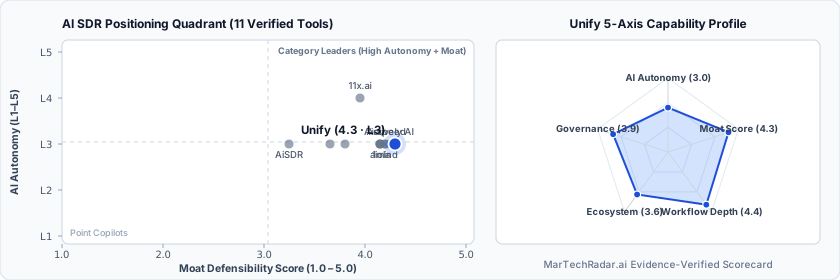
Unify is a Web SaaS tool for AI SDR (Autonomous B2B Sales Agents & AI BDRs) in AI SDR & Outbound. Pricing: From $20/mo. Best suited to B2B Sales Leaders, SDR/BDR Teams and Revenue Operations (RevOps). Editor ratings: AI autonomy L3 (conditional automation); moat score 4.3/5.0 (Proprietary moat (category leader)). Fact-checked by Tim Fenolz on Oct 12, 2026.
Autonomous outbound sales platform that identifies warm buyer intent signals and orchestrates AI-driven multichannel pipeline generation.
Unify buyer fit verdict: when to choose vs. when to walk away
Choose Unify if (Best Fit)
- Target ICP & Stack Fit: You operate as B2B Sales Leaders, SDR/BDR Teams and Revenue Operations (RevOps) requiring a Web SaaS deployment for AI SDR, with verified ecosystem connectivity for Outreach.
- L3 Architecture & Defensibility: Proprietary identity resolution spanning 40+ dynamic intent data feeds merged into an embedded multichannel sequencing and agentic execution layer.
- Commercial Model Fit: Your procurement budget aligns with From $20/mo.
Walk away from Unify if (Deal-Breakers)
- Walk away if your workflow requires uncapped enterprise volume on the From $20/mo entry plan without upgrading tiers.
- Walk away if your workflow cannot tolerate deliverability overhead: Automated email distribution across multi-agent campaigns requires external domain isolation, continuous DNS authentication management, and manual inbox warming to prevent domain reputation degradation.
- Walk away if signal attribution lag is a deal-breaker for your team: Third-party intent feeds exhibit variable ingestion latency, which occasionally triggers outbound cadences after competitor engagement has already begun or internal hiring priorities have pivoted.
Unify key facts & scorecard
| Pricing | From $20/moVendor pricing page |
|---|---|
| Free plan | No / not disclosed |
| Delivery | Web SaaS |
| Audience | B2B Sales Leaders, SDR/BDR Teams, Revenue Operations (RevOps) |
| AI autonomy level | L3 · Conditional automationEditor-verified |
| Moat tier & score | 4.3 / 5.0 · Proprietary moat (category leader)Editor-verified |
| Funding | Series B |
| Total funding | $58.3MBacked by Emergence Capital |
| Founders | Austin Hughes, Connor Heggie |
| Company size | 51-200 employees |
| Ecosystem integrations | Outreach |
| Governance & docs | Trust & Security ↗ · API & Docs ↗ · Changelog ↗ · Privacy ↗ |
| Headquarters | San Francisco, California |
| Founded | 2023 |
| Last verified |
Unify pros & cons: strengths vs. operational limitations
Pros: core strengths & capabilities
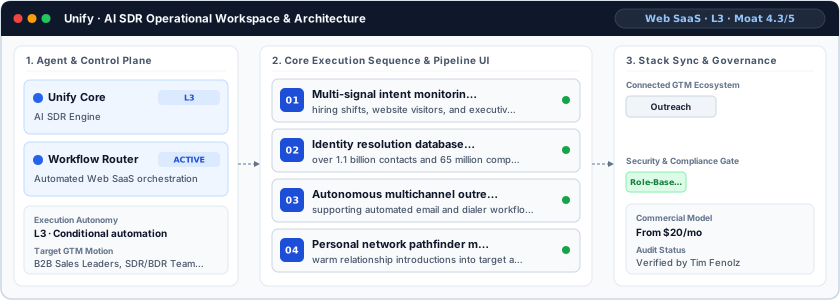
- Multi-signal intent monitoring capturing: hiring shifts, website visitors, and executive changes
- Identity resolution database covering: over 1.1 billion contacts and 65 million company profiles
- Autonomous multichannel outreach engine: supporting automated email and dialer workflows
- Personal network pathfinder mapping: warm relationship introductions into target accounts
Cons: operational limitations & risks
- Deliverability Overhead: Automated email distribution across multi-agent campaigns requires external domain isolation, continuous DNS authentication management, and manual inbox warming to prevent domain reputation degradation.
- Signal Attribution Lag: Third-party intent feeds exhibit variable ingestion latency, which occasionally triggers outbound cadences after competitor engagement has already begun or internal hiring priorities have pivoted.
- CRM Schema Drift: Bi-directional synchronization depends on standardized lead and contact structures, causing sync exceptions whenever custom sales objects or validation rules change inside host CRM systems.
Unify TCO & deal-breaker stress test
Simulate 12-month stepped TCO, hidden cost multipliers, contract lock-in exposure, and stack failure modes using only facts verified by Tim Fenolz on · Capture SHA 84582da3.
Unify aligns with your 5-seat / $800/mo profile. Review the walk-away triggers and contract levers below before deployment.
| Plan / Tier | Verified Rate | Scale Fit | Scope & Quota Notes |
|---|---|---|---|
| Entry / Starter | $20/mo | Unlimited seats (Entry credits) | 800 credits / seat / mo |
| Growth / Professional | $25/mo | Unlimited seats (Growth credits) | Mailbox warmup + rotation |
| Pro | $60/mo | Unlimited seats (Scale credits) | 2,400 credits / seat / mo |
- Moat Score
- 4.3 / 5.0
- AI Autonomy
- L3
- Free Tier / Trial
- None disclosed
Triggered audit signals & failure modes
- Published Self-Serve Entry FloorVerified Pricing Ledger
Unify publishes a transparent entry point (From $20/mo) for initial validation before committing.
- Tier Fit for 5-Seat Scale: Growth / Professional ($25/mo)Verified Tier Schedule
Mailbox warmup + rotation
- Primary Operational Bottleneck: Deliverability OverheadAudit by Tim Fenolz
Automated email distribution across multi-agent campaigns requires external domain isolation, continuous DNS authentication management, and manual inbox warming to prevent domain reputation degradation.
Hidden TCO Multipliers & Quota Gates
- Per-Seat Linear Scaling: Unify prices licenses on a per-user/seat basis (From $20/mo); expanding from 2 to 15+ operators multiplies base recurring spend linearly.
- Annual Billing Headline vs. Monthly Premium: Headline entry rates reflect annual billing commitments; month-to-month flexibility carries a higher effective monthly rate or requires annual prepayment.
- Credit & Usage Burn Multiplier: Automated workflows consume metered credits/usage quotas; multi-step enrichment, voice minutes, or high-frequency agent runs can trigger mid-cycle top-up packs.
When to Walk Away & Negotiation Levers
- Walk away if your workflow requires uncapped enterprise volume on the From $20/mo entry plan without upgrading tiers.
- Walk away if your workflow cannot tolerate deliverability overhead: Automated email distribution across multi-agent campaigns requires external domain isolation, continuous DNS authentication management, and manual inbox warming to prevent domain reputation degradation.
- Walk away if signal attribution lag is a deal-breaker for your team: Third-party intent feeds exhibit variable ingestion latency, which occasionally triggers outbound cadences after competitor engagement has already begun or internal hiring priorities have pivoted.
- Validate exact quota thresholds (seats, credits, or API calls) included in Unify's From $20/mo tier before converting from monthly to annual billing.
- Require a sandbox proof-of-concept testing deliverability overhead against your live CRM/data schema before annual sign-off.
Ask a custom procurement or TCO stress-test question about Unify
Fits within $800/mo budget (From $25/seat/mo · Enterprise plan)
Verified AI SDR peer (From $1/mo · Moat 4.2/5.0)
Unify key entities, modules & ecosystem stack
Unify moat & subtrack positioning
Proprietary identity resolution spanning 40+ dynamic intent data feeds merged into an embedded multichannel sequencing and agentic execution layer.
Editorial review
Fact-checked by Tim Fenolz (Lead AdTech, Programmatic & Attribution Analyst) on .
Background
Established with $58.3M in venture funding, Unify was founded in 2023 in San Francisco, California, to build autonomous outbound execution systems for B2B sales teams. The platform addresses sales development leaders and revenue operations directors seeking to automate outbound pipeline creation without stacking disparate data vendors. By pairing B2B contact intelligence directly with execution workflows, Unify eliminates the operational handoff between signal detection and message distribution.
How Unify works
Unify operates as an L3 autonomous outbound pipeline by continuously ingesting telemetry across 40 external data sources. The architecture surfaces buyer signals—including hiring expansions, executive movements, and anonymous account visits—against a proprietary graph of 65 million companies and 1.1 billion individuals. Once an account crosses intent thresholds, the agentic engine drafts personalized multi-channel cadences via large language models and dispatches them through synchronized sequencing and telephony infrastructure.
Limitations
Operational considerations and platform boundaries include:
- Deliverability Overhead: Automated email distribution across multi-agent campaigns requires external domain isolation, continuous DNS authentication management, and manual inbox warming to prevent domain reputation degradation.
- Signal Attribution Lag: Third-party intent feeds exhibit variable ingestion latency, which occasionally triggers outbound cadences after competitor engagement has already begun or internal hiring priorities have pivoted.
- CRM Schema Drift: Bi-directional synchronization depends on standardized lead and contact structures, causing sync exceptions whenever custom sales objects or validation rules change inside host CRM systems.
Unify pricing
Commercial pricing operates on a monthly per-seat subscription coupled with consumption-based credit allocations. Unify provides an introductory tier starting at $0 for initial evaluation with limited credits and basic model access for up to three seats. Paid self-serve deployment begins at $20 per seat monthly, granting 800 execution credits per rep to support scaled agentic outreach and enriched multi-channel cadences.
How Unify compares
Within the autonomous sales execution category, Unify competes directly against 11x.ai, 1mind, and Actively AI. While 11x.ai emphasizes fully delegated digital worker personas and 1mind targets complex buyer persona simulations, Unify differentiates by grounding agentic messaging in unified multi-source intent data. This architecture suits mid-market and enterprise commercial teams requiring verified account triggers rather than purely programmatic cold outreach.
Direct competitors & market radar
Top algorithmic competitors based on category positioning, capability overlap, and ICP alignment.
Frequently asked questions about Unify
How much does Unify cost and what pricing tiers are available?
Published pricing summary for Unify: From $20/mo. A permanent free plan is not disclosed for Unify. Verified tier schedule: Entry / Starter ($20/mo for Unlimited seats (Entry credits)); Growth / Professional ($25/mo for Unlimited seats (Growth credits)); Pro ($60/mo for Unlimited seats (Scale credits)). Commercial pricing operates on a monthly per-seat subscription coupled with consumption-based credit allocations. Unify provides an introductory tier starting at $0 for initial evaluation with limited credits and basic model access for up to three seats.
How does Unify work and how autonomous is its AI architecture?
Autonomous outbound sales platform that identifies warm buyer intent signals and orchestrates AI-driven multichannel pipeline generation. Within AI SDR (Autonomous B2B Sales Agents & AI BDRs), MarTechRadar rates its execution architecture at L3 · Conditional automation with a verified Moat Score of 4.3 / 5.0 (Proprietary moat (category leader)). Proprietary identity resolution spanning 40+ dynamic intent data feeds merged into an embedded multichannel sequencing and agentic execution layer. Corporate profile: Founded by Austin Hughes, Connor Heggie, operating at 51-200 employees scale.
What are the main limitations of Unify and when should buyers walk away?
Based on our editorial technical audit, key operational considerations and boundaries for Unify include: (1) Deliverability Overhead: Automated email distribution across multi-agent campaigns requires external domain isolation, continuous DNS authentication management, and manual inbox warming to prevent domain reputation degradation. (2) Signal Attribution Lag: Third-party intent feeds exhibit variable ingestion latency, which occasionally triggers outbound cadences after competitor engagement has already begun or internal hiring priorities have pivoted. (3) CRM Schema Drift: Bi-directional synchronization depends on standardized lead and contact structures, causing sync exceptions whenever custom sales objects or validation rules change inside host CRM systems. Primary procurement walk-away rule: Walk away if your workflow requires uncapped enterprise volume on the From $20/mo entry plan without upgrading tiers.
What integrations, compliance certifications, and contract terms apply to Unify?
Verified ecosystem and stack integrations include Outreach. First-party governance and developer endpoints verified on domain include: Trust/Security (https://trust.unifygtm.com), API Docs (https://docs.unifygtm.com/getting-started/welcome). Key TCO multiplier to watch: Per-Seat Linear Scaling (Unify prices licenses on a per-user/seat basis (From $20/mo); expanding from 2 to 15+ operators multiplies base recurring spend linearly.) Before signing a contract, procurement teams should validate exact quota thresholds (seats, credits, or API calls) included in Unify's From $20/mo tier before converting from monthly to annual billing.
What are the best Unify alternatives and head-to-head competitors in 2026?
Top fact-checked alternatives to Unify in AI SDR (Autonomous B2B Sales Agents & AI BDRs) include Groove.co (Custom / enterprise pricing), SleekFlow (From $1/mo), ShiftUp (Custom / enterprise pricing), Coffee (From $25/seat/mo · Enterprise plan). Within the autonomous sales execution category, Unify competes directly against 11x.ai, 1mind, and Actively AI. While 11x.ai emphasizes fully delegated digital worker personas and 1mind targets complex buyer persona simulations, Unify differentiates by grounding agentic messaging in unified multi-source intent data.
Verified sources & evidence trail
- Official product domain: https://www.unifygtm.com
- Commercial pricing verification: https://www.unifygtm.com/pricing
- Verified corporate entity profiles (
sameAs): LinkedIn Company Profile · Crunchbase Entity Record - First-party governance & documentation links: Trust & Security · API & Docs · Changelog · Privacy
- Editorial audit sign-off: Fact-checked by Tim Fenolz on under the MarTechRadar Evidence-Ledger Protocol.