SendX Review (2026): Email Marketing Pricing, Pros & Cons
Bottom line
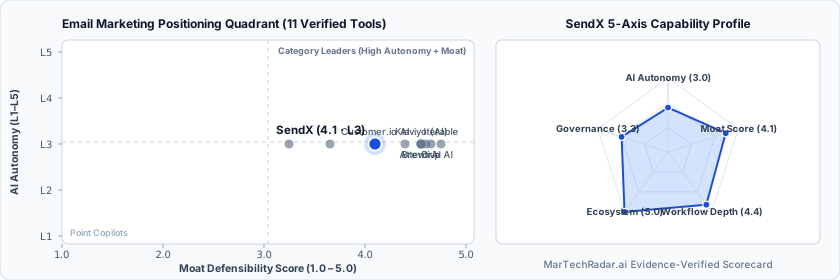
SendX is a Web SaaS tool for Email Marketing (AI Email Marketing & Lifecycle Journeys) in Lifecycle & CDP. Pricing: $7.49–$79.99/mo. Best suited to Creators / Solo. Editor ratings: AI autonomy L3 (conditional automation); moat score 4.1/5.0 (Proprietary moat). Fact-checked by MarTechRadar Research Desk on Oct 14, 2026.
Email marketing automation platform pairing automated sender reputation monitoring and adaptive throttling with high-volume dispatch infrastructure.
Is SendX worth it in 2026? Buyer fit & when to walk away
Choose SendX if (Best Fit)
- Target ICP & Stack Fit: You operate as Creators / Solo requiring a Web SaaS deployment for Email Marketing, with verified ecosystem connectivity for HubSpot, Shopify, WordPress, Klaviyo.
- L3 Architecture & Defensibility: Moat derives from proprietary automated throttling feedback loops and domain-level telemetry heuristics that sustain deliverability across multi-tenant IP pools, coupled with an unmetered send-to-contact pricing structure.
- Commercial Model Fit: Your procurement budget aligns with $7.49–$79.99/mo.
Walk away from SendX if (Deal-Breakers)
- Walk away if your workflow cannot tolerate multi-channel orchestration: The system architecture centers strictly on email protocols, lacking native integration for coordinated cross-channel journeys across SMS, mobile push, or ad audience syncing.
- Walk away if predictive segmentation granularity is a deal-breaker for your team: Rules engines rely predominantly on deterministic behavioral triggers rather than continuous unsupervised ML clustering, limiting predictive churn and dynamic propensity modeling.
SendX pricing, free plan & scorecard at a glance
| Pricing | $7.49–$79.99/moVendor pricing page |
|---|---|
| Free plan | No / not disclosed |
| Delivery | Web SaaS |
| Audience | Creators / Solo |
| AI autonomy level | L3 · Conditional automationEditor-verified |
| Moat tier & score | 4.1 / 5.0 · Proprietary moatEditor-verified |
| Funding | AcquiredAcquired by Inturact Capital |
| Founders | Agnibha Nath, Mayank Agarwal, Trevor Hatfield, Varun Jain |
| Company size | 11-50 employees |
| Ecosystem integrations | HubSpot, Shopify, WordPress, Klaviyo, Zapier |
| Governance & docs | Trust & Security ↗ · API & Docs ↗ · Privacy ↗ |
| Headquarters | Wilmington, County of New Castle, Delaware |
| Founded | 2016 |
| Last verified | Oct 14, 2026 |
SendX pros & cons: strengths vs. operational limitations
Pros: core strengths & capabilities
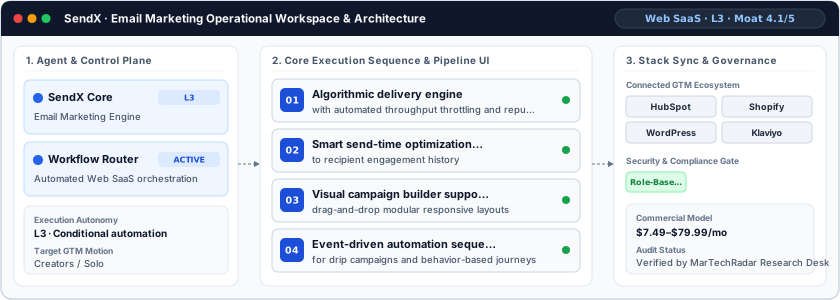
- Algorithmic delivery engine: with automated throughput throttling and reputation telemetry
- Smart send-time optimization calibrated: to recipient engagement history
- Visual campaign builder supporting: drag-and-drop modular responsive layouts
- Event-driven automation sequences: for drip campaigns and behavior-based journeys
Cons: operational limitations & risks
- Multi-Channel Orchestration: The system architecture centers strictly on email protocols, lacking native integration for coordinated cross-channel journeys across SMS, mobile push, or ad audience syncing.
- Predictive Segmentation Granularity: Rules engines rely predominantly on deterministic behavioral triggers rather than continuous unsupervised ML clustering, limiting predictive churn and dynamic propensity modeling.
- Complex Enterprise Governance: Access governance enforces basic team roles but lacks granular role-based access control (RBAC), multi-subsidiary account rollups, and verifiable audit logging for strictly regulated verticals.
SendX TCO & deal-breaker stress test
Simulate 12-month stepped TCO, hidden cost multipliers, contract lock-in exposure, and stack failure modes using only facts verified by MarTechRadar Research Desk on 2026-10-14 · Capture SHA eadc9e75.
SendX aligns with your 5-seat / $800/mo profile. Review the walk-away triggers and contract levers below before deployment.
- Moat Score
- 4.1 / 5.0
- AI Autonomy
- L3
- Free Tier / Trial
- None disclosed
Triggered audit signals & failure modes
- Published Self-Serve Entry FloorVerified Pricing Ledger
SendX publishes a transparent entry point ($7.49–$79.99/mo) for initial validation before committing.
- Primary Operational Bottleneck: Multi-Channel OrchestrationAudit by MarTechRadar Research Desk
The system architecture centers strictly on email protocols, lacking native integration for coordinated cross-channel journeys across SMS, mobile push, or ad audience syncing.
Test a custom SendX budget or stack constraint
Fits within $800/mo budget (From $13/mo)
Fits within $800/mo budget (From $27/mo)
SendX integrations, API, security & compliance stack
SendX AI moat & Email Marketing positioning
Moat derives from proprietary automated throttling feedback loops and domain-level telemetry heuristics that sustain deliverability across multi-tenant IP pools, coupled with an unmetered send-to-contact pricing structure.
SendX in-depth review, pricing & architecture analysis
Editor sign-off: Oct 14, 2026. How profiles are made.
What is SendX? Overview & background
Modern email infrastructure demands operational resilience against escalating mailbox provider defenses. Established in 2016 in Wilmington, County of New Castle, Delaware, SendX addresses programmatic messaging for growth marketers and retention operators navigating high-volume lifecycle campaigns. Following its acquisition by Inturact Capital, the platform concentrates on sustained deliverability by decoupling contact management from arbitrary volumetric dispatch caps. Operating within AI email marketing and lifecycle journeys, SendX functions as an execution engine designed to manage subscriber lists while automating technical delivery workflows.
How SendX works: architecture & workflow
Under the hood, SendX pairs an event-driven automation framework with an algorithmic sending engine. The ingestion layer processes subscriber interactions, tracking transactional opens, clicks, and domain-level bounce signatures. When campaigns trigger, the dispatch pipeline evaluates real-time reputation heuristics, dynamically throttling message cadence and re-routing traffic across warmed IP configurations to maintain high inbox placement. Concurrently, recipient-level historical engagement patterns inform predictive send-time algorithms, scheduling individual message drops when engagement likelihood peaks rather than using static batch distributions, alongside native workflow integrations for HubSpot, Shopify, Zapier, and Klaviyo.
SendX limitations, drawbacks & risks
Operational considerations and platform boundaries include:
- Multi-Channel Orchestration: The system architecture centers strictly on email protocols, lacking native integration for coordinated cross-channel journeys across SMS, mobile push, or ad audience syncing.
- Predictive Segmentation Granularity: Rules engines rely predominantly on deterministic behavioral triggers rather than continuous unsupervised ML clustering, limiting predictive churn and dynamic propensity modeling.
- Complex Enterprise Governance: Access governance enforces basic team roles but lacks granular role-based access control (RBAC), multi-subsidiary account rollups, and verifiable audit logging for strictly regulated verticals.
SendX pricing, plans & cost breakdown
Commercial access operates through a tiered subscription model indexed entirely to managed contact volume without monthly send limitations. Entry pricing begins at $7.49 per month for 1,000 subscribers, scaling up to contact bands such as 15,000 subscribers billed at $79.99 per month. All subscription tiers unlock complete functional features without arbitrary capability gating or paywalled workflow builders.
How SendX compares vs. competitors & alternatives
Within its software category, SendX competes against ecosystem players like 10Web AI, AB Tasty, and Ability.ai. While 10Web AI targets automated WordPress website generation and AB Tasty focuses on client-side experimentation pipelines, SendX concentrates purely on core delivery plumbing and unmetered email execution. Unlike Ability.ai, which targets autonomous agentic ad operations, SendX serves cost-sensitive mid-market operators seeking dependable inbox placement and straightforward lifecycle drips.
Frequently asked questions about SendX
How much does SendX cost in 2026?
SendX pricing: $7.49–$79.99/mo. No free plan is publicly disclosed. Commercial access operates through a tiered subscription model indexed entirely to managed contact volume without monthly send limitations.
What are the top SendX alternatives in Email Marketing?
Verified Email Marketing alternatives include Sailthru (Custom / enterprise pricing), Inbox Zero (From $18/mo), VerticalResponse (From $13/mo), Mailmodo (From $27/mo). Within its software category, SendX competes against ecosystem players like 10Web AI, AB Tasty, and Ability.ai.
What are the main limitations and trade-offs of SendX?
Operational considerations and platform boundaries include: Multi-Channel Orchestration: The system architecture centers strictly on email protocols, lacking native integration for coordinated cross-channel journeys across SMS, mobile push, or ad audience syncing. Walk away if your workflow cannot tolerate multi-channel orchestration: The system architecture centers strictly on email protocols, lacking native integration for coordinated cross-channel journeys across SMS, mobile push, or ad audience syncing.
Verified sources & evidence trail
- Official product domain: https://sendx.io
- Commercial pricing verification: https://www.sendx.io/pricing
- Verified corporate entity profiles (
sameAs): LinkedIn Company Profile · Crunchbase Entity Record - First-party governance & documentation links: Trust & Security · API & Docs · Privacy
- Editor sign-off: Oct 14, 2026 (how profiles are made).
