ReportGarden Review (2026): Marketing Attribution Pricing, Pros & Cons
Bottom line
ReportGarden is a Web SaaS tool for Marketing Attribution (Multi-Touch Attribution & eCommerce Dashboards) in Analytics & Attribution. Pricing: From $75/mo. Best suited to B2B SaaS and Marketing Agencies. Editor ratings: AI autonomy L2 (workflow copilot); moat score 1.6/5.0 (Thin wrapper). Fact-checked by MarTechRadar Research Desk on Oct 16, 2026.
Marketing agency reporting and client dashboard software that combines data from 100+ ad, SEO, and social channels into automated white-label reports.
Is ReportGarden worth it in 2026? Buyer fit & when to walk away
Choose ReportGarden if (Best Fit)
- Target ICP & Stack Fit: You operate as B2B SaaS and Marketing Agencies requiring a Web SaaS deployment for Marketing Attribution.
- L2 Architecture & Defensibility: Defensibility stems from its purpose-built agency reporting workflow, combining client-facing portal permissions, 100+ pre-built ad network connectors, and budget pacing utilities.
- Commercial Model Fit: Your procurement budget aligns with From $75/mo.
Walk away from ReportGarden if (Deal-Breakers)
- Walk away if your workflow cannot tolerate upstream ad API limits: Heavy report runs at the start of the month can hit third-party ad network rate limits and slow down live widget loads.
- Walk away if built for agency reports, not data lakes is a deal-breaker for your team: ReportGarden is built for visual client dashboards and scheduled PDFs rather than piping raw event rows into Snowflake or BigQuery.
ReportGarden pricing, free plan & scorecard at a glance
| Pricing | From $75/moVendor pricing page |
|---|---|
| Free plan | No / not disclosed |
| Delivery | Web SaaS |
| Audience | B2B SaaS, Marketing Agencies |
| AI autonomy level | L2 · Workflow copilotEditor-verified |
| Moat tier & score | 1.6 / 5.0 · Thin wrapperEditor-verified |
| Funding | Seed |
| Headquarters | Wilmington, Delaware, United States |
| Founded | 2013 |
| Last verified | Oct 16, 2026 |
ReportGarden pros & cons: strengths vs. operational limitations
Pros: core strengths & capabilities
- Automated cross-channel data ingestion: across 100+ paid search, social, e-commerce, and SEO platforms
- Configurable dashboard templates: with client-specific white-labeling and custom metrics
- Cross-platform data blending, keyword: rank tracking, and scheduled multi-channel report delivery
- Integrated agency budget pacing: trackers and client reporting portals
Cons: operational limitations & risks
- Upstream Ad API Limits: Heavy report runs at the start of the month can hit third-party ad network rate limits and slow down live widget loads.
- Built for Agency Reports, Not Data Lakes: ReportGarden is built for visual client dashboards and scheduled PDFs rather than piping raw event rows into Snowflake or BigQuery.
- Fair Usage Caps on Entry Tiers: Lower plans set fair usage caps on connected ad accounts and dashboards, so growing agencies must upgrade tiers as they add clients.
ReportGarden TCO & deal-breaker stress test
Simulate 12-month stepped TCO, hidden cost multipliers, contract lock-in exposure, and stack failure modes using only facts verified by MarTechRadar Research Desk on 2026-10-16 · Capture SHA ce6102b8.
ReportGarden aligns with your 5-seat / $800/mo profile. Review the walk-away triggers and contract levers below before deployment.
- Moat Score
- 1.6 / 5.0
- AI Autonomy
- L2
- Free Tier / Trial
- None disclosed
Triggered audit signals & failure modes
- Published Self-Serve Entry FloorVerified Pricing Ledger
ReportGarden publishes a transparent entry point (From $75/mo) for initial validation before committing.
- Primary Operational Bottleneck: Upstream Ad API LimitsAudit by MarTechRadar Research Desk
Heavy report runs at the start of the month can hit third-party ad network rate limits and slow down live widget loads.
Test a custom ReportGarden budget or stack constraint
Lower 5-seat floor (~$62/mo vs. From $75 / mo)
Lower 5-seat floor (~$50/mo vs. From $75 / mo)
ReportGarden AI moat & Marketing Attribution positioning
Defensibility stems from its purpose-built agency reporting workflow, combining client-facing portal permissions, 100+ pre-built ad network connectors, and budget pacing utilities.
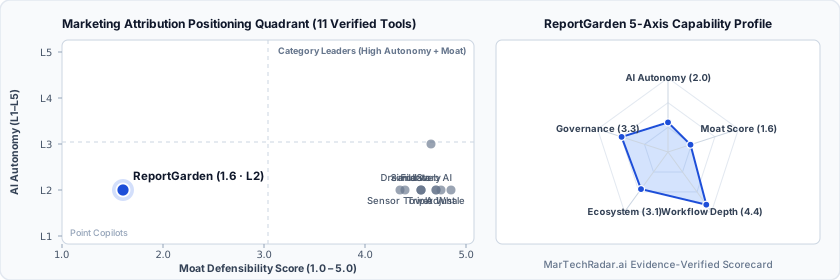
ReportGarden in-depth review, pricing & architecture analysis
Editor sign-off: Oct 16, 2026. How profiles are made.
What is ReportGarden? Overview & background
Founded in 2013 in Wilmington, Delaware, ReportGarden (reportgarden.com) is a dashboard and client reporting tool for digital agencies. Over 7,000 agencies have used it to build more than 100,000 dashboards and 1M reports. It serves agency account leads, PPC managers, and SEO teams who want to replace month-end spreadsheet work with scheduled, white-label client reports.
How ReportGarden works: architecture & workflow
Operating at Level 2 (L2) autonomy, ReportGarden links to over 100 ad, SEO, social media, PPC, and e-commerce sources via live API connectors. It pulls ad spend, clicks, keyword ranks, and sales into drag-and-drop templates and InsightHub dashboards. Account leads can blend data across channels, build custom math rules, track ad budget pacing, and schedule branded PDF or live link reports to go out on time.
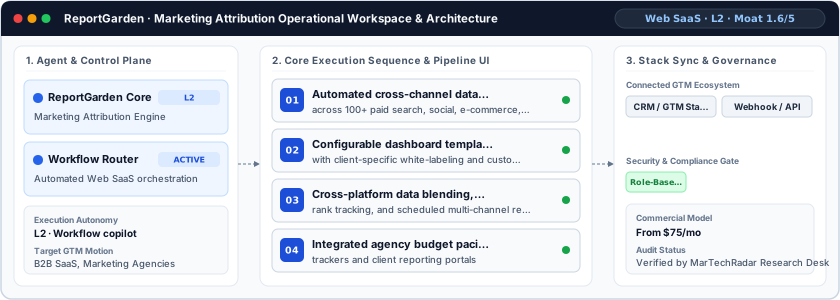
ReportGarden limitations, drawbacks & risks
Limitations and trade-offs to weigh before choosing ReportGarden:
- Upstream Ad API Limits: Heavy report runs at the start of the month can hit third-party ad network rate limits and slow down live widget loads.
- Built for Agency Reports, Not Data Lakes: ReportGarden is built for visual client dashboards and scheduled PDFs rather than piping raw event rows into Snowflake or BigQuery.
- Fair Usage Caps on Entry Tiers: Lower plans set fair usage caps on connected ad accounts and dashboards, so growing agencies must upgrade tiers as they add clients.
ReportGarden pricing, plans & cost breakdown
ReportGarden offers a 14-day free trial (no credit card required) and paid plans starting from $75/month (reportgarden.com/pricing). Higher tiers scale with the number of dashboards, connected ad accounts, white-label domain options, and franchise reporting features. New agency clients also get one-on-one onboarding support with a dedicated point of contact.
How ReportGarden compares vs. competitors & alternatives
In agency reporting and dashboard software, ReportGarden competes against Whatagraph, AgencyAnalytics, Oviond, Swydo, and TapClicks. Compared to pricier suites like Whatagraph and TapClicks, ReportGarden gives small and mid-sized agencies a low $75/month starting price with 100+ data connectors and built-in PPC budget tracking.
Direct competitors & market radar
Top algorithmic competitors based on category positioning, capability overlap, and ICP alignment.
Frequently asked questions about ReportGarden
How much does ReportGarden cost in 2026?
ReportGarden pricing: From $75/mo. No free plan is publicly disclosed. ReportGarden offers a 14-day free trial (no credit card required) and paid plans starting from $75/month (`reportgarden.com/pricing`).
What are the top ReportGarden alternatives in Marketing Attribution?
Verified Marketing Attribution alternatives include Oviond (From $50/mo), Swydo ($62–$69/mo), AgencyAnalytics (From $20/mo), Kochava (Custom / enterprise pricing). In agency reporting and dashboard software, ReportGarden competes against Whatagraph, AgencyAnalytics, Oviond, Swydo, and TapClicks.
What are the main limitations and trade-offs of ReportGarden?
Limitations and trade-offs to weigh before choosing ReportGarden: Upstream Ad API Limits: Heavy report runs at the start of the month can hit third-party ad network rate limits and slow down live widget loads. Walk away if your workflow cannot tolerate upstream ad API limits: Heavy report runs at the start of the month can hit third-party ad network rate limits and slow down live widget loads.
Verified sources & evidence trail
- Official product domain: https://reportgarden.com
- Commercial pricing verification: https://reportgarden.com/pricing
- Verified corporate entity profiles (
sameAs): LinkedIn Company Profile · Crunchbase Entity Record - Editor sign-off: Oct 16, 2026 (how profiles are made).
