Pathmatics Review (2026): Marketing Attribution Pricing, Pros & Cons
Bottom line
Pathmatics is a Web SaaS tool for Marketing Attribution (Multi-Touch Attribution & eCommerce Dashboards) in Analytics & Attribution. Pricing: Custom / enterprise pricing. Best suited to DTC / eCommerce and Enterprise Brands. Editor ratings: AI autonomy L2 (workflow copilot); moat score 2.3/5.0 (Workflow-embedded). Fact-checked by MarTechRadar Research Desk on Oct 16, 2026.
Competitive advertising intelligence platform offering multi-channel ad spend estimations, creative monitoring, and media placement transparency.
Is Pathmatics worth it in 2026? Buyer fit & when to walk away
Choose Pathmatics if (Best Fit)
- Target ICP & Stack Fit: You operate as DTC / eCommerce and Enterprise Brands requiring a Web SaaS deployment for Marketing Attribution.
- L2 Architecture & Defensibility: Proprietary panel-based ad scraping infrastructure, historical digital creative archives, and domain-level spend estimation heuristics that take years to replicate at scale.
- Commercial Model Fit: Your procurement budget aligns with Custom / enterprise pricing.
Walk away from Pathmatics if (Deal-Breakers)
- Walk away if you need published self-serve pricing: Pathmatics is sold by custom quote.
- Walk away if your workflow cannot tolerate spend estimation discrepancies: Model calculations rely on panel observations and normalized cost-per-thousand baselines, resulting in variances when competitors negotiate private programmatic marketplaces or custom direct buy discounts.
- Walk away if walled-garden visibility constraints is a deal-breaker for your team: Panel-based data capture within closed ecosystems like social applications is subject to platform interface alterations and regional panel sample biases.
Pathmatics pricing, free plan & scorecard at a glance
| Pricing | Custom / enterprise pricing |
|---|---|
| Free plan | No / not disclosed |
| Delivery | Web SaaS |
| Audience | DTC / eCommerce, Enterprise Brands |
| AI autonomy level | L2 · Workflow copilotEditor-verified |
| Moat tier & score | 2.3 / 5.0 · Workflow-embeddedEditor-verified |
| Funding | Acquired |
| Headquarters | United States |
| Last verified | Oct 16, 2026 |
Pathmatics pros & cons: strengths vs. operational limitations
Pros: core strengths & capabilities
- Digital ad spend estimation and impression share analytics across programmatic, social, and search channels
- Creative asset intelligence monitoring: display, video, mobile, and native visual ad formats
- Publisher direct versus programmatic: ad placement path tracking across digital inventory
- Competitor media mix benchmarking: by advertiser, category, brand, and target device
Cons: operational limitations & risks
- Spend estimation discrepancies: Model calculations rely on panel observations and normalized cost-per-thousand baselines, resulting in variances when competitors negotiate private programmatic marketplaces or custom direct buy discounts.
- Walled-garden visibility constraints: Panel-based data capture within closed ecosystems like social applications is subject to platform interface alterations and regional panel sample biases.
- Attribution and conversion disconnect: The system functions as top-of-funnel competitive intelligence and lacks first-party attribution hooks, web conversion telemetry, or deterministic customer journey tracking.
Pathmatics TCO & deal-breaker stress test
Simulate 12-month stepped TCO, hidden cost multipliers, contract lock-in exposure, and stack failure modes using only facts verified by MarTechRadar Research Desk on 2026-10-16.
Pathmatics triggers high-severity friction under your 5-seat / $800/mo constraints. Benchmark the verified subtrack alternatives below before committing.
- Moat Score
- 2.3 / 5.0
- AI Autonomy
- L2
- Free Tier / Trial
- None disclosed
Triggered audit signals & failure modes
- Opaque Enterprise Quoting vs. SMB/Mid-Market BudgetVerified Pricing Ledger
Pathmatics does not disclose a public self-serve floor (Custom / enterprise pricing). Buyers with a $800/mo cap face high sales-qualification friction.
- Sales-Gated Contract TermsFact-checked by MarTechRadar Research Desk
Pathmatics licenses its platform through a structured subscription model tailored to enterprise accounts.
- Primary Operational Bottleneck: Spend estimation discrepanciesAudit by MarTechRadar Research Desk
Model calculations rely on panel observations and normalized cost-per-thousand baselines, resulting in variances when competitors negotiate private programmatic marketplaces or custom direct buy discounts.
Test a custom Pathmatics budget or stack constraint
Lower 5-seat floor (~$44/mo vs. Custom Quote) · Transparent self-serve entry without mandatory annual lock-in
Pathmatics AI moat & Marketing Attribution positioning
Proprietary panel-based ad scraping infrastructure, historical digital creative archives, and domain-level spend estimation heuristics that take years to replicate at scale.
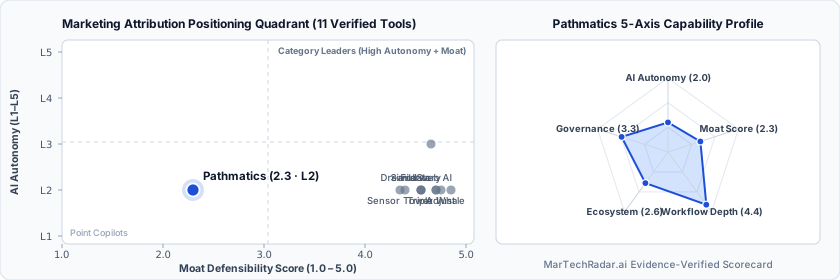
Pathmatics in-depth review, pricing & architecture analysis
Editor sign-off: Oct 16, 2026. How profiles are made.
What is Pathmatics? Overview & background
Modern digital media strategists require granular visibility into competitor advertising budgets, channel distributions, and creative messaging to steer performance investments effectively. Headquartered in the United States, Pathmatics serves enterprise media buyers, brand strategists, and eCommerce marketing directors seeking syndicated transparency into broader market ad execution. The software decodes public digital advertising signals to deliver competitive benchmarking across paid display, video, social, and programmatic ecosystems, helping commercial teams calibrate their acquisition tactics against industry benchmarks.
How Pathmatics works: architecture & workflow
Pathmatics processes advertising data via autonomous web-crawling networks, browser observation panels, and programmatic exchange listeners. These pipelines ingest creative assets, publisher domains, and auction bid signals across desktop, mobile, and social platforms. Natural language processing and image recognition extract copy attributes and creative variants, while statistical modeling engines translate observed impressions into estimated expenditure metrics using published cost-per-thousand averages and bidding density algorithms. This enables brand analytics teams to audit competitor media distribution paths and publisher relationships through structured analytical dashboards.
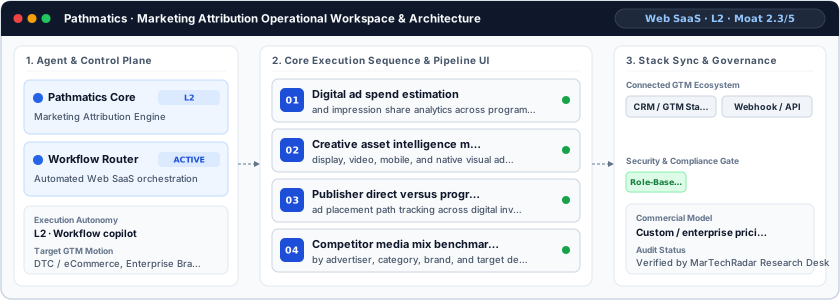
Pathmatics limitations, drawbacks & risks
Operational considerations and platform boundaries include:
- Spend estimation discrepancies: Model calculations rely on panel observations and normalized cost-per-thousand baselines, resulting in variances when competitors negotiate private programmatic marketplaces or custom direct buy discounts.
- Walled-garden visibility constraints: Panel-based data capture within closed ecosystems like social applications is subject to platform interface alterations and regional panel sample biases.
- Attribution and conversion disconnect: The system functions as top-of-funnel competitive intelligence and lacks first-party attribution hooks, web conversion telemetry, or deterministic customer journey tracking.
Pathmatics pricing, plans & cost breakdown
Pathmatics licenses its platform through a structured subscription model tailored to enterprise accounts. Commercial pricing is available on request through tailored enterprise sales quotes based on organizational scale, seats, data export requirements, and regional market coverage. Contracts typically follow annual commitments granting access to specific media modules and historical ad archive depths.
| Plan / Tier | Verified Price & Billing | Included Scope & Contract Terms |
|---|---|---|
| Enterprise / Custom | Custom quote | Custom-quoted plan; terms come from the vendor's sales team. |
How Pathmatics compares vs. competitors & alternatives
Within performance measurement, Pathmatics occupies a competitive intelligence niche that contrasts directly with attribution software like Adjust and AppsFlyer, which focus on deterministic mobile conversion tracking and device-level postbacks. It also differs from Adverity, an infrastructure ETL engine that consolidates internal marketing data warehouses rather than gathering syndicated competitor media insights. Pathmatics is ideal for enterprise marketing leadership teams that require comparative market spend visibility rather than direct-response internal multi-touch attribution.
Direct competitors & market radar
Top algorithmic competitors based on category positioning, capability overlap, and ICP alignment.
Frequently asked questions about Pathmatics
Does Pathmatics publish pricing or require an enterprise quote?
Pathmatics pricing: Custom / enterprise pricing. No free plan is publicly disclosed. Pathmatics licenses its platform through a structured subscription model tailored to enterprise accounts.
What are the top Pathmatics alternatives in Marketing Attribution?
Verified Marketing Attribution alternatives include Adjust (Custom / enterprise pricing), AppsFlyer (Usage-based pricing), Adverity (Custom / enterprise pricing), Similarweb AI (Custom / enterprise pricing). Within performance measurement, Pathmatics occupies a competitive intelligence niche that contrasts directly with attribution software like Adjust and AppsFlyer, which focus on deterministic mobile conversion tracking and device-level postbacks.
What are the main limitations and trade-offs of Pathmatics?
Operational considerations and platform boundaries include: Spend estimation discrepancies: Model calculations rely on panel observations and normalized cost-per-thousand baselines, resulting in variances when competitors negotiate private programmatic marketplaces or custom direct buy discounts. Walk away if you need published self-serve pricing: Pathmatics is sold by custom quote.
Verified sources & evidence trail
- Official product domain: https://pathmatics.com
- Commercial pricing verification: Verified against official vendor pricing policy (Custom / enterprise pricing)
- Editor sign-off: Oct 16, 2026 (how profiles are made).
