OpenX Review (2026): AI Programmatic Advertising Pricing, Pros & Cons
Bottom line
OpenX is a Web SaaS tool for AI Programmatic Advertising (Programmatic DSP/SSP & Contextual AdTech) in AdTech & Paid Media. Pricing: Custom / enterprise pricing. Best suited to DTC / eCommerce and Enterprise Brands. Editor ratings: AI autonomy L3 (conditional automation); moat score 3.7/5.0 (Proprietary moat). Fact-checked by MarTechRadar Research Desk on Oct 14, 2026.
Cloud-native supply-side platform delivering programmatic ad exchange infrastructure and supply-side decisioning containers for publishers and media buyers.
Is OpenX worth it in 2026? Buyer fit & when to walk away
Choose OpenX if (Best Fit)
- Target ICP & Stack Fit: You operate as DTC / eCommerce and Enterprise Brands requiring a Web SaaS deployment for AI Programmatic Advertising.
- L3 Architecture & Defensibility: Proprietary cloud-native exchange built entirely on Google Cloud Platform, deep supply-side targeting containers, and direct integration paths with major omnichannel demand partners.
- Commercial Model Fit: Your procurement budget aligns with Custom / enterprise pricing.
Walk away from OpenX if (Deal-Breakers)
- Walk away if you need published self-serve pricing: OpenX is sold by custom quote.
- Walk away if your workflow cannot tolerate signal degradation: Bid throttling algorithms can inadvertently drop niche buyer segments when incoming query-per-second thresholds breach partner capacity limits.
- Walk away if header wrapper overhead is a deal-breaker for your team: Client-side prebid wrapper deployments introduce browser runtime overhead, requiring ongoing JavaScript bundle pruning to prevent page performance regressions.
OpenX pricing, free plan & scorecard at a glance
| Pricing | Custom / enterprise pricing |
|---|---|
| Free plan | No / not disclosed |
| Delivery | Web SaaS |
| Audience | DTC / eCommerce, Enterprise Brands |
| AI autonomy level | L3 · Conditional automationEditor-verified |
| Moat tier & score | 3.7 / 5.0 · Proprietary moatEditor-verified |
| Funding | Series C+ |
| Company size | 201-500 employees |
| Governance & docs | Privacy ↗ |
| Headquarters | Pasadena, CA |
| Founded | 2007 |
| Last verified | Oct 14, 2026 |
OpenX pros & cons: strengths vs. operational limitations
Pros: core strengths & capabilities
- Supply-side decisioning containers: for identity and audience enrichment
- Cloud-native OpenRTB ad exchange: with low-latency bid stream processing
- Omnichannel supply coverage: across CTV, web, mobile app, and video environments
- Contextual intelligence and cookieless: audience targeting mechanisms
Cons: operational limitations & risks
- Signal Degradation: Bid throttling algorithms can inadvertently drop niche buyer segments when incoming query-per-second thresholds breach partner capacity limits.
- Header Wrapper Overhead: Client-side prebid wrapper deployments introduce browser runtime overhead, requiring ongoing JavaScript bundle pruning to prevent page performance regressions.
- Identifier Fragmentation: Container-level alternate identity resolution degrades across environments lacking third-party cookies unless publishers maintain authenticated first-party identity graphs.
OpenX TCO & deal-breaker stress test
Simulate 12-month stepped TCO, hidden cost multipliers, contract lock-in exposure, and stack failure modes using only facts verified by MarTechRadar Research Desk on 2026-10-14.
OpenX triggers high-severity friction under your 5-seat / $800/mo constraints. Benchmark the verified subtrack alternatives below before committing.
- Moat Score
- 3.7 / 5.0
- AI Autonomy
- L3
- Free Tier / Trial
- None disclosed
Triggered audit signals & failure modes
- Opaque Enterprise Quoting vs. SMB/Mid-Market BudgetVerified Pricing Ledger
OpenX does not disclose a public self-serve floor (Custom / enterprise pricing). Buyers with a $800/mo cap face high sales-qualification friction.
- Sales-Gated Contract TermsFact-checked by MarTechRadar Research Desk
OpenX operates an indirect transaction-based model where commercial pricing is available on request through tailored enterprise sales quotes based on organizational scale and seats.
- Primary Operational Bottleneck: Signal DegradationAudit by MarTechRadar Research Desk
Bid throttling algorithms can inadvertently drop niche buyer segments when incoming query-per-second thresholds breach partner capacity limits.
Test a custom OpenX budget or stack constraint
Verified AI Programmatic Advertising peer (Custom / enterprise pricing · Moat 4.3/5.0)
Verified AI Programmatic Advertising peer (Custom / enterprise pricing · Moat 4.2/5.0)
OpenX AI moat & AI Programmatic Advertising positioning
Proprietary cloud-native exchange built entirely on Google Cloud Platform, deep supply-side targeting containers, and direct integration paths with major omnichannel demand partners.
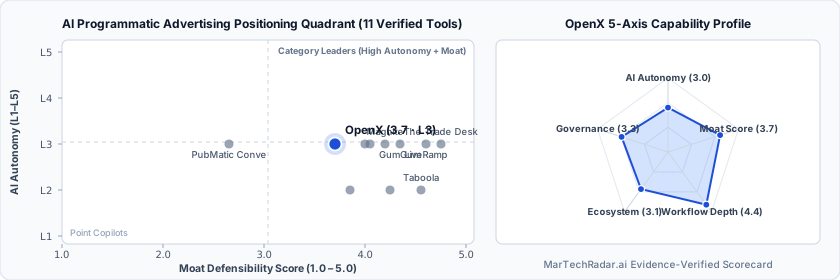
OpenX in-depth review, pricing & architecture analysis
Editor sign-off: Oct 14, 2026. How profiles are made.
What is OpenX? Overview & background
Architected as an independent supply-side platform, OpenX was established in 2007 in Pasadena, CA to decouple digital ad monetization from closed publisher ecosystems. The platform addresses programmatic media operations for enterprise digital publishers, app developers, and supply-path optimization buyers. Designed to process cross-screen bid transactions across web, mobile, and connected television environments, OpenX functions as an infrastructure layer for open-web yield generation and programmatic inventory curation.
How OpenX works: architecture & workflow
The platform functions as a cloud-native real-time bidding exchange that executes automated traffic shaping and auction mechanics. Running its exchange infrastructure on distributed Google Cloud instances, the platform ingests OpenRTB request streams, normalizing request schemas within single-digit millisecond latency windows. Its supply-side decisioning containers orchestrate identifier translation, cookieless audience enrichment, and contextual classification directly on the supply path before auction dispatch. Algorithmic throttling filters bid requests to minimize downstream infrastructure compute overhead while maximizing bid density.
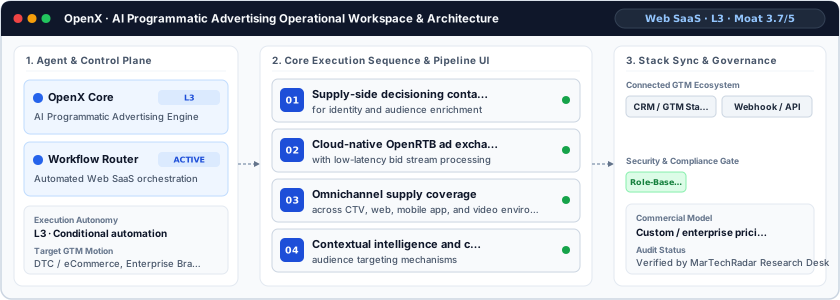
OpenX limitations, drawbacks & risks
Operational considerations and platform boundaries include:
- Signal Degradation: Bid throttling algorithms can inadvertently drop niche buyer segments when incoming query-per-second thresholds breach partner capacity limits.
- Header Wrapper Overhead: Client-side prebid wrapper deployments introduce browser runtime overhead, requiring ongoing JavaScript bundle pruning to prevent page performance regressions.
- Identifier Fragmentation: Container-level alternate identity resolution degrades across environments lacking third-party cookies unless publishers maintain authenticated first-party identity graphs.
OpenX pricing, plans & cost breakdown
OpenX operates an indirect transaction-based model where commercial pricing is available on request through tailored enterprise sales quotes based on organizational scale and seats. The platform monetizes primarily via programmatic revenue shares and exchange take rates deducted directly from cleared bid transactions. Publisher partners and supply-path optimization buyers negotiate custom take-rate structures and clearing fee schedules governed by programmatic impression volume, deployment configurations, and data enrichment modules.
| Plan / Tier | Verified Price & Billing | Included Scope & Contract Terms |
|---|---|---|
| Enterprise / Custom | Custom quote | Custom-quoted plan; terms come from the vendor's sales team. |
How OpenX compares vs. competitors & alternatives
Within programmatic infrastructure, OpenX focuses on sell-side yield and supply-side decisioning, contrasting with AdRoll, which operates as an execution-oriented demand platform targeting performance marketers. While LiveRamp provides deterministic identity graphs across offline and online records without operating an ad exchange, OpenX activates multiple alternative identifiers within live bid streams. Meanwhile, contextual specialists like GumGum emphasize computer-vision ad placements, whereas OpenX emphasizes scaled programmatic exchange liquidity for global publisher networks.
Direct competitors & market radar
Top algorithmic competitors based on category positioning, capability overlap, and ICP alignment.
Frequently asked questions about OpenX
Does OpenX publish pricing or require an enterprise quote?
OpenX pricing: Custom / enterprise pricing. No free plan is publicly disclosed. OpenX operates an indirect transaction-based model where commercial pricing is available on request through tailored enterprise sales quotes based on organizational scale and seats.
What are the top OpenX alternatives in AI Programmatic Advertising?
Verified AI Programmatic Advertising alternatives include Teads (Custom / enterprise pricing), TripleLift (Custom / enterprise pricing), Index Exchange (Custom / enterprise pricing), Revcontent (Custom / enterprise pricing). Within programmatic infrastructure, OpenX focuses on sell-side yield and supply-side decisioning, contrasting with AdRoll, which operates as an execution-oriented demand platform targeting performance marketers.
What are the main limitations and trade-offs of OpenX?
Operational considerations and platform boundaries include: Signal Degradation: Bid throttling algorithms can inadvertently drop niche buyer segments when incoming query-per-second thresholds breach partner capacity limits. Walk away if you need published self-serve pricing: OpenX is sold by custom quote.
Verified sources & evidence trail
- Official product domain: https://openx.com
- Commercial pricing verification: Verified against official vendor pricing policy (Custom / enterprise pricing)
- Verified corporate entity profiles (
sameAs): LinkedIn Company Profile - First-party governance & documentation links: Privacy
- Editor sign-off: Oct 14, 2026 (how profiles are made).
