Octopus CRM Review (2026): AI SDR Pricing, Pros & Cons
Bottom line
Octopus CRM is a Web SaaS tool for AI SDR (Autonomous B2B Sales Agents & AI BDRs) in AI SDR & Outbound. Pricing: Custom / enterprise pricing. Best suited to Creators / Solo. Editor ratings: AI autonomy L3 (conditional automation); moat score 1.3/5.0 (Thin wrapper). Fact-checked by MarTechRadar Research Desk on Oct 16, 2026.
Sales prospecting automation software designed to execute LinkedIn connection requests, messaging sequences, and profile engagement workflows at scale.
Is Octopus CRM worth it in 2026? Buyer fit & when to walk away
Choose Octopus CRM if (Best Fit)
- Target ICP & Stack Fit: You operate as Creators / Solo requiring a Web SaaS deployment for AI SDR.
- L3 Architecture & Defensibility: Octopus CRM relies primarily on client-side browser automation and workflow sequencing rather than proprietary foundational models. Its defensibility stems from template libraries and established execution heuristics, leaving it vulnerable to platform policy shifts and headless browser detection compared to server-side autonomous sales agents.
- Commercial Model Fit: Your procurement budget aligns with Custom / enterprise pricing.
Walk away from Octopus CRM if (Deal-Breakers)
- Walk away if you need published self-serve pricing: Octopus CRM is sold by custom quote.
- Walk away if your workflow cannot tolerate platform rate limiting and session fragility: Client-side browser automation is constrained by strict network rate limits, exposing accounts to algorithmic throttling, temporary session lockouts, or shadowbans if sequence volumes exceed platform heuristics.
- Walk away if environmental execution dependency is a deal-breaker for your team: Because tasks run within a local browser environment, execution halts when the host machine sleeps, disconnects, or closes browser sessions, necessitating constant local system availability.
Octopus CRM pricing, free plan & scorecard at a glance
| Pricing | Custom / enterprise pricing |
|---|---|
| Free plan | No / not disclosed |
| Delivery | Web SaaS |
| Audience | Creators / Solo |
| AI autonomy level | L3 · Conditional automationEditor-verified |
| Moat tier & score | 1.3 / 5.0 · Thin wrapperEditor-verified |
| Funding | Bootstrapped |
| Headquarters | United States |
| Last verified | Oct 16, 2026 |
Octopus CRM pros & cons: strengths vs. operational limitations
Pros: core strengths & capabilities
- Automated connection request sequencing: with custom personalization tokens
- Bulk messaging module: for first-degree professional network connections
- Profile auto-viewing and skill: endorsement actions to generate inbound touchpoints
- Campaign performance reporting and activity log export to enterprise CRMs via webhooks
Cons: operational limitations & risks
- Platform Rate Limiting and Session Fragility: Client-side browser automation is constrained by strict network rate limits, exposing accounts to algorithmic throttling, temporary session lockouts, or shadowbans if sequence volumes exceed platform heuristics.
- Environmental Execution Dependency: Because tasks run within a local browser environment, execution halts when the host machine sleeps, disconnects, or closes browser sessions, necessitating constant local system availability.
- Dynamic Contextual Reasoning Deficit: The system follows rigid deterministic branches and string replacements, failing to evaluate open-ended prospect replies or modify messaging logic based on real-time conversational sentiment.
Octopus CRM TCO & deal-breaker stress test
Simulate 12-month stepped TCO, hidden cost multipliers, contract lock-in exposure, and stack failure modes using only facts verified by MarTechRadar Research Desk on 2026-10-16.
Octopus CRM triggers high-severity friction under your 5-seat / $800/mo constraints. Benchmark the verified subtrack alternatives below before committing.
- Moat Score
- 1.3 / 5.0
- AI Autonomy
- L3
- Free Tier / Trial
- None disclosed
Triggered audit signals & failure modes
- Opaque Enterprise Quoting vs. SMB/Mid-Market BudgetVerified Pricing Ledger
Octopus CRM does not disclose a public self-serve floor (Custom / enterprise pricing). Buyers with a $800/mo cap face high sales-qualification friction.
- Sales-Gated Contract TermsFact-checked by MarTechRadar Research Desk
Pricing is available on request through tailored enterprise sales quotes, with custom enterprise tiers structured around organizational scale, user seats, and workflow volume.
- Primary Operational Bottleneck: Platform Rate Limiting and Session FragilityAudit by MarTechRadar Research Desk
Client-side browser automation is constrained by strict network rate limits, exposing accounts to algorithmic throttling, temporary session lockouts, or shadowbans if sequence volumes exceed platform heuristics.
Test a custom Octopus CRM budget or stack constraint
Lower 5-seat floor (~$20/mo vs. Custom Quote) · Transparent self-serve entry without mandatory annual lock-in
Octopus CRM AI moat & AI SDR positioning
Octopus CRM relies primarily on client-side browser automation and workflow sequencing rather than proprietary foundational models. Its defensibility stems from template libraries and established execution heuristics, leaving it vulnerable to platform policy shifts and headless browser detection compared to server-side autonomous sales agents.
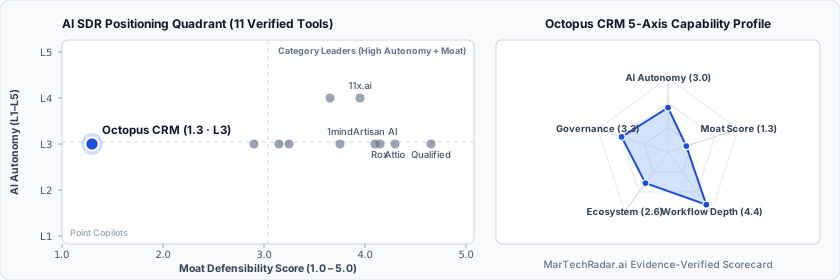
Octopus CRM in-depth review, pricing & architecture analysis
Editor sign-off: Oct 16, 2026. How profiles are made.
What is Octopus CRM? Overview & background
Octopus CRM addresses the manual bottlenecks of outbound professional social prospecting by automating repetitive top-of-funnel touchpoints across social selling channels. Headquartered in the United States, the software serves revenue development representatives and growth marketers seeking systematic campaign orchestration without manual outreach overhead. By structuring outbound actions into repeatable funnels, it converts unstructured networking tasks into scheduled execution sequences.
How Octopus CRM works: architecture & workflow
Architecturally, Octopus CRM operates through client-side browser extension scripts that interact directly with the web interface of social platforms. Inbound lead lists are ingested via platform search URLs or flat CSV uploads, which the system queues across dedicated campaign buckets. Execution loops cycle through connection requests, follow-up messages, profile visits, and skill endorsements using customizable delays to emulate natural user navigation. Task execution runs locally on the operator machine, serializing state changes into local storage before synchronizing status records outward via webhooks and third-party integrations.
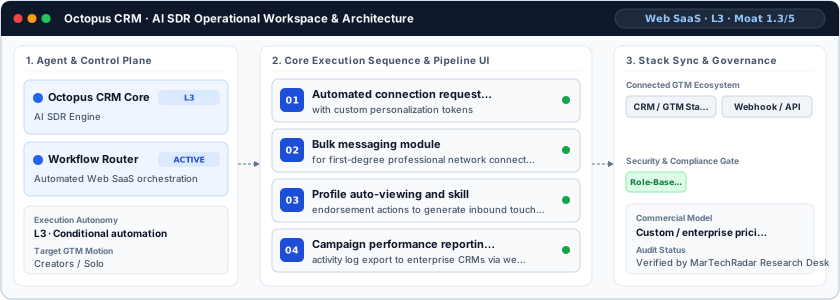
Octopus CRM limitations, drawbacks & risks
Operational considerations and platform boundaries include:
- Platform Rate Limiting and Session Fragility: Client-side browser automation is constrained by strict network rate limits, exposing accounts to algorithmic throttling, temporary session lockouts, or shadowbans if sequence volumes exceed platform heuristics.
- Environmental Execution Dependency: Because tasks run within a local browser environment, execution halts when the host machine sleeps, disconnects, or closes browser sessions, necessitating constant local system availability.
- Dynamic Contextual Reasoning Deficit: The system follows rigid deterministic branches and string replacements, failing to evaluate open-ended prospect replies or modify messaging logic based on real-time conversational sentiment.
Octopus CRM pricing, plans & cost breakdown
Pricing is available on request through tailored enterprise sales quotes, with custom enterprise tiers structured around organizational scale, user seats, and workflow volume.
| Plan / Tier | Verified Price & Billing | Included Scope & Contract Terms |
|---|---|---|
| Enterprise / Custom | Custom quote | Custom-quoted plan; terms come from the vendor's sales team. |
How Octopus CRM compares vs. competitors & alternatives
Within the outbound engagement landscape, Octopus CRM occupies a deterministic, client-side niche compared to modern autonomous agents like 11x.ai, Confido, and Unify within the AI SDR segment. While autonomous solutions leverage server-side architectures, large language models, and unified email-to-social goal decomposition, Octopus CRM remains an operational macro sequencer bound to the desktop browser. It best suits small outbound teams executing basic connection campaigns, whereas enterprises requiring autonomous multi-channel qualification gravitate toward fully autonomous agent architectures.
Frequently asked questions about Octopus CRM
Does Octopus CRM publish pricing or require an enterprise quote?
Octopus CRM pricing: Custom / enterprise pricing. No free plan is publicly disclosed. Pricing is available on request through tailored enterprise sales quotes, with custom enterprise tiers structured around organizational scale, user seats, and workflow volume.
What are the top Octopus CRM alternatives in AI SDR?
Verified AI SDR alternatives include Octolane AI (From $20/mo), Overpath (Custom / enterprise pricing), GrowthSync Digital (Custom / enterprise pricing), 11x.ai (Custom / enterprise pricing). Within the outbound engagement landscape, Octopus CRM occupies a deterministic, client-side niche compared to modern autonomous agents like 11x.ai, Confido, and Unify within the AI SDR segment.
What are the main limitations and trade-offs of Octopus CRM?
Operational considerations and platform boundaries include: Platform Rate Limiting and Session Fragility: Client-side browser automation is constrained by strict network rate limits, exposing accounts to algorithmic throttling, temporary session lockouts, or shadowbans if sequence volumes exceed platform heuristics. Walk away if you need published self-serve pricing: Octopus CRM is sold by custom quote.
Verified sources & evidence trail
- Official product domain: https://octopuscrm.com
- Commercial pricing verification: Verified against official vendor pricing policy (Custom / enterprise pricing)
- Editor sign-off: Oct 16, 2026 (how profiles are made).
