Octolane AI vs Octopus CRM
Reviewed by MarTechRadar Research Desk. Pricing & entity snapshots verified Oct 16, 2026.
Octolane AI (Web SaaS) and Octopus CRM (Web SaaS) both compete in Autonomous B2B Sales Agents & AI BDRs. On pricing, Octolane AI lists From $20/mo (no free plan disclosed), whereas Octopus CRM lists Custom / enterprise pricing (no free plan disclosed). Technically, Octolane AI is rated L3 · Conditional automation with a 2.8/5.0 (Workflow-embedded) moat, while Octopus CRM is rated L3 · Conditional automation with a 1.3/5.0 (Thin wrapper) moat. Corporate profile: Octolane AI (founded 2024, HQ San Francisco, California, $2.6M funding) vs. Octopus CRM (HQ United States). Verified by the MarTechRadar Research Desk (Oct 12, 2026 for Octolane AI; Oct 16, 2026 for Octopus CRM). At a 5-seat team baseline, Octolane AI starts at ~$20/mo (base) vs Octopus CRM at Custom quote.
Octolane AI
Autonomous sales CRM agent automating account research, meeting preparation, post-call transcription analysis, and pipeline updates for revenue teams.
5-User Team Cost: ~$20/mo (base) (From $20/mo) · Autonomy: L3 · Conditional automation · Moat: 2.8/5.0 (Workflow-embedded)
Target fit: B2B Sales Leaders, SDR/BDR Teams, Revenue Operations (RevOps) (Web SaaS)
Octopus CRM
Sales prospecting automation software designed to execute LinkedIn connection requests, messaging sequences, and profile engagement workflows at scale.
5-User Team Cost: Custom quote (Custom / enterprise pricing) · Autonomy: L3 · Conditional automation · Moat: 1.3/5.0 (Thin wrapper)
Target fit: Creators / Solo (Web SaaS)
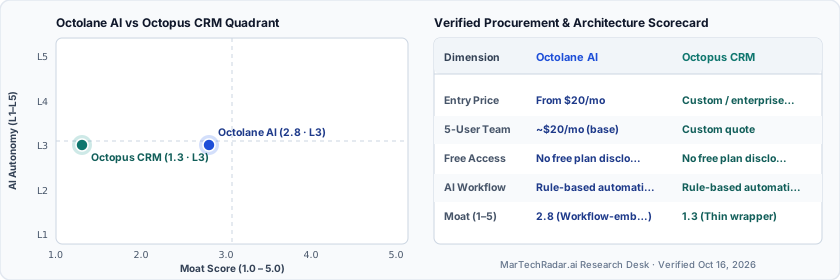
How Octolane AI and Octopus CRM differ
- Pricing model: Octolane AI is subscription, Octopus CRM is enterprise / quote.
- Octolane AI publishes an entry price (From $20/mo); Octopus CRM does not (Custom / enterprise pricing).
- Moat tier: Octolane AI is rated Workflow-embedded, Octopus CRM Thin wrapper.
- Headquarters: Octolane AI in San Francisco, California, Octopus CRM in United States.
- Funding stage: Octolane AI is Pre-seed; Octopus CRM is Bootstrapped.
- Audience: Octolane AI targets B2B Sales Leaders, SDR/BDR Teams, Revenue Operations (RevOps); Octopus CRM targets Creators / Solo.
Computed from the fields below. Only editor-verified ratings and vendor-sourced prices are compared.
When to choose Octolane AI vs Octopus CRM (and when to walk away)
Choose Octolane AI if
- Target ICP & Stack Fit: You operate as B2B Sales Leaders, SDR/BDR Teams and Revenue Operations (RevOps) requiring a Web SaaS deployment for AI SDR, with verified ecosystem connectivity for Salesforce, HubSpot, Pipedrive, Gong.
- L3 Architecture & Defensibility: Defensibility centers on an integrated workflow architecture that combines CRM storage, call transcription, and automated account enrichment into a single autonomous loop, minimizing context loss across fragmented sales tools.
- Commercial Model Fit: Your procurement budget aligns with From $20/mo.
Walk away from Octolane AI if
- Walk away if your workflow requires uncapped enterprise volume on the From $20/mo entry plan without upgrading tiers.
- Walk away if your workflow cannot tolerate enrichment schema drift: Automated web parsing can extract noisy or outdated firmographic signals, requiring human verification when target companies operate complex corporate subsidiaries.
- Walk away if autonomous field update collisions is a deal-breaker for your team: Concurrent manual edits by sales representatives during active pipeline calls can conflict with agentic batch updates, causing overwrite discrepancies.
Choose Octopus CRM if
- Target ICP & Stack Fit: You operate as Creators / Solo requiring a Web SaaS deployment for AI SDR.
- L3 Architecture & Defensibility: Octopus CRM relies primarily on client-side browser automation and workflow sequencing rather than proprietary foundational models. Its defensibility stems from template libraries and established execution heuristics, leaving it vulnerable to platform policy shifts and headless browser detection compared to server-side autonomous sales agents.
- Commercial Model Fit: Your procurement budget aligns with Custom / enterprise pricing.
Walk away from Octopus CRM if
- Walk away if you require transparent self-serve monthly billing or your budget ceiling is under $1,000/mo (Octopus CRM requires sales-gated custom quoting).
- Walk away if your workflow cannot tolerate platform rate limiting and session fragility: Client-side browser automation is constrained by strict network rate limits, exposing accounts to algorithmic throttling, temporary session lockouts, or shadowbans if sequence volumes exceed platform heuristics.
- Walk away if environmental execution dependency is a deal-breaker for your team: Because tasks run within a local browser environment, execution halts when the host machine sleeps, disconnects, or closes browser sessions, necessitating constant local system availability.
Side-by-side facts
| Field | Octolane AI | Octopus CRM |
|---|---|---|
| Subtrack | Autonomous B2B Sales Agents & AI BDRs | Autonomous B2B Sales Agents & AI BDRs |
| Pricing | From $20/mo | Custom / enterprise pricing |
| Pricing model | Subscription | Enterprise / quote |
| Published pricing tiers | Pro ($20/mo) | Enterprise / Custom (Custom quote) |
| Free access | No free plan disclosed | No free plan disclosed |
| Enterprise plan | Not recorded | Yes |
| AI autonomy level | L3 · Conditional automation | L3 · Conditional automation |
| Moat tier & score | 2.8 / 5.0 · Workflow-embedded | 1.3 / 5.0 · Thin wrapper |
| Delivery | Web SaaS | Web SaaS |
| Audience | B2B Sales Leaders, SDR/BDR Teams, Revenue Operations (RevOps) | Creators / Solo |
| Ecosystem integrations | Salesforce, HubSpot, Pipedrive, Gong, Slack, Twilio Segment | — |
| Compliance & governance | SOC 2, GDPR, HIPAA | — |
| Funding & backing | $2.6M · Backed by Y Combinator, Pioneer | Bootstrapped |
| Founders | Md Abdul Halim Rafi, One Chowdhury | — |
| Company size | 2-10 employees | — |
| Founded | 2024 | — |
| Headquarters | San Francisco, California | United States |
| Fact-checked | MarTechRadar Research Desk, Oct 12, 2026 | MarTechRadar Research Desk, Oct 16, 2026 |
| Governance & docs | Terms ↗ · Privacy ↗ | — |
Octolane AI vs Octopus CRM: TCO & constraint stress test
Test how both tools behave under your team size, monthly budget ceiling, CRM ecosystem, and governance guardrails.
Octolane AI
Low Procurement Risk · Strong Fit- Published Self-Serve Entry Floor: Octolane AI publishes a transparent entry point (From $20/mo) for initial validation before committing.
- Primary Operational Bottleneck: AI Credit Consumption Caps: High-volume transcription and multi-step account research consume pooled operational credits rapidly, requiring quota monitoring to prevent pipeline processing pauses.
Walk-Away Rule: Walk away if your workflow requires uncapped enterprise volume on the From $20/mo entry plan without upgrading tiers.
Negotiation Lever: Validate exact quota thresholds (seats, credits, or API calls) included in Octolane AI's From $20/mo tier before converting from monthly to annual billing.
Octopus CRM
High Deal-Risk · Constraint Mismatch- Opaque Enterprise Quoting vs. SMB/Mid-Market Budget: Octopus CRM does not disclose a public self-serve floor (Custom / enterprise pricing). Buyers with a $800/mo cap face high sales-qualification friction.
- Sales-Gated Contract Terms: Pricing is available on request through tailored enterprise sales quotes, with custom enterprise tiers structured around organizational scale, user seats, and workflow volume.
- Primary Operational Bottleneck: Platform Rate Limiting and Session Fragility: Client-side browser automation is constrained by strict network rate limits, exposing accounts to algorithmic throttling, temporary session lockouts, or shadowbans if sequence volumes exceed platform heuristics.
Walk-Away Rule: Walk away if you require transparent self-serve monthly billing or your budget ceiling is under $1,000/mo (Octopus CRM requires sales-gated custom quoting).
Negotiation Lever: Demand a 30- to 60-day paid pilot opt-out clause in the Octopus CRM order form before signing a 12-month enterprise commitment.
Limitations
Octolane AI
Operational considerations and platform boundaries include: Enrichment Schema Drift: Automated web parsing can extract noisy or outdated firmographic signals, requiring human verification when target companies operate complex corporate subsidiaries.Full limitations in the Octolane AI review
Octopus CRM
Operational considerations and platform boundaries include: Platform Rate Limiting and Session Fragility: Client-side browser automation is constrained by strict network rate limits, exposing accounts to algorithmic throttling, temporary session lockouts, or shadowbans if sequence volumes exceed platform heuristics.Full limitations in the Octopus CRM review
Official vendor architectural differentiators & migration proof
To help buyers evaluate real-world switching costs, verified founders, solutions architects, and PMMs at both Octolane AI and Octopus CRM can submit up to 3 evidence-backed architectural differentiators or verified customer migration case studies.
Why teams choose Octolane AI over Octopus CRM
Work at Octolane AI? Verify your official domain email to publish 3 technical differentiators, migration benchmarks, or a head-to-head buyer sandbox offer on this comparison page:
+ Submit Octolane AI Official Differentiators & Case Study →Why teams choose Octopus CRM over Octolane AI
Work at Octopus CRM? Verify your official domain email to publish 3 technical differentiators, migration benchmarks, or a head-to-head buyer sandbox offer on this comparison page:
+ Submit Octopus CRM Official Differentiators & Case Study →Pricing notes & tier schedules
Octolane AI: From $20/mo
Octolane AI structures commercial access around usage tiers starting from $20 per month. The Pro tier is offered at $39 per month billed yearly for up to three seats, bundling $20 per month in baseline AI credits alongside an initial $50 bonus credit allocation.
- Pro ($20/mo, 1–2 seats): For founders running their own sales. The agents draft, you approve and send. Up to 3 seats.
- Annual Billing Headline vs. Monthly Premium: Headline entry rates reflect annual billing commitments (Save 20%); month-to-month flexibility carries a higher effective monthly rate or requires annual prepayment.
- Credit & Usage Burn Multiplier: Workflows on Octolane AI consume metered credits or usage quotas; voice/media minutes, multi-step synthesis, or high-frequency runs can exhaust base allocations and trigger mid-cycle top-up packs.
Octopus CRM: Custom / enterprise pricing
Pricing is available on request through tailored enterprise sales quotes, with custom enterprise tiers structured around organizational scale, user seats, and workflow volume.
- Enterprise / Custom (Custom quote, 15–50+ seats (Enterprise SLA)): Sales-negotiated annual contract for custom volume, SSO/RBAC governance, and dedicated SLA.
- Platform Rate Limiting and Session Fragility: Client-side browser automation is constrained by strict network rate limits, exposing accounts to algorithmic throttling, temporary session lockouts, or shadowbans if sequence volumes exceed platform heuristics.
- Environmental Execution Dependency: Because tasks run within a local browser environment, execution halts when the host machine sleeps, disconnects, or closes browser sessions, necessitating constant local system availability.
Frequently asked questions: Octolane AI vs Octopus CRM
How does Octolane AI pricing compare to Octopus CRM in 2026?
Octolane AI is listed at From $20/mo (subscription, no free plan disclosed), whereas Octopus CRM is listed at Custom / enterprise pricing (enterprise / quote, no free plan disclosed).
How do Octolane AI and Octopus CRM compare on AI autonomy and moat depth?
On the MarTechRadar L1–L5 scale, Octolane AI is rated L3 · Conditional automation with a Workflow-embedded moat (2.8/5.0), while Octopus CRM is rated L3 · Conditional automation with a Thin wrapper moat (1.3/5.0).
Which teams are Octolane AI and Octopus CRM built for?
Octolane AI is a Web SaaS product in Autonomous B2B Sales Agents & AI BDRs designed for B2B Sales Leaders, SDR/BDR Teams, Revenue Operations (RevOps). Octopus CRM is a Web SaaS product in Autonomous B2B Sales Agents & AI BDRs designed for Creators / Solo.
What are the main limitations of Octolane AI vs Octopus CRM?
For Octolane AI: Operational considerations and platform boundaries include: Enrichment Schema Drift: Automated web parsing can extract noisy or outdated firmographic signals, requiring human verification when target companies operate complex corporate subsidiaries. For Octopus CRM: Operational considerations and platform boundaries include: Platform Rate Limiting and Session Fragility: Client-side browser automation is constrained by strict network rate limits, exposing accounts to algorithmic throttling, temporary session lockouts, or shadowbans if sequence volumes exceed platform heuristics.
What are the hidden TCO drivers and contract negotiation levers for Octolane AI vs Octopus CRM?
For Octolane AI: Annual Billing Headline vs. Monthly Premium (Headline entry rates reflect annual billing commitments (Save 20%); month-to-month flexibility carries a higher effective monthly rate or requires annual prepayment.) Negotiation lever: Validate exact quota thresholds (seats, credits, or API calls) included in Octolane AI's From $20/mo tier before converting from monthly to annual billing. For Octopus CRM: Platform Rate Limiting and Session Fragility (Client-side browser automation is constrained by strict network rate limits, exposing accounts to algorithmic throttling, temporary session lockouts, or shadowbans if sequence volumes exceed platform heuristics.) Negotiation lever: Demand a 30- to 60-day paid pilot opt-out clause in the Octopus CRM order form before signing a 12-month enterprise commitment.
Excerpts are quoted verbatim from each fact-checked review. Last updated Oct 16, 2026.