Media.net Review (2026): AI Programmatic Advertising Pricing, Pros & Cons
Bottom line
Media.net is a Web SaaS tool for AI Programmatic Advertising (Programmatic DSP/SSP & Contextual AdTech) in AdTech & Paid Media. Pricing: Custom / enterprise pricing. Best suited to DTC / eCommerce, Enterprise Brands and Creators / Solo. Editor ratings: AI autonomy L2 (workflow copilot); moat score 3.1/5.0 (Workflow-embedded (strong)). Fact-checked by MarTechRadar Research Desk on Oct 14, 2026.
Supply-side programmatic advertising platform leveraging contextual semantic analysis and header bidding infrastructure to optimize publisher ad yield.
Is Media.net worth it in 2026? Buyer fit & when to walk away
Choose Media.net if (Best Fit)
- Target ICP & Stack Fit: You operate as DTC / eCommerce, Enterprise Brands and Creators / Solo requiring a Web SaaS deployment for AI Programmatic Advertising.
- L2 Architecture & Defensibility: Proprietary semantic natural language parsing engine paired with extensive direct publisher supply integrations and dual-sided contextual keyword matching infrastructure.
- Commercial Model Fit: Your procurement budget aligns with Custom / enterprise pricing.
Walk away from Media.net if (Deal-Breakers)
- Walk away if you need published self-serve pricing: Media.net is sold by custom quote.
- Walk away if your workflow cannot tolerate page rendering latency: Complex semantic content evaluation and dynamic ad injection can introduce cumulative layout shifts and client-side execution delays when integrated via non-optimized header bidding setups.
- Walk away if niche content taxonomy gaps is a deal-breaker for your team: Semantic classification engines exhibit degraded keyword precision on highly specialized, technical, or sparse editorial pages, leading to sub-optimal fill rates for non-mainstream verticals.
Media.net pricing, free plan & scorecard at a glance
| Pricing | Custom / enterprise pricing |
|---|---|
| Free plan | No / not disclosed |
| Delivery | Web SaaS |
| Audience | DTC / eCommerce, Enterprise Brands, Creators / Solo |
| AI autonomy level | L2 · Workflow copilotEditor-verified |
| Moat tier & score | 3.1 / 5.0 · Workflow-embedded (strong)Editor-verified |
| Funding | Undisclosed |
| Governance & docs | Terms ↗ · Privacy ↗ |
| Headquarters | Dubai |
| Founded | 2010 |
| Last verified | Oct 14, 2026 |
Media.net pros & cons: strengths vs. operational limitations
Pros: core strengths & capabilities
- Contextual Natural Language Processing engine: for real-time page-level content analysis
- Pre-bid and post-bid auction: optimization mechanics to maximize publisher yield
- Media.net ONE unified supply platform: delivering curated contextual inventory packages
- Cross-format programmatic monetization supporting: display, native, and contextual search ads
Cons: operational limitations & risks
- Page Rendering Latency: Complex semantic content evaluation and dynamic ad injection can introduce cumulative layout shifts and client-side execution delays when integrated via non-optimized header bidding setups.
- Niche Content Taxonomy Gaps: Semantic classification engines exhibit degraded keyword precision on highly specialized, technical, or sparse editorial pages, leading to sub-optimal fill rates for non-mainstream verticals.
- Ad Exchange Yield Discrepancies: Pre-bid latency windows create bid loss friction against external demand-side platforms when strict publisher timeout thresholds truncate multi-partner auction resolutions.
Media.net TCO & deal-breaker stress test
Simulate 12-month stepped TCO, hidden cost multipliers, contract lock-in exposure, and stack failure modes using only facts verified by MarTechRadar Research Desk on 2026-10-14.
Media.net triggers high-severity friction under your 5-seat / $800/mo constraints. Benchmark the verified subtrack alternatives below before committing.
- Moat Score
- 3.1 / 5.0
- AI Autonomy
- L2
- Free Tier / Trial
- None disclosed
Triggered audit signals & failure modes
- Opaque Enterprise Quoting vs. SMB/Mid-Market BudgetVerified Pricing Ledger
Media.net does not disclose a public self-serve floor (Custom / enterprise pricing). Buyers with a $800/mo cap face high sales-qualification friction.
- Sales-Gated Contract TermsFact-checked by MarTechRadar Research Desk
Commercial pricing is available on request through tailored enterprise sales quotes based on organizational scale and seats.
- Primary Operational Bottleneck: Page Rendering LatencyAudit by MarTechRadar Research Desk
Complex semantic content evaluation and dynamic ad injection can introduce cumulative layout shifts and client-side execution delays when integrated via non-optimized header bidding setups.
Test a custom Media.net budget or stack constraint
Free / open entry ($0 floor vs. Custom / enterprise pricing) · Transparent self-serve entry without mandatory annual lock-in
Verified AI Programmatic Advertising peer (Pricing not disclosed · Moat 4.1/5.0)
Media.net AI moat & AI Programmatic Advertising positioning
Proprietary semantic natural language parsing engine paired with extensive direct publisher supply integrations and dual-sided contextual keyword matching infrastructure.
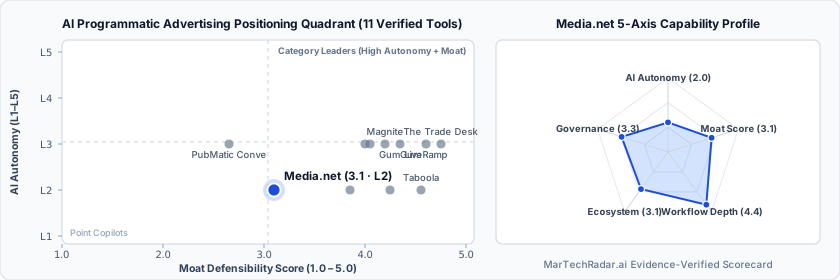
Media.net in-depth review, pricing & architecture analysis
Editor sign-off: Oct 14, 2026. How profiles are made.
What is Media.net? Overview & background
Established in 2010 with headquarters in Dubai, Media.net is a supply-side platform and contextual monetization engine engineered to resolve third-party cookie deprecation via semantic page-level analysis. The company serves enterprise digital publishers, media networks, and monetization leads requiring programmatic yield management across web properties. Media.net bridges content taxonomies directly with advertiser demand pools to capture brand intent at the moment of content consumption without cross-site persistent tracking identifiers.
How Media.net works: architecture & workflow
Media.net operates as an L2 assistive yield-optimization engine centered on natural language processing pipelines that parse unstructured editorial content in real time. Incoming publisher page requests pass through semantic parsing layers that extract contextual keywords, entity relationships, and sentiment indicators prior to bid auction generation. This metadata feeds server-side pre-bid and post-bid auction wrappers, exposing enriched impressions across open exchanges and private marketplaces to match advertiser contextual targets without deterministic consumer profiles.
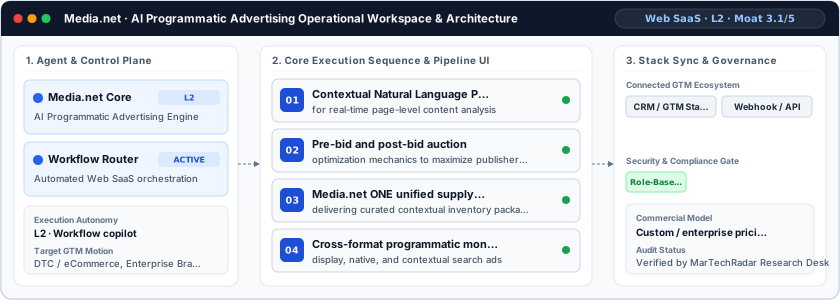
Media.net limitations, drawbacks & risks
Operational considerations and platform boundaries include:
- Page Rendering Latency: Complex semantic content evaluation and dynamic ad injection can introduce cumulative layout shifts and client-side execution delays when integrated via non-optimized header bidding setups.
- Niche Content Taxonomy Gaps: Semantic classification engines exhibit degraded keyword precision on highly specialized, technical, or sparse editorial pages, leading to sub-optimal fill rates for non-mainstream verticals.
- Ad Exchange Yield Discrepancies: Pre-bid latency windows create bid loss friction against external demand-side platforms when strict publisher timeout thresholds truncate multi-partner auction resolutions.
Media.net pricing, plans & cost breakdown
Commercial pricing is available on request through tailored enterprise sales quotes based on organizational scale and seats. The platform primarily utilizes a publisher revenue-share structure and custom net revenue-split agreements established during direct contract negotiations with media partners. Enterprise arrangements scale based on aggregate programmatic impressions, monthly page views, and ad format implementation scopes without fixed upfront licensing tiers.
| Plan / Tier | Verified Price & Billing | Included Scope & Contract Terms |
|---|---|---|
| Enterprise / Custom | Custom quote | Custom-quoted plan; terms come from the vendor's sales team. |
How Media.net compares vs. competitors & alternatives
Compared to GumGum's computer vision and multimodal contextual focus, Media.net maintains deeper legacy roots in textual search-intent contextualization and direct publisher header bidding pipelines within the AI Programmatic Advertising segment. Whereas LiveRamp addresses addressability through deterministic identity resolution graphs and AdRoll focuses on mid-market omnichannel demand retargeting, Media.net is optimized for large-scale web publishers requiring cookieless supply-side monetization without managing heavy identity synchronization infrastructure.
Direct competitors & market radar
Top algorithmic competitors based on category positioning, capability overlap, and ICP alignment.
Frequently asked questions about Media.net
Does Media.net publish pricing or require an enterprise quote?
Media.net pricing: Custom / enterprise pricing. No free plan is publicly disclosed. Commercial pricing is available on request through tailored enterprise sales quotes based on organizational scale and seats.
What are the top Media.net alternatives in AI Programmatic Advertising?
Verified AI Programmatic Advertising alternatives include PubMatic Convert (Custom / enterprise pricing), StackAdapt (Pricing not disclosed), Sharethrough (Custom / enterprise pricing), Infolinks (Custom / enterprise pricing). Compared to GumGum's computer vision and multimodal contextual focus, Media.net maintains deeper legacy roots in textual search-intent contextualization and direct publisher header bidding pipelines within the AI Programmatic Advertising segment.
What are the main limitations and trade-offs of Media.net?
Operational considerations and platform boundaries include: Page Rendering Latency: Complex semantic content evaluation and dynamic ad injection can introduce cumulative layout shifts and client-side execution delays when integrated via non-optimized header bidding setups. Walk away if you need published self-serve pricing: Media.net is sold by custom quote.
Verified sources & evidence trail
- Official product domain: https://media.net
- Commercial pricing verification: Verified against official vendor pricing policy (Custom / enterprise pricing)
- Verified corporate entity profiles (
sameAs): LinkedIn Company Profile · Crunchbase Entity Record - First-party governance & documentation links: Terms · Privacy
- Editor sign-off: Oct 14, 2026 (how profiles are made).
