Mailveri Review (2026): Sales Intelligence Pricing, Pros & Cons
Bottom line
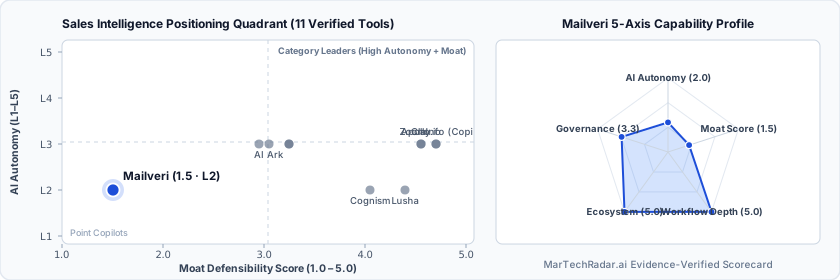
Mailveri is a Web SaaS tool for Sales Intelligence (Lead Enrichment & Waterfall Orchestration) in AI SDR & Outbound. Pricing: $9–$299 usage-based. Editor ratings: AI autonomy L2 (workflow copilot); moat score 1.5/5.0 (Thin wrapper). Fact-checked by MarTechRadar Research Desk on Oct 28, 2026.
Bulk CSV and REST API email verification platform running deep SMTP handshakes, catch-all probing, disposable domain filtering, and MCP agent checks.
Is Mailveri worth it in 2026? Buyer fit & when to walk away
Choose Mailveri if (Best Fit)
- Target ICP & Stack Fit: You operate as Sales Intelligence teams requiring a Web SaaS deployment for Sales Intelligence, with verified ecosystem connectivity for HubSpot, Apollo.io, Klaviyo, ActiveCampaign.
- L2 Architecture & Defensibility: Combines 1M-row batch file cleaning and sub-second REST API SMTP verification with free catch-all probing, non-expiring pay-as-you-go credits, and an open-source MCP server for AI agents.
- Commercial Model Fit: Your procurement budget aligns with $9–$299 usage-based and want trial evaluation before contract sign-off.
Walk away from Mailveri if (Deal-Breakers)
- Walk away if your workflow requires uncapped enterprise volume on the $9–$299 usage-based entry plan without upgrading tiers.
- Walk away if your workflow cannot tolerate verification-only scope (no contact discovery or sending): Mailveri strictly validates existing email strings; outbound teams that need B2B contact database search, LinkedIn waterfall email finding, or cold email warmup and sequence sending face workflow dependency on external tools like Clay, Apollo, or Instantly.
- Walk away if probabilistic limits on strict enterprise catch-all servers is a deal-breaker for your team: While Mailveri probes catch-all configurations at no extra cost, recipient mail servers protected by anti-probing gateways (such as Mimecast or Proofpoint) that accept all RCPT TO commands during SMTP handshakes cannot be deterministically guaranteed against silent post-accept drops.
Mailveri pricing, free plan & scorecard at a glance
| Pricing | $9–$299 usage-basedVendor pricing page |
|---|---|
| Free plan | No / not disclosed |
| Delivery | Web SaaS |
| Audience | — |
| AI autonomy level | L2 · Workflow copilotEditor-verified |
| Moat tier & score | 1.5 / 5.0 · Thin wrapperEditor-verified |
| Funding | Bootstrapped |
| Ecosystem integrations | HubSpot, Apollo.io, Klaviyo, ActiveCampaign, Mailchimp, Zapier |
| Headquarters | — |
| Founded | 2022 |
| Last verified | Oct 28, 2026 |
Mailveri pros & cons: strengths vs. operational limitations
Pros: core strengths & capabilities
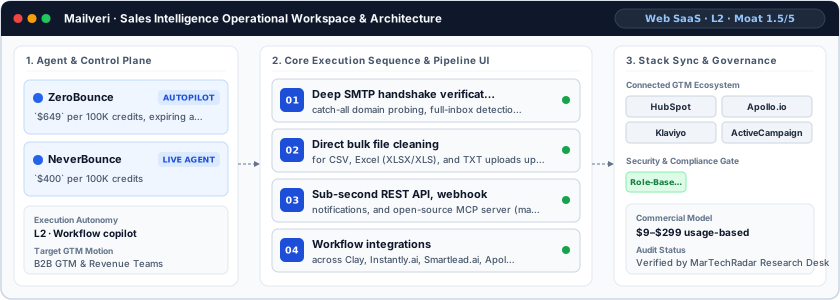
- Deep SMTP handshake verification,: catch-all domain probing, full-inbox detection, and disposable/role filtering
- Direct bulk file cleaning: for CSV, Excel (XLSX/XLS), and TXT uploads up to 1,000,000+ rows per file
- Sub-second REST API, webhook: notifications, and open-source MCP server (mailveri-mcp) for AI agents
- Workflow integrations: across Clay, Instantly.ai, Smartlead.ai, Apollo.io, HubSpot, Klaviyo, n8n, Make, and Zapier
Cons: operational limitations & risks
- Verification-Only Scope (No Contact Discovery or Sending): Mailveri strictly validates existing email strings; outbound teams that need B2B contact database search, LinkedIn waterfall email finding, or cold email warmup and sequence sending face workflow dependency on external tools like Clay, Apollo, or Instantly.
- Probabilistic Limits on Strict Enterprise Catch-All Servers: While Mailveri probes catch-all configurations at no extra cost, recipient mail servers protected by anti-probing gateways (such as Mimecast or Proofpoint) that accept all RCPT TO commands during SMTP handshakes cannot be deterministically guaranteed against silent post-accept drops.
- Throughput Latency on Million-Row Batches: When cleaning maximum-capacity 1,000,000-row spreadsheets containing high concentrations of throttled ISP domains, defensive rate-limiting by receiving MX servers introduces queue latency bottlenecks compared to sub-second single API lookups.
Mailveri TCO & deal-breaker stress test
Simulate 12-month stepped TCO, hidden cost multipliers, contract lock-in exposure, and stack failure modes using only facts verified by MarTechRadar Research Desk on 2026-10-28 · Capture SHA b5985b40.
Mailveri is viable for 5 seats, but requires commercial or technical verification on the flagged items below.
- Moat Score
- 1.5 / 5.0
- AI Autonomy
- L2
- Free Tier / Trial
- Free trial
Triggered audit signals & failure modes
- Published Self-Serve Entry FloorVerified Pricing Ledger
Mailveri publishes a transparent entry point ($9–$299 usage-based) with a free trial for initial validation before committing.
- Usage / Credit Burn VolatilityCommercial Model Audit
Mailveri uses credit or usage-metered billing ($9–$299 usage-based). High-volume automated workflows across 5 seats can trigger mid-cycle overage charges.
- Primary Operational Bottleneck: Probabilistic Limits on Strict Enterprise Catch-All ServersAudit by MarTechRadar Research Desk
While Mailveri probes catch-all configurations at no extra cost, recipient mail servers protected by anti-probing gateways (such as Mimecast or Proofpoint) that accept all RCPT TO commands during SMTP handshakes cannot be deterministically guaranteed against silent post-accept drops.
Test a custom Mailveri budget or stack constraint
Fits within $800/mo budget ($39–$379/mo)
Fits within $800/mo budget ($12.50–$1,499/mo)
Mailveri integrations, API, security & compliance stack
`$649` per 100K credits, expiring after 365 days
`$400` per 100K credits
Mailveri AI moat & Sales Intelligence positioning
Combines 1M-row batch file cleaning and sub-second REST API SMTP verification with free catch-all probing, non-expiring pay-as-you-go credits, and an open-source MCP server for AI agents.
Mailveri in-depth review, pricing & architecture analysis
Audited by MarTechRadar Research Desk (First-Party Snapshot Audited) on Oct 28, 2026.
What is Mailveri? Overview & background
### What Mailveri actually does
High hard-bounce rates and unverified catch-all domains quickly burn outbound sending domains and inflate monthly contact storage bills inside marketing automation platforms. Mailveri (mailveri.com), a bootstrapped email verification platform founded in 2022, provides high-throughput list hygiene and real-time address verification for outbound sales teams, lifecycle marketers, and developers. Rather than locking teams into expiring monthly subscriptions, Mailveri operates on non-expiring pay-as-you-go credit packages supporting both million-row batch uploads and sub-second API/MCP checks.
How Mailveri works: architecture & workflow
### How the SMTP verification & MCP pipeline works
Core Mechanism: Mailveri executes a multi-stage verification pipeline—covering syntax validation, DNS/MX record inspection, disposable email provider matching, role-based account detection (such as info@ or support@), full-inbox detection, and deep SMTP handshakes against recipient mail servers without transmitting an email message. Catch-all domain detection is included at no extra surcharge, classifying addresses into detailed 7-status verification reports targeting 99%+ deliverability accuracy. Users can upload .CSV, .XLSX, .XLS, or .TXT files containing up to 1,000,000+ rows per file, or trigger real-time single and batch checks via REST API and webhook notifications. For agentic GTM stacks, Mailveri maintains an open-source Model Context Protocol (MCP) server (github.com/mailveri/mailveri-mcp) alongside workflow connectors for Clay, Instantly.ai, Smartlead.ai, Apollo.io, HubSpot, Klaviyo, Mailchimp, ActiveCampaign, n8n, Make, and Zapier.
Mailveri limitations, drawbacks & risks
### Where the platform hits operational limits
Operational considerations and platform boundaries include:
- Verification-Only Scope (No Contact Discovery or Sending): Mailveri strictly validates existing email strings; outbound teams that need B2B contact database search, LinkedIn waterfall email finding, or cold email warmup and sequence sending face workflow dependency on external tools like Clay, Apollo, or Instantly.
- Probabilistic Limits on Strict Enterprise Catch-All Servers: While Mailveri probes catch-all configurations at no extra cost, recipient mail servers protected by anti-probing gateways (such as Mimecast or Proofpoint) that accept all RCPT TO commands during SMTP handshakes cannot be deterministically guaranteed against silent post-accept drops.
- Throughput Latency on Million-Row Batches: When cleaning maximum-capacity 1,000,000-row spreadsheets containing high concentrations of throttled ISP domains, defensive rate-limiting by receiving MX servers introduces queue latency bottlenecks compared to sub-second single API lookups.
Mailveri pricing, plans & cost breakdown
### Pricing & non-expiring credit packages
Commercial Model: Every new account receives 1,000 free trial credits without a credit card. Paid usage runs strictly on one-time, non-expiring credit packs with all features and catch-all checks included:
- Entry Packs:
$9for 10,000 credits,$19for 25,000 credits, or$39for 60,000 credits (50K + 20% bonus). - Mid-Volume Packs:
$59for 100,000 credits,$119for 250,000 credits, or$199for 500,000 credits. - High-Volume Packs:
$299for 1,000,000 credits, with larger multi-million credit bundles and custom enterprise SLA and dedicated IP packages available via sales.
How Mailveri compares vs. competitors & alternatives
### How Mailveri compares to email verification peers
Competitive Landscape: Within CAT-04-02 (*Lead Generation, Enrichment & Waterfall Data*), Mailveri competes directly on cost-per-verification and agent accessibility against ZeroBounce, NeverBounce, and VeriMails.
- ZeroBounce (
$649per 100K credits, expiring after 365 days) and NeverBounce ($400per 100K credits) charge significantly higher rates for bulk list cleaning, whereas Mailveri prices 100,000 non-expiring checks at$59and 1,000,000 checks at$299. - VeriMails offers hybrid annual subscriptions alongside prepaid credit packs, while Mailveri operates a pure pay-as-you-go model paired with an open-source MCP server (
mailveri-mcp) for AI agents. - Best fit: High-volume cold email agencies, Clay/n8n workflow builders, and lifecycle marketers seeking low-cost, non-expiring bulk and API email verification.
Frequently asked questions about Mailveri
How does Mailveri usage pricing work in 2026?
Mailveri pricing: $9–$299 usage-based. No permanent free tier is listed; trial evaluation is offered. ### Pricing & non-expiring credit packages Commercial Model: Every new account receives 1,000 free trial credits without a credit card.
What are the top Mailveri alternatives in Sales Intelligence?
Verified Sales Intelligence alternatives include Smartlead.ai ($39–$379/mo), VeriMails ($12.50–$1,499/mo), Northlight (Custom / enterprise pricing), Clay (Free plan · $54–$180/mo). ### How Mailveri compares to email verification peers Competitive Landscape: Within `CAT-04-02` (*Lead Generation, Enrichment & Waterfall Data*), Mailveri competes directly on cost-per-verification and agent accessibility against ZeroBounce, NeverBounce, and VeriMails.
Verified sources & evidence trail
- Official product domain: https://mailveri.com
- Commercial pricing verification: https://mailveri.com/pricing
- Editorial audit sign-off: Audited by MarTechRadar Research Desk (First-Party Snapshot Audited) on Oct 28, 2026.
