Luma Dream Machine Review (2026): Pitch Deck Pricing, Pros & Cons
Bottom line
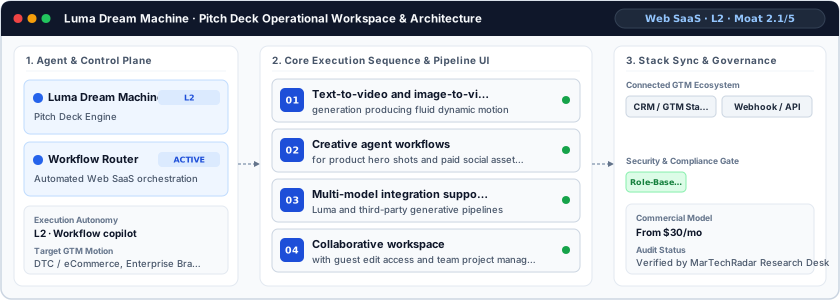
Luma Dream Machine is a Web SaaS tool for Pitch Deck (Marketing Visuals & Pitch Decks) in Visual & Creative Media. Pricing: From $30/mo. Best suited to DTC / eCommerce, Enterprise Brands and Creators / Solo. Editor ratings: AI autonomy L2 (workflow copilot); moat score 2.1/5.0 (Workflow-embedded). Fact-checked by MarTechRadar Research Desk on Oct 15, 2026.
Generative AI video and visual asset model synthesizing cinematic video clips, product hero shots, and creative marketing variations from text and image.
Is Luma Dream Machine worth it in 2026? Buyer fit & when to walk away
Choose Luma Dream Machine if (Best Fit)
- Target ICP & Stack Fit: You operate as DTC / eCommerce, Enterprise Brands and Creators / Solo requiring a Web SaaS deployment for Pitch Deck.
- L2 Architecture & Defensibility: Proprietary generative video foundation model trained on spatial and physical dynamics, integrated creative agent workflows, and scalable cloud inference infrastructure.
- Commercial Model Fit: Your procurement budget aligns with From $30/mo.
Walk away from Luma Dream Machine if (Deal-Breakers)
- Walk away if your workflow cannot tolerate temporal prompt drift: Complex multi-action prompts frequently trigger physical motion artifacts or gradual loss of subject geometry across extended frame sequences.
- Walk away if text and typography rendering is a deal-breaker for your team: The generative latent space struggles with fine typographic rendering, requiring downstream post-processing to overlay legible brand copy and UI elements.
Luma Dream Machine pricing, free plan & scorecard at a glance
| Pricing | From $30/moVendor pricing page |
|---|---|
| Free plan | No / not disclosed |
| Delivery | Web SaaS |
| Audience | DTC / eCommerce, Enterprise Brands, Creators / Solo |
| AI autonomy level | L2 · Workflow copilotEditor-verified |
| Moat tier & score | 2.1 / 5.0 · Workflow-embeddedEditor-verified |
| Funding | Undisclosed |
| Governance & docs | DPA ↗ · Terms ↗ · Privacy ↗ |
| Headquarters | United States |
| Founded | 2021 |
| Last verified | Oct 15, 2026 |
Luma Dream Machine pros & cons: strengths vs. operational limitations
Pros: core strengths & capabilities
- Text-to-video and image-to-video diffusion: generation producing fluid dynamic motion
- Creative agent workflows: for product hero shots and paid social asset variations
- Multi-model integration supporting native: Luma and third-party generative pipelines
- Collaborative workspace: with guest edit access and team project management
Cons: operational limitations & risks
- Temporal Prompt Drift: Complex multi-action prompts frequently trigger physical motion artifacts or gradual loss of subject geometry across extended frame sequences.
- Text and Typography Rendering: The generative latent space struggles with fine typographic rendering, requiring downstream post-processing to overlay legible brand copy and UI elements.
- Credit Consumption Volatility: High-resolution multi-take generation exhausts monthly balance pools quickly during iterative creative exploration, demanding manual asset triage.
Luma Dream Machine TCO & deal-breaker stress test
Simulate 12-month stepped TCO, hidden cost multipliers, contract lock-in exposure, and stack failure modes using only facts verified by MarTechRadar Research Desk on 2026-10-15 · Capture SHA 93e86153.
Luma Dream Machine aligns with your 5-seat / $800/mo profile. Review the walk-away triggers and contract levers below before deployment.
- Moat Score
- 2.1 / 5.0
- AI Autonomy
- L2
- Free Tier / Trial
- None disclosed
Triggered audit signals & failure modes
- Published Self-Serve Entry FloorVerified Pricing Ledger
Luma Dream Machine publishes a transparent entry point (From $30/mo) for initial validation before committing.
- Tier Fit for 5-Seat Scale: Pro ($90/mo)Verified Tier Schedule
Everything in Plus, with:
- Primary Operational Bottleneck: Credit Consumption VolatilityAudit by MarTechRadar Research Desk
High-resolution multi-take generation exhausts monthly balance pools quickly during iterative creative exploration, demanding manual asset triage.
Test a custom Luma Dream Machine budget or stack constraint
Lower 5-seat floor (~$7/mo vs. $90 / mo)
Luma Dream Machine AI moat & Pitch Deck positioning
Proprietary generative video foundation model trained on spatial and physical dynamics, integrated creative agent workflows, and scalable cloud inference infrastructure.
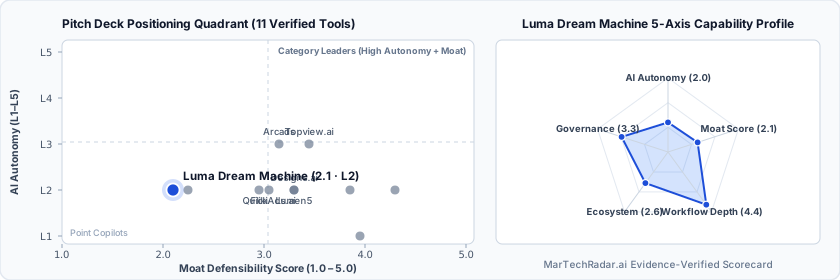
Luma Dream Machine in-depth review, pricing & architecture analysis
Editor sign-off: Oct 15, 2026. How profiles are made.
What is Luma Dream Machine? Overview & background
Headquartered in the United States, Luma Dream Machine addresses the complex challenge of producing high-fidelity motion graphics and video collateral without conventional physical production overhead. Built for creative directors, growth marketers, and digital production teams, the platform replaces traditional studio filming and manual 3D asset rendering with generative synthetic video generation. Within the visual marketing and asset production category, the system operates as an automated creative engine that converts static brand assets, product imagery, and natural language briefs into dynamic, high-resolution video collateral.
How Luma Dream Machine works: architecture & workflow
Dream Machine operates via a generative video architecture that models realistic lighting, physical motion, and camera dynamics across synthetic sequences. Operating at Level 2 workflow-copilot autonomy, users submit text descriptions or keyframe image anchors to guide scene composition. The platform executes iterative latent denoising across temporal dimensions, preserving subject consistency and spatial depth across generated clips. Creative agents then automate derivative generation, allowing marketing teams to orchestrate product hero shots and multivariate paid social creative variations through conversational prompt refinement.
Luma Dream Machine limitations, drawbacks & risks
Operational considerations and platform boundaries include:
- Temporal Prompt Drift: Complex multi-action prompts frequently trigger physical motion artifacts or gradual loss of subject geometry across extended frame sequences.
- Text and Typography Rendering: The generative latent space struggles with fine typographic rendering, requiring downstream post-processing to overlay legible brand copy and UI elements.
- Credit Consumption Volatility: High-resolution multi-take generation exhausts monthly balance pools quickly during iterative creative exploration, demanding manual asset triage.
Luma Dream Machine pricing, plans & cost breakdown
The software is licensed through a tiered credit-based subscription model. Entry-level usage begins on the Plus tier at $30 per month, which supplies 10,000 credits, commercial usage rights, and multi-model access. Mid-volume creative production scales through the Pro tier at $90 per month with 40,000 credits, while scaled production workflows utilize the Ultra tier at $300 per month for 150,000 credits. Dedicated Team and Enterprise packages provide pooled asset management, centralized billing, and custom agent compute allocations.
| Plan / Tier | Verified Price & Billing | Included Scope & Contract Terms | |
|---|---|---|---|
| Plus | $30/mo | Luma and third-party image and video models | |
| Pro | $90/mo | Everything in Plus, with: | |
| Contract Watchout: Annual Billing Headline vs. Monthly Premium | The vendor pricing page advertises an annual-billing discount (Save up to 20%); month-to-month billing carries a higher effective monthly rate. | ||
How Luma Dream Machine compares vs. competitors & alternatives
Compared to direct category competitors like Flair.ai and Photoroom, Luma Dream Machine functions as an alternative focused on specialized workflow execution. Within visual asset production, Dream Machine serves an entirely different architectural purpose than legacy layout platforms like Ceros or vector-centric tools such as Fotor AI and Picmaker. While Ceros focuses on interactive, deterministic web experiences and Picmaker emphasizes static social templates, Dream Machine delivers dynamic video generation via foundation models. The platform is best suited for performance marketing teams and creative studios requiring rapid iteration of cinematic video b-roll and motion concepts at scale.
Frequently asked questions about Luma Dream Machine
How much does Luma Dream Machine cost in 2026?
Luma Dream Machine pricing: From $30/mo. No free plan is publicly disclosed. Published tiers: Plus ($30/mo); Pro ($90/mo). The software is licensed through a tiered credit-based subscription model. Entry-level usage begins on the Plus tier at $30 per month, which supplies 10,000 credits, commercial usage rights, and multi-model access.
What are the top Luma Dream Machine alternatives in Pitch Deck?
Verified Pitch Deck alternatives include Pupila Brand Studio (Custom / enterprise pricing), Moovly (Custom / enterprise pricing), CapCut Commerce Pro (Custom / enterprise pricing), Photoroom (Free plan · $7.50–$82.50/mo). Compared to direct category competitors like Flair.ai and Photoroom, Luma Dream Machine functions as an alternative focused on specialized workflow execution.
What are the main limitations and trade-offs of Luma Dream Machine?
Operational considerations and platform boundaries include: Temporal Prompt Drift: Complex multi-action prompts frequently trigger physical motion artifacts or gradual loss of subject geometry across extended frame sequences. Walk away if your workflow cannot tolerate temporal prompt drift: Complex multi-action prompts frequently trigger physical motion artifacts or gradual loss of subject geometry across extended frame sequences.
Verified sources & evidence trail
- Official product domain: https://lumalabs.ai
- Commercial pricing verification: https://lumalabs.ai/pricing
- First-party governance & documentation links: DPA · Terms · Privacy
- Editor sign-off: Oct 15, 2026 (how profiles are made).
