Lifesight Review (2026): Marketing Attribution Pricing, Pros & Cons
Bottom line
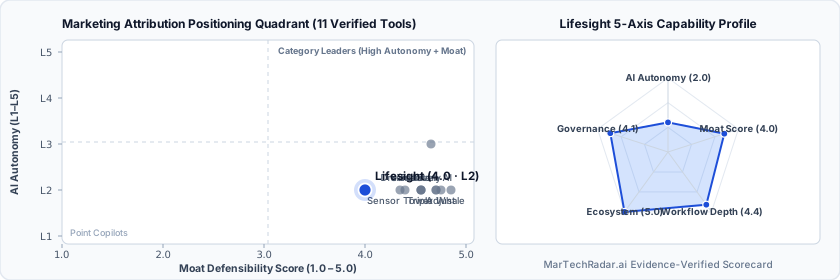
Lifesight is a Web SaaS tool for Marketing Attribution (Multi-Touch Attribution & eCommerce Dashboards) in Analytics & Attribution. Pricing: Custom / enterprise pricing. Best suited to B2B SaaS and Marketing Agencies. Editor ratings: AI autonomy L2 (workflow copilot); moat score 4.0/5.0 (Proprietary moat). Fact-checked by MarTechRadar Research Desk on Oct 7, 2026.
Agentic unified marketing measurement platform combining Bayesian marketing mix modeling, multi-touch attribution, and incrementality experimentation.
Is Lifesight worth it in 2026? Buyer fit & when to walk away
Choose Lifesight if (Best Fit)
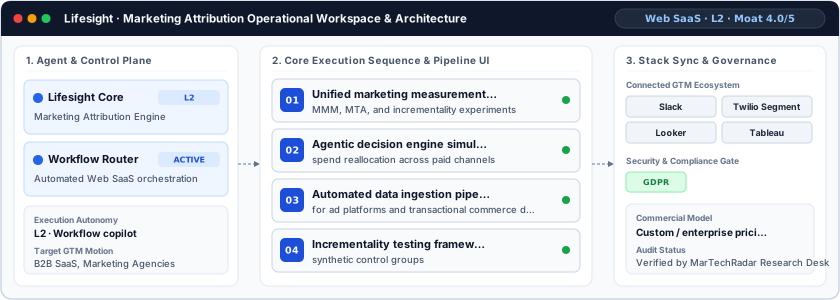
- Target ICP & Stack Fit: You operate as B2B SaaS and Marketing Agencies requiring a Web SaaS deployment for Marketing Attribution, with verified ecosystem connectivity for Slack, Twilio Segment, Looker, Tableau.
- L2 Architecture & Defensibility: Lifesight builds defensibility by unifying top-down Bayesian MMM with bottom-up touchpoint attribution and causal incrementality experiments in a closed-loop agentic workflow, reducing dependency on degraded client-side identity graphs.
- Commercial Model Fit: Your procurement budget aligns with Custom / enterprise pricing.
Walk away from Lifesight if (Deal-Breakers)
- Walk away if you need published self-serve pricing: Lifesight is sold by custom quote.
- Walk away if your workflow cannot tolerate cold-start data volume requirements: Bayesian MMM calibration requires at least two continuous years of historical media expenditure and transactional data to yield statistically valid media decay and saturation coefficients.
- Walk away if walled-garden latency and schema drift is a deal-breaker for your team: Connector pipelines depend on third-party ad network reporting APIs, leaving attribution models vulnerable to ad-network schema adjustments and retroactive reporting lag.
Lifesight pricing, free plan & scorecard at a glance
| Pricing | Custom / enterprise pricing |
|---|---|
| Free plan | No / not disclosed |
| Delivery | Web SaaS |
| Audience | B2B SaaS, Marketing Agencies |
| AI autonomy level | L2 · Workflow copilotEditor-verified |
| Moat tier & score | 4.0 / 5.0 · Proprietary moatEditor-verified |
| Funding | Venture-backed |
| Founders | Rohit Maheswaran, Tobin Thomas |
| Company size | 201-500 employees |
| Ecosystem integrations | Slack, Twilio Segment, Looker, Tableau, Power BI |
| Compliance & governance | GDPR |
| Governance & docs | Trust & Security ↗ · API & Docs ↗ · Changelog ↗ · DPA ↗ · Terms ↗ · Privacy ↗ |
| Headquarters | Singapore |
| Founded | 2017 |
| Last verified | Oct 7, 2026 |
Lifesight pros & cons: strengths vs. operational limitations
Pros: core strengths & capabilities
- Unified marketing measurement synthesizing: MMM, MTA, and incrementality experiments
- Agentic decision engine simulating: spend reallocation across paid channels
- Automated data ingestion pipelines: for ad platforms and transactional commerce data
- Incrementality testing framework utilizing: synthetic control groups
Cons: operational limitations & risks
- Cold-Start Data Volume Requirements: Bayesian MMM calibration requires at least two continuous years of historical media expenditure and transactional data to yield statistically valid media decay and saturation coefficients.
- Walled-Garden Latency and Schema Drift: Connector pipelines depend on third-party ad network reporting APIs, leaving attribution models vulnerable to ad-network schema adjustments and retroactive reporting lag.
- Incrementality Test Isolation Overhead: Executing synthetic control group experiments demands strict geo-isolation or audience holdouts, which can introduce operational channel friction and short-term revenue suppressions.
Lifesight TCO & deal-breaker stress test
Simulate 12-month stepped TCO, hidden cost multipliers, contract lock-in exposure, and stack failure modes using only facts verified by MarTechRadar Research Desk on 2026-10-07.
Lifesight triggers high-severity friction under your 5-seat / $800/mo constraints. Benchmark the verified subtrack alternatives below before committing.
- Moat Score
- 4.0 / 5.0
- AI Autonomy
- L2
- Free Tier / Trial
- None disclosed
Triggered audit signals & failure modes
- Opaque Enterprise Quoting vs. SMB/Mid-Market BudgetVerified Pricing Ledger
Lifesight does not disclose a public self-serve floor (Custom / enterprise pricing). Buyers with a $800/mo cap face high sales-qualification friction.
- Sales-Gated Contract TermsFact-checked by MarTechRadar Research Desk
Lifesight operates an enterprise-tier software-as-a-service model. Commercial pricing is available on request through tailored enterprise sales quotes based on organizational scale and seats.
- Primary Operational Bottleneck: Cold-Start Data Volume RequirementsAudit by MarTechRadar Research Desk
Bayesian MMM calibration requires at least two continuous years of historical media expenditure and transactional data to yield statistically valid media decay and saturation coefficients.
Test a custom Lifesight budget or stack constraint
Lower 5-seat floor (~$44/mo vs. Custom Quote) · Transparent self-serve entry without mandatory annual lock-in
Lower 5-seat floor (~$49/mo vs. Custom Quote) · Transparent self-serve entry without mandatory annual lock-in
Lifesight integrations, API, security & compliance stack
Lifesight AI moat & Marketing Attribution positioning
Lifesight builds defensibility by unifying top-down Bayesian MMM with bottom-up touchpoint attribution and causal incrementality experiments in a closed-loop agentic workflow, reducing dependency on degraded client-side identity graphs.
Lifesight in-depth review, pricing & architecture analysis
Editor sign-off: Oct 7, 2026. How profiles are made.
What is Lifesight? Overview & background
Architected to solve cross-channel signal loss stemming from privacy frameworks and cookie deprecation, Lifesight was founded in 2017 in Singapore. The platform operates within modern marketing analytics stacks as a unified measurement engine, targeting growth leads, heads of performance marketing, and eCommerce revenue directors. Rather than relying on fragile single-touch models, Lifesight positions itself as an agentic measurement suite that reconciles disparate attribution streams into a single system of record.
How Lifesight works: architecture & workflow
At its technical core, Lifesight operates an L3 autonomous measurement engine that triangulates three distinct analytical methodologies: Bayesian Marketing Mix Modeling (MMM), bottom-up Multi-Touch Attribution (MTA), and causal incrementality experimentation. Lifesight ingests first-party eCommerce transactions, offline sales feeds, and ad spend telemetry via prebuilt ETL connectors. It then applies Bayesian priors to evaluate macro trends while running synthetic control experiments to measure genuine lift. Algorithmic budget optimization agents parse saturation curves, continuously outputting suggested capital allocations directly to media planners, alongside native workflow integrations for Slack, Looker, Tableau, and Power BI under verified GDPR governance controls.
Lifesight limitations, drawbacks & risks
Operational considerations and platform boundaries include:
- Cold-Start Data Volume Requirements: Bayesian MMM calibration requires at least two continuous years of historical media expenditure and transactional data to yield statistically valid media decay and saturation coefficients.
- Walled-Garden Latency and Schema Drift: Connector pipelines depend on third-party ad network reporting APIs, leaving attribution models vulnerable to ad-network schema adjustments and retroactive reporting lag.
- Incrementality Test Isolation Overhead: Executing synthetic control group experiments demands strict geo-isolation or audience holdouts, which can introduce operational channel friction and short-term revenue suppressions.
Lifesight pricing, plans & cost breakdown
Lifesight operates an enterprise-tier software-as-a-service model. Commercial pricing is available on request through tailored enterprise sales quotes based on organizational scale and seats. Deployments scale primarily on annualized tracked advertising expenditure, data connector breadth, and dedicated support provisions, avoiding public self-serve tiers in favor of contractually agreed enterprise implementations.
| Plan / Tier | Verified Price & Billing | Included Scope & Contract Terms |
|---|---|---|
| Enterprise / Custom | Custom quote | Custom-quoted plan; terms come from the vendor's sales team. |
How Lifesight compares vs. competitors & alternatives
Lifesight contends with mobile attribution and data aggregation systems such as AppsFlyer, Adjust, and Adverity within the Marketing Attribution segment. While AppsFlyer and Adjust concentrate predominantly on native mobile app software development kit telemetry and deterministic post-install events, Lifesight differentiates through agentic top-down econometrics and incrementality for omnichannel merchants. Unlike Adverity, which acts primarily as a middleware ETL pipeline requiring third-party visualization, Lifesight delivers closed-loop causal modeling and budget optimization natively. The platform suits multi-channel retail organizations spending heavily across both walled gardens and offline channels.
Direct competitors & market radar
Top algorithmic competitors based on category positioning, capability overlap, and ICP alignment.
Frequently asked questions about Lifesight
Does Lifesight publish pricing or require an enterprise quote?
Lifesight pricing: Custom / enterprise pricing. No free plan is publicly disclosed. Lifesight operates an enterprise-tier software-as-a-service model. Commercial pricing is available on request through tailored enterprise sales quotes based on organizational scale and seats.
What are the top Lifesight alternatives in Marketing Attribution?
Verified Marketing Attribution alternatives include Adverity (Custom / enterprise pricing), OuterSignal (From $49/mo), Triple Whale (Custom / enterprise pricing), Supermetrics (From $44/mo · Enterprise plan). Lifesight contends with mobile attribution and data aggregation systems such as AppsFlyer, Adjust, and Adverity within the Marketing Attribution segment.
What are the main limitations and trade-offs of Lifesight?
Operational considerations and platform boundaries include: Cold-Start Data Volume Requirements: Bayesian MMM calibration requires at least two continuous years of historical media expenditure and transactional data to yield statistically valid media decay and saturation coefficients. Walk away if you need published self-serve pricing: Lifesight is sold by custom quote.
Verified sources & evidence trail
- Official product domain: https://lifesight.io
- Commercial pricing verification: Verified against official vendor pricing policy (Custom / enterprise pricing)
- Verified corporate entity profiles (
sameAs): LinkedIn Company Profile · Crunchbase Entity Record - First-party governance & documentation links: Trust & Security · API & Docs · Changelog · DPA · Terms · Privacy
- Editor sign-off: Oct 7, 2026 (how profiles are made).
