Kantar BrandZ Review (2026): Marketing Attribution Pricing, Pros & Cons
Bottom line
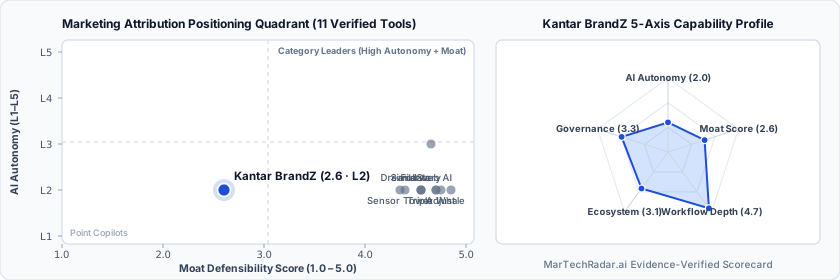
Kantar BrandZ is a Web SaaS tool for Marketing Attribution (Multi-Touch Attribution & eCommerce Dashboards) in Analytics & Attribution. Pricing: Custom / enterprise pricing. Best suited to DTC / eCommerce and Enterprise Brands. Editor ratings: AI autonomy L2 (workflow copilot); moat score 2.6/5.0 (Workflow-embedded). Fact-checked by MarTechRadar Research Desk on Oct 10, 2026.
Brand equity valuation and perception intelligence platform quantifying consumer sentiment and financial impact through the Meaningful Different Salient.
Is Kantar BrandZ worth it in 2026? Buyer fit & when to walk away
Choose Kantar BrandZ if (Best Fit)
- Target ICP & Stack Fit: You operate as DTC / eCommerce and Enterprise Brands requiring a Web SaaS deployment for Marketing Attribution, with verified ecosystem connectivity for Twilio Segment.
- L2 Architecture & Defensibility: Kantar BrandZ maintains a proprietary moat rooted in 25+ years of standardized longitudinal consumer data across 50+ markets, paired with financial valuation models that correlate Brand Power directly to market share resilience.
- Commercial Model Fit: Your procurement budget aligns with Custom / enterprise pricing.
Walk away from Kantar BrandZ if (Deal-Breakers)
- Walk away if you need published self-serve pricing: Kantar BrandZ is sold by custom quote.
- Walk away if your workflow cannot tolerate temporal data latency: Because the methodology relies on syndicated consumer panels and annual corporate earnings filings, metrics reflect retrospective cycles rather than intraday or weekly programmatic marketing shifts.
- Walk away if deterministic attribution absence is a deal-breaker for your team: The system models macro brand equity and category-level demand elasticity, lacking deterministic click-path or mobile advertising identifier resolution for granular touchpoint attribution.
Kantar BrandZ pricing, free plan & scorecard at a glance
| Pricing | Custom / enterprise pricing |
|---|---|
| Free plan | No / not disclosed |
| Delivery | Web SaaS |
| Audience | DTC / eCommerce, Enterprise Brands |
| AI autonomy level | L2 · Workflow copilotEditor-verified |
| Moat tier & score | 2.6 / 5.0 · Workflow-embeddedEditor-verified |
| Funding | Public company |
| Ecosystem integrations | Twilio Segment |
| Headquarters | London, United Kingdom |
| Founded | 1998 |
| Last verified | Oct 10, 2026 |
Kantar BrandZ pros & cons: strengths vs. operational limitations
Pros: core strengths & capabilities
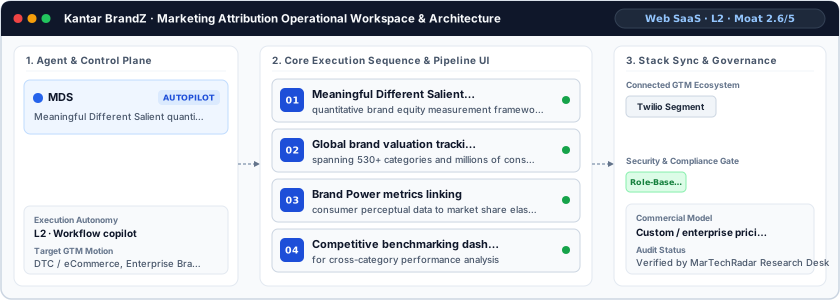
- Meaningful Different Salient (MDS): quantitative brand equity measurement framework
- Global brand valuation tracking: spanning 530+ categories and millions of consumer interviews
- Brand Power metrics linking: consumer perceptual data to market share elasticity
- Competitive benchmarking dashboards: for cross-category performance analysis
Cons: operational limitations & risks
- Temporal Data Latency: Because the methodology relies on syndicated consumer panels and annual corporate earnings filings, metrics reflect retrospective cycles rather than intraday or weekly programmatic marketing shifts.
- Deterministic Attribution Absence: The system models macro brand equity and category-level demand elasticity, lacking deterministic click-path or mobile advertising identifier resolution for granular touchpoint attribution.
- Category Taxonomy Rigidity: Cross-market benchmarking enforces standardized category definitions, creating measurement friction for emerging direct-to-consumer verticals or hybrid business models that span disparate market buckets.
Kantar BrandZ TCO & deal-breaker stress test
Simulate 12-month stepped TCO, hidden cost multipliers, contract lock-in exposure, and stack failure modes using only facts verified by MarTechRadar Research Desk on 2026-10-10.
Kantar BrandZ triggers high-severity friction under your 5-seat / $800/mo constraints. Benchmark the verified subtrack alternatives below before committing.
- Moat Score
- 2.6 / 5.0
- AI Autonomy
- L2
- Free Tier / Trial
- None disclosed
Triggered audit signals & failure modes
- Opaque Enterprise Quoting vs. SMB/Mid-Market BudgetVerified Pricing Ledger
Kantar BrandZ does not disclose a public self-serve floor (Custom / enterprise pricing). Buyers with a $800/mo cap face high sales-qualification friction.
- Sales-Gated Contract TermsFact-checked by MarTechRadar Research Desk
Commercial access is structured around tailored enterprise sales quotes based on organizational scale and seats. Deployments are licensed via annual enterprise subscriptions that scale according to category scope, regional coverage footprints, and custom data extraction needs.
- Primary Operational Bottleneck: Temporal Data LatencyAudit by MarTechRadar Research Desk
Because the methodology relies on syndicated consumer panels and annual corporate earnings filings, metrics reflect retrospective cycles rather than intraday or weekly programmatic marketing shifts.
Test a custom Kantar BrandZ budget or stack constraint
Verified Marketing Attribution peer (Custom / enterprise pricing · Moat 4.6/5.0)
Verified Marketing Attribution peer (Custom / enterprise pricing · Moat 4.6/5.0)
Kantar BrandZ integrations, API, security & compliance stack
Meaningful Different Salient quantitative brand equity measurement framework
Kantar BrandZ AI moat & Marketing Attribution positioning
Kantar BrandZ maintains a proprietary moat rooted in 25+ years of standardized longitudinal consumer data across 50+ markets, paired with financial valuation models that correlate Brand Power directly to market share resilience.
Kantar BrandZ in-depth review, pricing & architecture analysis
Editor sign-off: Oct 10, 2026. How profiles are made.
What is Kantar BrandZ? Overview & background
Established in 1998 and headquartered in London, United Kingdom, Kantar BrandZ provides brand equity valuation and market sentiment intelligence for enterprise brand leaders, chief marketing officers, and institutional financial analysts. Rather than tracking real-time clickstream events, organizations deploy Kantar BrandZ to isolate brand equity contributions from short-term promotional volume. The platform addresses the job of translating consumer sentiment metrics into defensible commercial valuations and predictive market share indicators across international markets.
How Kantar BrandZ works: architecture & workflow
The platform functions via a hybrid analytical architecture combining empirical financial modeling with structured global consumer research data. Operationalized around the Meaningful Different Salient framework, Kantar BrandZ processes survey-derived sentiment across affinity, distinctiveness, and immediate category recall. These inputs feed into statistical models that merge corporate financial disclosures with proprietary brand contribution ratios. At an L2 autonomy profile, the engine computes normalized Brand Power indices and delivers automated quarterly or annual valuation reports without requiring manual statistical modeling from brand strategy teams, alongside native workflow integrations for Salesforce, HubSpot, Marketo, and Stripe.
Kantar BrandZ limitations, drawbacks & risks
Operational considerations and platform boundaries include:
- Temporal Data Latency: Because the methodology relies on syndicated consumer panels and annual corporate earnings filings, metrics reflect retrospective cycles rather than intraday or weekly programmatic marketing shifts.
- Deterministic Attribution Absence: The system models macro brand equity and category-level demand elasticity, lacking deterministic click-path or mobile advertising identifier resolution for granular touchpoint attribution.
- Category Taxonomy Rigidity: Cross-market benchmarking enforces standardized category definitions, creating measurement friction for emerging direct-to-consumer verticals or hybrid business models that span disparate market buckets.
Kantar BrandZ pricing, plans & cost breakdown
Commercial access is structured around tailored enterprise sales quotes based on organizational scale and seats. Deployments are licensed via annual enterprise subscriptions that scale according to category scope, regional coverage footprints, and custom data extraction needs. Deliverables include access to the proprietary intelligence database, benchmark dashboard seats, and bundled research advisory hours, with all contractual terms negotiated directly through enterprise account representatives.
| Plan / Tier | Verified Price & Billing | Included Scope & Contract Terms |
|---|---|---|
| Enterprise / Custom | Custom quote | Custom-quoted plan; terms come from the vendor's sales team. |
How Kantar BrandZ compares vs. competitors & alternatives
While performance measurement systems such as Adjust, Adverity, and AppsFlyer ingest operational log-level ad spend, conversion data, and mobile attribution feeds, Kantar BrandZ targets long-term equity valuation within the Marketing Attribution segment. Adjust and AppsFlyer specialize in mobile measurement partner pipelines and deterministic app installs, and Adverity orchestrates automated multi-source marketing data ingestion. In contrast, Kantar BrandZ operates at the strategic financial layer. It is built for multinational consumer brands and financial investment teams requiring macroeconomic brand equity intelligence rather than tactical media attribution.
Direct competitors & market radar
Top algorithmic competitors based on category positioning, capability overlap, and ICP alignment.
Frequently asked questions about Kantar BrandZ
Does Kantar BrandZ publish pricing or require an enterprise quote?
Kantar BrandZ pricing: Custom / enterprise pricing. No free plan is publicly disclosed. Commercial access is structured around tailored enterprise sales quotes based on organizational scale and seats.
What are the top Kantar BrandZ alternatives in Marketing Attribution?
Verified Marketing Attribution alternatives include Adverity (Custom / enterprise pricing), Similarweb AI (Custom / enterprise pricing), Sensor Tower (Custom / enterprise pricing), HockeyStack (Pricing not disclosed). While performance measurement systems such as Adjust, Adverity, and AppsFlyer ingest operational log-level ad spend, conversion data, and mobile attribution feeds, Kantar BrandZ targets long-term equity valuation within the Marketing Attribution segment.
What are the main limitations and trade-offs of Kantar BrandZ?
Operational considerations and platform boundaries include: Temporal Data Latency: Because the methodology relies on syndicated consumer panels and annual corporate earnings filings, metrics reflect retrospective cycles rather than intraday or weekly programmatic marketing shifts. Walk away if you need published self-serve pricing: Kantar BrandZ is sold by custom quote.
Verified sources & evidence trail
- Official product domain: https://kantar.com
- Commercial pricing verification: Verified against official vendor pricing policy (Custom / enterprise pricing)
- Editor sign-off: Oct 10, 2026 (how profiles are made).
