Imprezia Review (2026): AI Programmatic Advertising Pricing, Limits & Alternatives
Bottom line
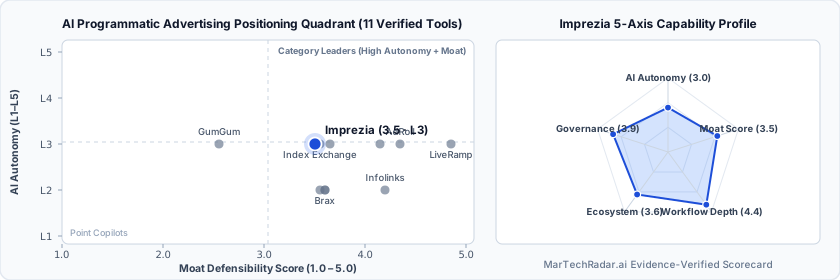
Imprezia is a Web SaaS tool for AI Programmatic Advertising (Programmatic DSP/SSP & Contextual AdTech) in AdTech & Paid Media. Pricing: Pricing not disclosed. Best suited to B2B SaaS and Marketing & Growth Teams. Editor ratings: AI autonomy L3 (conditional automation); moat score 3.5/5.0 (Proprietary moat). Fact-checked by Julie Brot on Oct 16, 2026.
Conversational AI advertising network and intent exchange enabling AI apps to monetize chat prompts with native sponsored recommendations.
Imprezia buyer fit verdict: when to choose vs. when to walk away
Choose Imprezia if (Best Fit)
- Target ICP & Stack Fit: You operate as B2B SaaS and Marketing & Growth Teams requiring a Web SaaS deployment for AI Programmatic Advertising, with verified ecosystem connectivity for Google Ads.
- L3 Architecture & Defensibility: Embedding a lightweight two-line monetization SDK directly into LLM chat and agent pipelines creates supply-side network effects across conversational AI inventory.
- Commercial Model Fit: Your procurement budget aligns with Pricing not disclosed.
Walk away from Imprezia if (Deal-Breakers)
- Walk away if you require transparent self-serve monthly billing or your budget ceiling is under $1,000/mo (Imprezia requires sales-gated custom quoting).
- Walk away if your workflow cannot tolerate two-sided inventory scale limitation: A primary marketplace limitation is that advertiser reach depends directly on the traffic volume and vertical mix of third-party AI applications integrated into the exchange.
- Walk away if enterprise privacy governance barrier is a deal-breaker for your team: Internal enterprise copilots and regulated healthcare or financial assistants struggle with strict data-governance rules, creating a governance barrier that prohibits transmitting user prompt context to external ad exchanges.
Imprezia key facts & scorecard
| Pricing | Pricing not disclosed |
|---|---|
| Free plan | No / not disclosed |
| Delivery | Web SaaS |
| Audience | B2B SaaS, Marketing & Growth Teams |
| AI autonomy level | L3 · Conditional automationEditor-verified |
| Moat tier & score | 3.5 / 5.0 · Proprietary moatEditor-verified |
| Funding | Pre-seed |
| Total funding | $500K |
| Founders | Bishesh Khadka |
| Company size | 2-10 employees |
| Ecosystem integrations | Google Ads |
| Governance & docs | API & Docs ↗ · Terms ↗ · Privacy ↗ |
| Headquarters | San Francisco, California |
| Founded | 2025 |
| Last verified |
Imprezia pros & cons: strengths vs. operational limitations
Pros: core strengths & capabilities
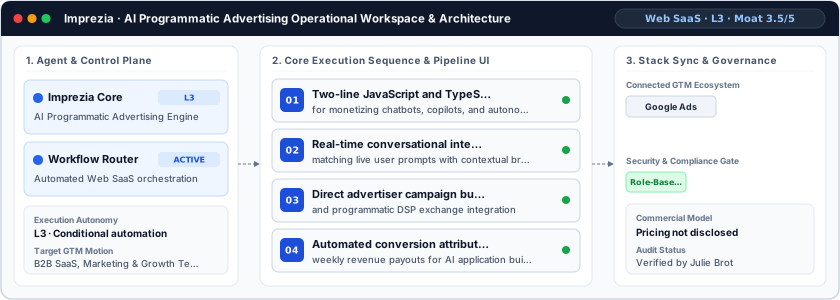
- Two-line JavaScript and TypeScript SDK: for monetizing chatbots, copilots, and autonomous agents
- Real-time conversational intent extraction: matching live user prompts with contextual brand placements
- Direct advertiser campaign buying: and programmatic DSP exchange integration
- Automated conversion attribution and: weekly revenue payouts for AI application builders
Cons: operational limitations & risks
- Two-Sided Inventory Scale Limitation: A primary marketplace limitation is that advertiser reach depends directly on the traffic volume and vertical mix of third-party AI applications integrated into the exchange.
- Enterprise Privacy Governance Barrier: Internal enterprise copilots and regulated healthcare or financial assistants struggle with strict data-governance rules, creating a governance barrier that prohibits transmitting user prompt context to external ad exchanges.
- Conversational Creative Learning Curve: Performance marketers accustomed to visual social feeds face a creative learning curve and cold start bottleneck when adapting ad copy into utility-first conversational answers that avoid user friction.
Imprezia TCO & deal-breaker stress test
Simulate 12-month stepped TCO, hidden cost multipliers, contract lock-in exposure, and stack failure modes using only facts verified by Julie Brot on · Capture SHA 9b617505.
Imprezia triggers high-severity friction under your 5-seat / $800/mo constraints. Benchmark the verified subtrack alternatives below before committing.
| Plan / Tier | Verified Rate | Scale Fit | Scope & Quota Notes |
|---|---|---|---|
| Enterprise / Custom | Custom quote | 15–50+ seats (Enterprise SLA) | Sales-negotiated annual contract for custom volume, SSO/RBAC governance, and dedicated SLA. |
- Moat Score
- 3.5 / 5.0
- AI Autonomy
- L3
- Free Tier / Trial
- None disclosed
Triggered audit signals & failure modes
- Opaque Enterprise Quoting vs. SMB/Mid-Market BudgetVerified Pricing Ledger
Imprezia does not disclose a public self-serve floor (Pricing not disclosed). Buyers with a $800/mo cap face high sales-qualification friction.
- Sales-Gated Contract TermsFact-checked by Julie Brot
Pricing is available on request through enterprise sales quotes, with customized tiers based on seat counts or usage volume.
- Primary Operational Bottleneck: Two-Sided Inventory Scale LimitationAudit by Julie Brot
A primary marketplace limitation is that advertiser reach depends directly on the traffic volume and vertical mix of third-party AI applications integrated into the exchange.
Hidden TCO Multipliers & Quota Gates
- Credit & Usage Burn Multiplier: Automated workflows consume metered credits/usage quotas; multi-step enrichment, voice minutes, or high-frequency agent runs can trigger mid-cycle top-up packs.
- Two-Sided Inventory Scale Limitation: A primary marketplace limitation is that advertiser reach depends directly on the traffic volume and vertical mix of third-party AI applications integrated into the exchange.
- Enterprise Privacy Governance Barrier: Internal enterprise copilots and regulated healthcare or financial assistants struggle with strict data-governance rules, creating a governance barrier that prohibits transmitting user prompt context to external ad exchanges.
When to Walk Away & Negotiation Levers
- Walk away if you require transparent self-serve monthly billing or your budget ceiling is under $1,000/mo (Imprezia requires sales-gated custom quoting).
- Walk away if your workflow cannot tolerate two-sided inventory scale limitation: A primary marketplace limitation is that advertiser reach depends directly on the traffic volume and vertical mix of third-party AI applications integrated into the exchange.
- Walk away if enterprise privacy governance barrier is a deal-breaker for your team: Internal enterprise copilots and regulated healthcare or financial assistants struggle with strict data-governance rules, creating a governance barrier that prohibits transmitting user prompt context to external ad exchanges.
- Demand a 30- to 60-day paid pilot opt-out clause in the Imprezia order form before signing a 12-month enterprise commitment.
- Require a sandbox proof-of-concept testing two-sided inventory scale limitation against your live CRM/data schema before annual sign-off.
Ask a custom procurement or TCO stress-test question about Imprezia
Lower 5-seat floor (~$36/mo vs. Custom Quote) · Transparent self-serve entry without mandatory annual lock-in
Verified AI Programmatic Advertising peer (Pricing not disclosed · Moat 3.9/5.0)
Imprezia key entities, modules & ecosystem stack
Imprezia moat & subtrack positioning
Embedding a lightweight two-line monetization SDK directly into LLM chat and agent pipelines creates supply-side network effects across conversational AI inventory.
Editorial review
Fact-checked by Julie Brot (Enterprise SaaS Governance & Procurement Editor) on .
Background
Founded in 2025 by Bishesh Khadka and headquartered in San Francisco, California, Imprezia (imprezia.ai) is a conversational AI advertising network and intent exchange built for generative AI application developers, consumer copilot publishers, and performance marketing teams. Operating with a team of 2 to 10 employees and backed by $500K in Pre-Seed funding from Y Combinator (S25) and Pioneer Fund, the company builds native monetization infrastructure designed specifically for intelligent chat interfaces. Instead of forcing disruptive display banners into conversational workflows, Imprezia matches high-intent user prompts with relevant brand and product recommendations that help developers offset LLM token inference bills.
How Imprezia works
Imprezia operates at Level 3 autonomy through its Intent Exchange engine and lightweight developer SDK (Imprezia.init and Imprezia.monetize). When a user interacts with a participating chatbot, shopping assistant, or AI copilot—such as asking for a travel itinerary or software recommendation—the SDK passes structured conversational context to Imprezia's real-time matching pipeline. The platform uses semantic intent classification to identify commercial intent, runs an auction across direct advertisers and connected programmatic DSPs, and returns a native sponsored recommendation that blends natively into the assistant's response while tracking downstream clicks, conversions, and weekly publisher payouts.
Limitations
Operational limitations and technical trade-offs include:
- Two-Sided Inventory Scale Limitation: A primary marketplace limitation is that advertiser reach depends directly on the traffic volume and vertical mix of third-party AI applications integrated into the exchange.
- Enterprise Privacy Governance Barrier: Internal enterprise copilots and regulated healthcare or financial assistants struggle with strict data-governance rules, creating a governance barrier that prohibits transmitting user prompt context to external ad exchanges.
- Conversational Creative Learning Curve: Performance marketers accustomed to visual social feeds face a creative learning curve and cold start bottleneck when adapting ad copy into utility-first conversational answers that avoid user friction.
Imprezia pricing
Pricing is available on request through enterprise sales quotes, with customized tiers based on seat counts or usage volume. Imprezia operates on a performance and CPM revenue-share model where AI application developers receive weekly publisher payouts scaled by monetized conversations, while brand advertisers and agencies fund contextual campaigns based on intent-qualified impressions and clicks.
How Imprezia compares
Within the Ad Networks, DSPs & Programmatic Buying category, Imprezia competes against legacy search and programmatic alternatives such as Google Ads AI, StackAdapt, and Perplexity sponsored placements. Versus traditional cookie-based DSPs like StackAdapt that target display slots on static web pages, Imprezia differentiates itself by auctioning real-time multi-turn prompt intent inside third-party LLM applications. Consumer AI developers seeking immediate inference monetization and performance marketers testing conversational ad inventory favor Imprezia over legacy banner networks.
Frequently asked questions about Imprezia
How much does Imprezia cost and does it require a custom enterprise quote?
Published pricing summary for Imprezia: Pricing not disclosed. A permanent free plan is not disclosed for Imprezia. Pricing is available on request through enterprise sales quotes, with customized tiers based on seat counts or usage volume.
How does Imprezia work and how autonomous is its AI architecture?
Conversational AI advertising network and intent exchange enabling AI apps to monetize chat prompts with native sponsored recommendations. Within AI Programmatic Advertising (Programmatic DSP/SSP & Contextual AdTech), MarTechRadar rates its execution architecture at L3 · Conditional automation with a verified Moat Score of 3.5 / 5.0 (Proprietary moat). Embedding a lightweight two-line monetization SDK directly into LLM chat and agent pipelines creates supply-side network effects across conversational AI inventory. Corporate profile: Founded by Bishesh Khadka, operating at 2-10 employees scale.
What are the main limitations of Imprezia and when should buyers walk away?
Based on our editorial technical audit, key operational considerations and boundaries for Imprezia include: (1) Two-Sided Inventory Scale Limitation: A primary marketplace limitation is that advertiser reach depends directly on the traffic volume and vertical mix of third-party AI applications integrated into the exchange. (2) Enterprise Privacy Governance Barrier: Internal enterprise copilots and regulated healthcare or financial assistants struggle with strict data-governance rules, creating a governance barrier that prohibits transmitting user prompt context to external ad exchanges. (3) Conversational Creative Learning Curve: Performance marketers accustomed to visual social feeds face a creative learning curve and cold start bottleneck when adapting ad copy into utility-first conversational answers that avoid user friction. Primary procurement walk-away rule: Walk away if you require transparent self-serve monthly billing or your budget ceiling is under $1,000/mo (Imprezia requires sales-gated custom quoting).
What integrations, compliance certifications, and contract terms apply to Imprezia?
Verified ecosystem and stack integrations include Google Ads. First-party governance and developer endpoints verified on domain include: API Docs (https://www.imprezia.com/developers). Key TCO multiplier to watch: Credit & Usage Burn Multiplier (Automated workflows consume metered credits/usage quotas; multi-step enrichment, voice minutes, or high-frequency agent runs can trigger mid-cycle top-up packs.) Before signing a contract, procurement teams should demand a 30- to 60-day paid pilot opt-out clause in the Imprezia order form before signing a 12-month enterprise commitment.
What are the best Imprezia alternatives and head-to-head competitors in 2026?
Top fact-checked alternatives to Imprezia in AI Programmatic Advertising (Programmatic DSP/SSP & Contextual AdTech) include StackAdapt (Pricing not disclosed), Media.net (Custom / enterprise pricing), Revcontent (Custom / enterprise pricing), Channel3 (Pricing not disclosed). Within the Ad Networks, DSPs & Programmatic Buying category, Imprezia competes against legacy search and programmatic alternatives such as Google Ads AI, StackAdapt, and Perplexity sponsored placements.
Verified sources & evidence trail
- Official product domain: https://imprezia.ai
- Commercial pricing verification: Verified against official vendor pricing policy (Pricing not disclosed)
- Verified corporate entity profiles (
sameAs): LinkedIn Company Profile · Crunchbase Entity Record - First-party governance & documentation links: API & Docs · Terms · Privacy
- Editorial audit sign-off: Fact-checked by Julie Brot on under the MarTechRadar Evidence-Ledger Protocol.