Groove.co Review (2026): AI SDR Pricing, Pros & Cons
Bottom line
Groove.co is a Web SaaS tool for AI SDR (Autonomous B2B Sales Agents & AI BDRs) in AI SDR & Outbound. Pricing: Custom / enterprise pricing. Best suited to B2B SaaS, DTC / eCommerce and Enterprise Brands. Editor ratings: AI autonomy L3 (conditional automation); moat score 4.0/5.0 (Proprietary moat). Fact-checked by MarTechRadar Research Desk on Oct 12, 2026.
Salesforce-native sales engagement and predictive revenue execution platform that prioritizes rep actions through algorithmic signals and automated CRM.
Is Groove.co worth it in 2026? Buyer fit & when to walk away
Choose Groove.co if (Best Fit)
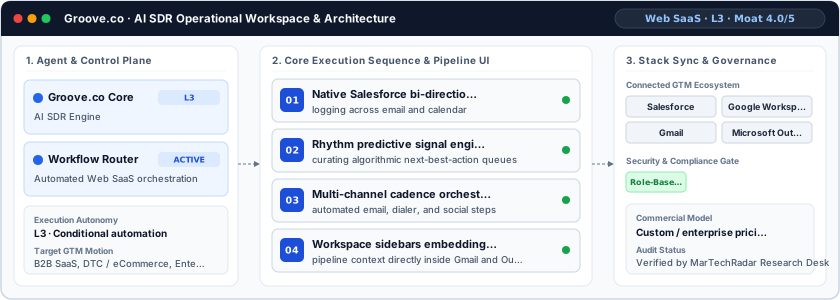
- Target ICP & Stack Fit: You operate as B2B SaaS, DTC / eCommerce and Enterprise Brands requiring a Web SaaS deployment for AI SDR, with verified ecosystem connectivity for Salesforce, Google Workspace, Gmail, Microsoft Outlook.
- L3 Architecture & Defensibility: Native Salesforce relational data architecture bypassing external ETL sync lag, paired with Rhythm workflow orchestration that converts real-time buyer engagement telemetry into deterministic seller task queues.
- Commercial Model Fit: Your procurement budget aligns with Custom / enterprise pricing.
Walk away from Groove.co if (Deal-Breakers)
- Walk away if you need published self-serve pricing: Groove.co is sold by custom quote.
- Walk away if your workflow cannot tolerate CRM infrastructure dependency: Because the platform relies entirely on native Salesforce objects, organizations operating hybrid or non-Salesforce CRM stacks face severe architectural incompatibility.
- Walk away if signal triaging latency is a deal-breaker for your team: When inbound multi-channel interaction volume surges, the Rhythm engine can generate dense task queues that require manual seller filtering rather than programmatic execution.
Groove.co pricing, free plan & scorecard at a glance
| Pricing | Custom / enterprise pricing |
|---|---|
| Free plan | No / not disclosed |
| Delivery | Web SaaS |
| Audience | B2B SaaS, DTC / eCommerce, Enterprise Brands |
| AI autonomy level | L3 · Conditional automationEditor-verified |
| Moat tier & score | 4.0 / 5.0 · Proprietary moatEditor-verified |
| Funding | AcquiredAcquired by Clari |
| Total funding | $61MBacked by Uncork Capital, Level Equity Management, Alchemist Accelerator, Capital One Ventures, Quest Venture Partners |
| Founders | Alexander Kerschhofer, Austin Wang, Chris Rothstein |
| Company size | 501-1000 employees |
| Ecosystem integrations | Salesforce, Google Workspace, Gmail, Microsoft Outlook, Twilio Segment |
| Governance & docs | Trust & Security ↗ · System Status ↗ · Changelog ↗ · Terms ↗ |
| Headquarters | Atlanta, GA |
| Founded | 2011 |
| Last verified | Oct 12, 2026 |
Groove.co pros & cons: strengths vs. operational limitations
Pros: core strengths & capabilities
- Native Salesforce bi-directional activity: logging across email and calendar
- Rhythm predictive signal engine: curating algorithmic next-best-action queues
- Multi-channel cadence orchestration covering: automated email, dialer, and social steps
- Workspace sidebars embedding CRM: pipeline context directly inside Gmail and Outlook
Cons: operational limitations & risks
- CRM Infrastructure Dependency: Because the platform relies entirely on native Salesforce objects, organizations operating hybrid or non-Salesforce CRM stacks face severe architectural incompatibility.
- Signal Triaging Latency: When inbound multi-channel interaction volume surges, the Rhythm engine can generate dense task queues that require manual seller filtering rather than programmatic execution.
- Extensibility Governance: Custom schema variations and complex enterprise validation rules inside the primary CRM frequently demand ongoing APEX-level maintenance and custom field mapping audits.
Groove.co TCO & deal-breaker stress test
Simulate 12-month stepped TCO, hidden cost multipliers, contract lock-in exposure, and stack failure modes using only facts verified by MarTechRadar Research Desk on 2026-10-12.
Groove.co triggers high-severity friction under your 5-seat / $800/mo constraints. Benchmark the verified subtrack alternatives below before committing.
- Moat Score
- 4.0 / 5.0
- AI Autonomy
- L3
- Free Tier / Trial
- None disclosed
Triggered audit signals & failure modes
- Opaque Enterprise Quoting vs. SMB/Mid-Market BudgetVerified Pricing Ledger
Groove.co does not disclose a public self-serve floor (Custom / enterprise pricing). Buyers with a $800/mo cap face high sales-qualification friction.
- Sales-Gated Contract TermsFact-checked by MarTechRadar Research Desk
Commercial pricing is available on request through tailored enterprise sales quotes based on organizational scale and seats.
- Primary Operational Bottleneck: CRM Infrastructure DependencyAudit by MarTechRadar Research Desk
Because the platform relies entirely on native Salesforce objects, organizations operating hybrid or non-Salesforce CRM stacks face severe architectural incompatibility.
Test a custom Groove.co budget or stack constraint
Lower 5-seat floor (~$100/mo vs. Custom Quote) · Transparent self-serve entry without mandatory annual lock-in
Lower 5-seat floor (~$49/mo vs. Custom Quote) · Transparent self-serve entry without mandatory annual lock-in
Groove.co integrations, API, security & compliance stack
Groove.co AI moat & AI SDR positioning
Native Salesforce relational data architecture bypassing external ETL sync lag, paired with Rhythm workflow orchestration that converts real-time buyer engagement telemetry into deterministic seller task queues.
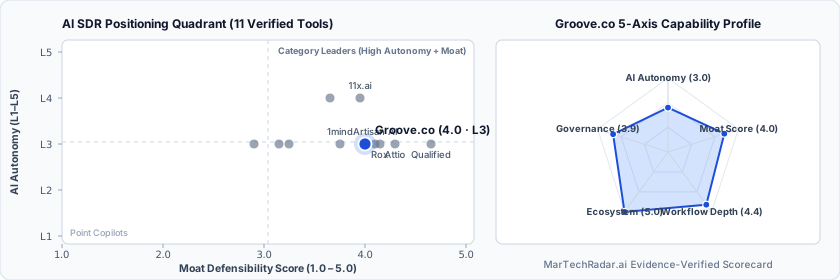
Groove.co in-depth review, pricing & architecture analysis
Editor sign-off: Oct 12, 2026. How profiles are made.
What is Groove.co? Overview & background
Architectural coupling to the underlying CRM database defines modern sales execution. Established in 2011 and headquartered in Atlanta, GA, Groove.co secured $61M in total funding to address data silos in account execution. Built intentionally for enterprise revenue operations, sales leadership, and account executives, the platform embeds predictive engagement workflows directly into frontline seller environments.
How Groove.co works: architecture & workflow
At the architectural layer, the system conditional execution, the platform ingests omni-channel signals via bi-directional integrations across Google Workspace, Microsoft Outlook, and enterprise telephony. Groove.co avoids secondary data warehousing by utilizing a native Salesforce data layer, eliminating synchronization latency. Its Rhythm engine processes external engagement triggers—such as intent surges, event attendance, and inbound email replies—to generate deterministic, prioritized next-best-action workflows for reps.
Groove.co limitations, drawbacks & risks
Operational considerations and platform boundaries include:
- CRM Infrastructure Dependency: Because the platform relies entirely on native Salesforce objects, organizations operating hybrid or non-Salesforce CRM stacks face severe architectural incompatibility.
- Signal Triaging Latency: When inbound multi-channel interaction volume surges, the Rhythm engine can generate dense task queues that require manual seller filtering rather than programmatic execution.
- Extensibility Governance: Custom schema variations and complex enterprise validation rules inside the primary CRM frequently demand ongoing APEX-level maintenance and custom field mapping audits.
Groove.co pricing, plans & cost breakdown
Commercial pricing is available on request through tailored enterprise sales quotes based on organizational scale and seats. Contracts operate under annual enterprise licensing models with seat tiers determined by role access, platform add-ons, and administrative governance requirements.
| Plan / Tier | Verified Price & Billing | Included Scope & Contract Terms |
|---|---|---|
| Enterprise / Custom | Custom quote | Custom-quoted plan; terms come from the vendor's sales team. |
How Groove.co compares vs. competitors & alternatives
Relative to autonomous out-of-band sales agents such as 11x.ai, Confido, and Unify, Groove.co functions as a copilot prioritizing human rep workflows rather than a fully synthetic outbound agent within the AI SDR segment. While autonomous platforms generate and execute unstructured correspondence autonomously, Groove.co preserves deterministic human-in-the-loop oversight and governance, making it ideal for enterprise revenue organizations requiring strict CRM hygiene and pipeline compliance.
Direct competitors & market radar
Top algorithmic competitors based on category positioning, capability overlap, and ICP alignment.
Frequently asked questions about Groove.co
Does Groove.co publish pricing or require an enterprise quote?
Groove.co pricing: Custom / enterprise pricing. No free plan is publicly disclosed. Commercial pricing is available on request through tailored enterprise sales quotes based on organizational scale and seats.
What are the top Groove.co alternatives in AI SDR?
Verified AI SDR alternatives include Nooks (Custom / enterprise pricing), Unify (Free plan · $20–$60/seat/mo · Enterprise plan), Superhuman AI (Custom / enterprise pricing), Hexus (From $49/mo). Relative to autonomous out-of-band sales agents such as 11x.ai, Confido, and Unify, Groove.co functions as a copilot prioritizing human rep workflows rather than a fully synthetic outbound agent within the AI SDR segment.
What are the main limitations and trade-offs of Groove.co?
Operational considerations and platform boundaries include: CRM Infrastructure Dependency: Because the platform relies entirely on native Salesforce objects, organizations operating hybrid or non-Salesforce CRM stacks face severe architectural incompatibility. Walk away if you need published self-serve pricing: Groove.co is sold by custom quote.
Verified sources & evidence trail
- Official product domain: https://groove.co
- Commercial pricing verification: Verified against official vendor pricing policy (Custom / enterprise pricing)
- Verified corporate entity profiles (
sameAs): LinkedIn Company Profile · Crunchbase Entity Record - First-party governance & documentation links: Trust & Security · System Status · Changelog · Terms
- Editor sign-off: Oct 12, 2026 (how profiles are made).
